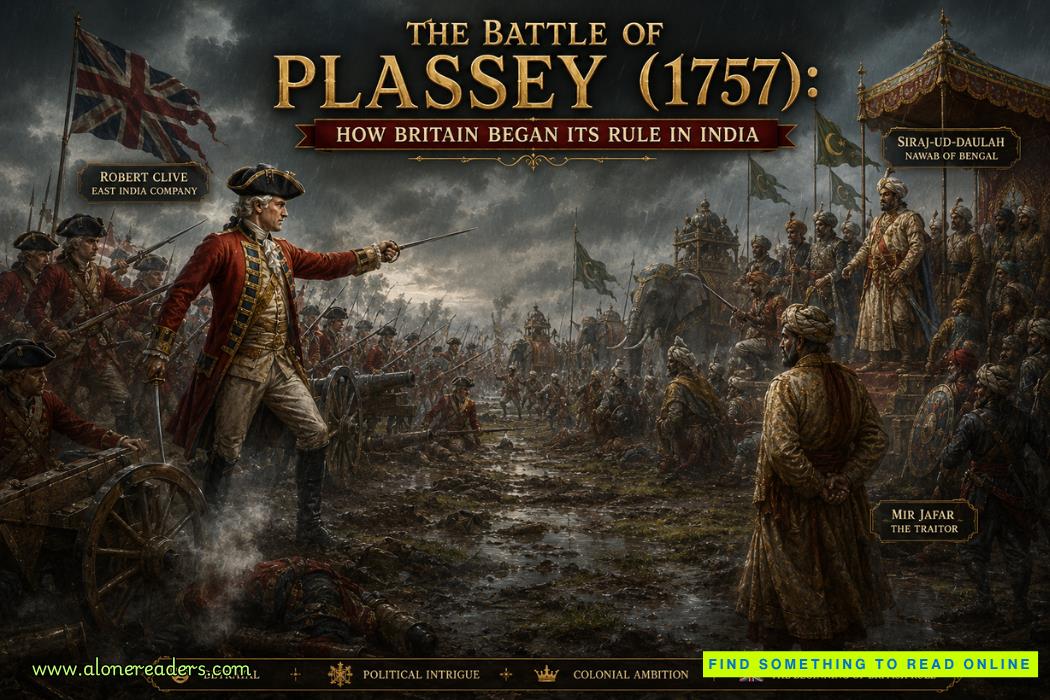
The Battle of Plassey, fought on June 23, 1757, stands as one of the most decisive and transformative events in the history of the Indian subcontinent. Though militarily a relatively small engagement, its consequences were immense, setting into motion a chain of events that led to the establishment of British colonial dominance in India. What unfolded on the plains of Plassey, near the banks of the Bhagirathi River in Bengal, was not merely a clash of armies, but a calculated convergence of political ambition, betrayal, economic greed, and imperial strategy.
At the time of the battle, the Mughal Empire was already in visible decline. Once a powerful and centralized authority, it had fragmented into semi-autonomous regional states. Bengal, one of the richest provinces of the empire, was under the rule of Nawab Siraj-ud-Daulah. His rule, however, was marked by instability, internal dissent, and a growing sense of threat from foreign trading companies, particularly the British East India Company. Bengal’s immense wealth, fertile lands, and thriving trade networks made it an attractive target for European powers seeking both commercial and political dominance.
The British East India Company had initially entered India as a trading entity, granted privileges by Mughal emperors to conduct commerce. However, over time, the Company began to expand its military capabilities and political influence. By the mid-18th century, it was no longer just a trading corporation; it had become a powerful political actor with its own army. Tensions between the Company and Siraj-ud-Daulah escalated when the British began fortifying their settlements in Calcutta without the Nawab’s permission. This act was perceived as a direct challenge to his authority.
Siraj-ud-Daulah responded decisively by attacking and capturing Calcutta in 1756. This event, often associated with the controversial narrative of the Black Hole of Calcutta, provided the British with a justification to launch a retaliatory campaign. Robert Clive, a young and ambitious officer of the East India Company, was dispatched to Bengal with a combined force of European soldiers and Indian sepoys. Clive’s mission was not only to reclaim lost territory but to secure British interests in the region permanently.
However, what truly defined the outcome of the Battle of Plassey was not military strength but strategic manipulation and betrayal. Within Siraj-ud-Daulah’s court, there were several disgruntled nobles and military commanders who were dissatisfied with his leadership. Among them was Mir Jafar, the commander-in-chief of the Nawab’s army. The British, recognizing the internal divisions within the Bengal court, entered into a secret agreement with Mir Jafar. In exchange for his support and defection during the battle, the British promised to install him as the Nawab of Bengal.
This conspiracy proved to be the turning point. On the day of the battle, Siraj-ud-Daulah’s forces significantly outnumbered the British. Estimates suggest that the Nawab’s army consisted of around 50,000 troops, including cavalry, infantry, and artillery, while Clive commanded a force of approximately 3,000 men. Despite this numerical disadvantage, the British had better discipline, superior artillery tactics, and, most importantly, the assurance of internal betrayal within the enemy ranks.
As the battle commenced, heavy rains soaked the battlefield, rendering much of the Nawab’s artillery ineffective. The British, having covered their gunpowder, maintained their operational capability. Meanwhile, Mir Jafar and his contingent remained largely inactive, refusing to engage fully in the battle. This deliberate inaction created confusion and weakened the morale of Siraj-ud-Daulah’s forces. Believing himself betrayed and outmaneuvered, the Nawab eventually fled the battlefield.
The battle itself lasted only a few hours, but its outcome was decisive. Siraj-ud-Daulah was later captured and executed, and Mir Jafar was installed as the new Nawab of Bengal, effectively becoming a puppet ruler under British control. This marked the beginning of a new political order in India, where the British East India Company exercised power not just through trade but through direct political influence.
The significance of the Battle of Plassey lies in its far-reaching consequences. It marked the transition of the British East India Company from a commercial enterprise to a territorial power. With control over Bengal, the Company gained access to immense resources, including revenue from land taxes and trade. This financial strength enabled it to expand its military operations and consolidate its authority across other parts of India.
Economically, the battle had profound implications for Bengal. Once a prosperous region known for its textile industry and agricultural productivity, Bengal began to experience economic decline under British exploitation. The Company prioritized its own profits over the welfare of the local population, leading to increased taxation, disruption of traditional industries, and eventual famines. The wealth extracted from Bengal played a crucial role in fueling Britain’s industrial growth, illustrating how colonial exploitation was deeply intertwined with global economic transformations.
Politically, the victory at Plassey weakened the already fragile Mughal authority. Although the Mughal emperor nominally remained the sovereign ruler, real power increasingly shifted to the British. The Company began to intervene in the internal affairs of Indian states, often using a combination of diplomacy, coercion, and military force to expand its influence. The concept of indirect rule through local intermediaries became a hallmark of British strategy in India.
The Battle of Plassey also set a precedent for the use of divide and rule tactics. By exploiting internal divisions and forming alliances with local elites, the British were able to achieve their objectives with minimal military expenditure. This strategy would later be employed across the subcontinent, enabling the British to establish control over vast territories without facing unified resistance.
From a broader historical perspective, Plassey represents the beginning of colonial rule in India. It was the first major step in a process that would eventually lead to nearly two centuries of British dominance. The battle demonstrated how a relatively small European power could overcome larger indigenous forces through a combination of superior organization, strategic planning, and political manipulation.
At the same time, the events surrounding Plassey highlight the complexities of Indian politics during the 18th century. The fragmentation of authority, rivalry among regional powers, and lack of unity created conditions that foreign powers could exploit. While the British played a decisive role, the outcome was also shaped by internal dynamics within Indian society.
The legacy of the Battle of Plassey continues to be debated by historians. Some view it as a turning point that marked the beginning of modern Indian history, while others emphasize its role in initiating a period of economic exploitation and political subjugation. Regardless of interpretation, its impact is undeniable. It altered the trajectory of the Indian subcontinent and reshaped its political, economic, and social landscape.
In understanding the Battle of Plassey, it is essential to recognize that it was not merely a military event but a symbol of transformation. It signified the decline of one era and the rise of another, where foreign powers would come to dominate the destiny of millions. The story of Plassey is a reminder of how power can shift through a combination of force and intrigue, and how the consequences of a single event can resonate across centuries.
Ultimately, the Battle of Plassey stands as a critical moment in the history of the Mughal Empire and India as a whole. It marked the beginning of British political supremacy, the erosion of indigenous sovereignty, and the emergence of a new colonial order that would shape the future of the region for generations to come.




 The Hundred Days Offensive: How the Allies Defeated Germany in World War I
 The Second Battle of the Marne: The Turning Point of World War I in 1918
 The Spring Offensive of 1918: Germany's Final Gamble to Win World War I
 The Treaty of Brest-Litovsk: How Russia Left World War I
 The Russian Revolution and World War I: How War Brought Down the Tsar
 The Zimmermann Telegram Explained: Germany's Secret Offer to Mexico in World War I