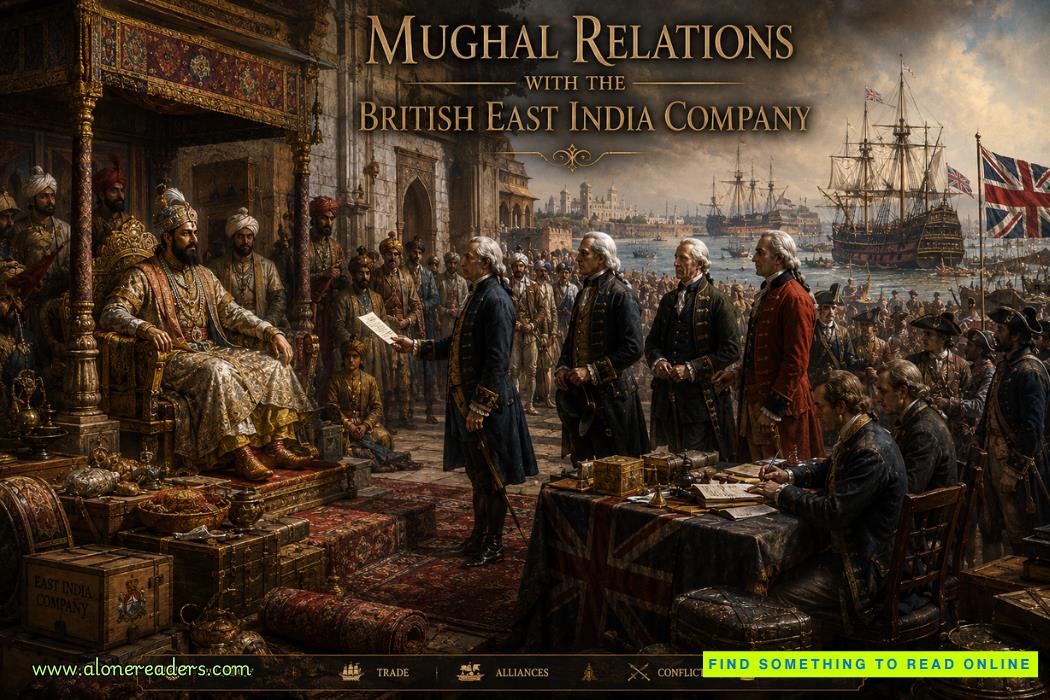
Mughal relations with the British East India Company began as a relationship of cautious trade and diplomatic bargaining, but over time it turned into a story of unequal power, commercial expansion, and political collapse. In the early seventeenth century, the Mughal Empire stood as one of the richest and most formidable states in the world, while the East India Company was still a small overseas trading venture seeking access to Asian markets. The relationship therefore did not begin with conquest; it began with negotiation, permission, and the Mughal court’s confidence that it controlled the terms of contact.
When the English first arrived, they came not as rulers but as petitioners. Their goal was to obtain trading rights in ports under Mughal authority, especially in the western and eastern coastal regions of India. The Mughal state valued order, revenue, and imperial dignity, so foreign traders had to prove that they could be useful, obedient, and profitable. This early phase is important because it shows that the Company’s rise was not immediate. For decades, the British depended on Mughal goodwill, Mughal officials, and Mughal law to survive in India.
The first serious English attempts to build relations with the Mughal court were tied to the reign of Jahangir. English merchants and diplomats realized that they could not establish a durable commercial presence without imperial authorization. They therefore sent envoys, gifts, and formal requests to the emperor, hoping to secure permission to trade and to set up factories, which were trading posts rather than military bases. The Mughal response was cautious but practical. Jahangir saw the English as useful commercial partners, yet not as equals, and certainly not as powers capable of challenging the empire. This imbalance shaped the earliest decades of contact.
One of the most famous figures in this phase was Sir Thomas Roe, who arrived as an envoy of King James I. His mission was to convince Jahangir to give the English a stronger trading position. Roe’s experience reveals the reality of Mughal strength. He was treated as a diplomatic outsider who had to wait, negotiate, and show deference. The Mughal court did not rush to satisfy English demands. Instead, it weighed the advantages of trade against the risks of allowing another European company too much freedom. The result was limited but meaningful access: the Company won the right to trade in selected places and slowly expanded its presence.
This early arrangement created a pattern that would last for a generation. The Company gained opportunity through diplomacy, but it did so under Mughal supervision. English merchants established factories in coastal centers such as Surat and later expanded to other locations. Their commercial activity involved textiles, spices, saltpeter, and other valuable goods that connected India to global markets. In this period, the Mughals were not passive observers. They collected customs, controlled permissions, and treated foreign traders as part of the wider imperial economy. The Company prospered, but only because the empire allowed it to operate within the imperial frame.
The Mughal attitude toward the Company was shaped by the empire’s wider political confidence. The Mughal world was vast, wealthy, and administratively sophisticated. It did not fear a small group of foreign merchants in the same way that a weakened state might. Yet the Mughals also understood that trade could bring practical benefits. European silver, maritime connections, and expanding commercial networks could strengthen regional markets. The English therefore became tolerated partners, not because they were powerful, but because they were profitable and manageable. This distinction matters, because it helps explain why the Company remained submissive for so long.
Over time, however, the relationship began to change. The East India Company learned that trade alone would not always protect its interests. It started building stronger fortified settlements, maintaining armed forces, and interfering more actively in local affairs. In other words, commerce gradually began to merge with coercion. The Company’s ambitions expanded faster than its formal status. While it still relied on Mughal authority in theory, in practice it was preparing for a different future, one in which trade posts could become military strongholds and commercial negotiations could become territorial claims.
Aurangzeb’s reign marked a turning point in this history. Under him, the Mughal Empire reached immense territorial scale, but it also faced greater strain from long wars, administrative burdens, and regional unrest. The Company continued to seek privileges, including trade concessions and tax exemptions, and Aurangzeb sometimes granted them when it suited imperial interests. Yet the growing complexity of Mughal politics created openings for European firms to manipulate local officials, exploit rivalries, and push for more advantages. The Company was still subordinate, but it was becoming more aggressive and more confident in using imperial weakness to its own benefit.
The most dramatic clash came in the late seventeenth century, when Company behavior crossed from trade into defiance. English forces attacked Mughal interests in an attempt to protect or advance commercial privileges, but the Mughal response was swift and humiliating for the Company. Mughal power remained overwhelming, and the English learned that they could not easily challenge the empire by force. This episode is a reminder that the Mughals were still the dominant power in India at that time. The Company’s survival depended on apology, negotiation, and renewed permission to trade. Its military arrogance had not yet matched its ambitions.
Yet even after this setback, the deeper trend continued in the Company’s favor. The Mughal Empire was becoming less able to enforce centralized control across its vast territories. After Aurangzeb, succession struggles, regional fragmentation, and fiscal decline weakened the imperial structure. Provincial governors, local elites, and military leaders gained more autonomy. This decline did not destroy Mughal authority overnight, but it reduced the empire’s ability to regulate foreign companies with the same consistency as before. The Company seized on this weakness, expanding from a trade organization into a political actor.
Bengal became the most important arena in this transformation. The region was wealthy, commercially vibrant, and crucial to both Mughal and Company interests. The English developed settlements and fortifications there, often claiming they were merely protecting trade. In reality, they were building a base for future dominance. The Mughal administration in Bengal faced the difficult task of balancing revenue needs, local stability, and the growing intrusions of the Company. Tensions rose as the English pushed for special privileges while local officials tried to preserve authority. The conflict was no longer just about trade. It was about sovereignty.
The Company’s success in Bengal was closely linked to the weakness of imperial supervision. Local Mughal representatives and successor powers often lacked the ability to stop English expansion. The Company used bribery, negotiation, military preparation, and commercial pressure to deepen its influence. It was able to present itself as a necessary trading partner while quietly building the instruments of power. Forts, troops, naval support, and administrative networks all strengthened the Company’s position. The Mughal court, far away and increasingly strained, could no longer discipline the English in the way it once had.
The final collapse of Mughal supremacy over the Company came in the middle of the eighteenth century. At this stage, the Mughal emperor still existed, but imperial authority had become fragmented. The Company fought and won decisive battles that reshaped the political map of India. The most important of these was the Battle of Buxar, where Company forces defeated a coalition that included the Mughal emperor. This event was not merely a military victory. It marked the moment when the Company moved from dependence on Mughal favor to direct control over Mughal-derived revenue rights. The emperor was no longer the master of the relationship. He had become a symbol within a new power structure.
After this, the grant of revenue rights in Bengal made the change unmistakable. The Company was now collecting income from one of the richest regions in India, giving it the financial foundation for future expansion. In practical terms, this meant that the Mughal empire had lost control over the economic lifeblood of its former provinces. The empire’s prestige remained, but its power had been hollowed out. The Company no longer needed Mughal permission in the same way, because it had acquired the means to rule in its own name.
The broader meaning of Mughal relations with the British East India Company lies in this gradual reversal. What began as a relationship in which the Company bowed before imperial authority ended as a process in which the Company exploited imperial decline. The Mughal court’s early openness to trade allowed the English to establish a foothold. The Company’s own ambitions then turned that foothold into a base for expansion. Mughal strength made early British caution necessary, but Mughal fragmentation later made British domination possible. The relationship therefore changed not in one sudden moment, but through a long series of negotiations, accommodations, conflicts, and opportunistic advances.
This history also challenges a simple story of immediate British conquest. The Company did not arrive in India as an unstoppable empire. For much of the seventeenth century, it was a dependent commercial outsider operating under Mughal supervision. Its rise was slow, adaptive, and deeply connected to the political conditions of the Mughal world. The British learned from Mughal administration, used Mughal institutions when convenient, and expanded through the cracks left by imperial decline. In this sense, the Mughal Empire did not simply fall to an external enemy. It was gradually undermined by a foreign company that adapted to the empire’s strengths first and then exploited its weaknesses.
For a history of empire, this relationship is especially revealing. It shows how trade can become power, how permission can become privilege, and how privilege can become rule. It also shows that empires do not only fall through battlefield defeat; they can be weakened through fiscal strain, regional fragmentation, and the slow transfer of authority to outside actors. The Mughal case demonstrates that the British East India Company’s rise was built on a long foundation of access granted by a far stronger empire. That access was useful to both sides at first, but it eventually became the pathway through which British political control emerged.
The legacy of this relationship still matters because it explains why the early modern Indian Ocean world cannot be understood as a simple clash of civilizations. It was a world of diplomacy, commerce, military force, and imperial competition. The Mughals were not helpless, and the Company was not invincible. For a long time, the balance of power favored the Mughal state. Yet the Company’s persistence, flexibility, and willingness to combine trade with force allowed it to move from the margins of the empire to its center. That transformation shaped the future of India and opened the door to British colonial rule.



 The Hundred Days Offensive: How the Allies Defeated Germany in World War I
 The Second Battle of the Marne: The Turning Point of World War I in 1918
 The Spring Offensive of 1918: Germany's Final Gamble to Win World War I
 The Treaty of Brest-Litovsk: How Russia Left World War I
 The Russian Revolution and World War I: How War Brought Down the Tsar
 The Zimmermann Telegram Explained: Germany's Secret Offer to Mexico in World War I