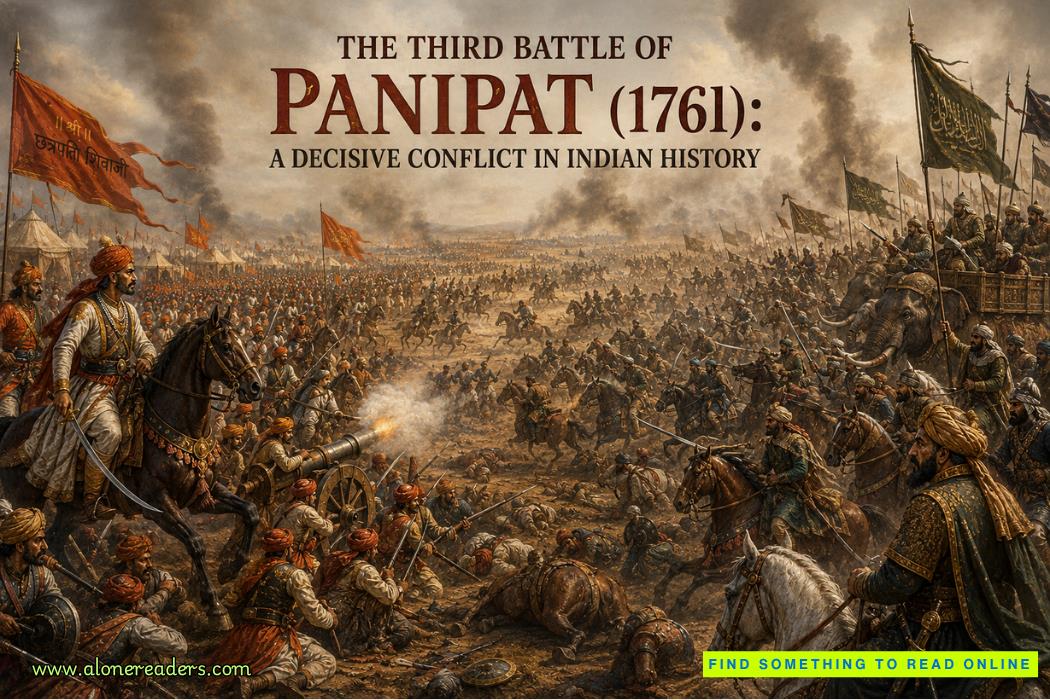
The Third Battle of Panipat, fought on January 14, 1761, stands as one of the most decisive and catastrophic military confrontations in Indian history. It was not merely a battle between two armies, but a clash of ambitions, ideologies, and regional powers that ultimately reshaped the political future of the Indian subcontinent. This monumental conflict took place between the expanding Maratha Empire and the invading forces of Ahmad Shah Abdali, also known as Ahmad Shah Durrani, the founder of the Durrani Empire.
At the heart of this confrontation was a struggle for dominance over North India, particularly the weakening Mughal Empire, whose authority had drastically declined by the mid-18th century. The Mughal emperor had become little more than a symbolic figure, and real power was being contested by regional forces such as the Marathas, Rohillas, Jats, and Afghans. The Marathas, under the leadership of the Peshwas, had emerged as the most powerful indigenous force, steadily expanding their influence across large parts of India. By the 1750s, they had reached Delhi and were effectively controlling Mughal affairs.
However, this expansion brought them into direct conflict with Ahmad Shah Abdali, who had already invaded India multiple times. Abdali saw North India as a region of both strategic and economic importance. His alliance with key Indian Muslim leaders, including Najib-ud-Daula and the Rohillas, strengthened his position significantly. On the other hand, the Marathas, led by Sadashivrao Bhau and supported by the young and ambitious Vishwasrao, sought to establish their supremacy in the north and eliminate Afghan influence.
The roots of the battle can be traced to the political vacuum created by the decline of the Mughal Empire. The Marathas aimed to fill this vacuum and establish a pan-Indian empire. Their strategy included placing allies in positions of power and extracting tribute from various regions. However, their rapid expansion also led to resentment among local rulers, many of whom saw the Marathas as outsiders imposing control rather than legitimate rulers. This lack of local support would later prove to be a critical weakness for the Maratha forces.
In contrast, Ahmad Shah Abdali skillfully built alliances with regional powers who were wary of Maratha dominance. The Rohillas, led by Najib-ud-Daula, and Shuja-ud-Daula, the Nawab of Awadh, joined forces with Abdali. This coalition provided not only additional manpower but also crucial knowledge of the terrain and logistics of North India. Abdali’s leadership was marked by strategic patience and calculated decision-making, qualities that would play a significant role in the outcome of the battle.
The Maratha army that marched north was one of the largest and most well-equipped forces of its time. It included infantry trained in European-style warfare, heavy artillery, and a large cavalry contingent. However, this army also carried with it a massive number of non-combatants, including families, servants, and camp followers. This significantly slowed their movement and placed enormous strain on their supply lines. The decision to bring such a large entourage has often been criticized as a major strategic error.
As the Marathas advanced into North India, they faced increasing resistance and logistical challenges. Abdali employed a strategy of attrition and encirclement, cutting off supply routes and preventing the Marathas from accessing food and resources. Over time, the Maratha army found itself trapped near Panipat, with dwindling supplies and no easy way to retreat. This situation created immense pressure on their leadership to engage in a decisive battle despite unfavorable conditions.
The battlefield of Panipat itself had historical significance, having witnessed two previous major battles that altered the course of Indian history. In 1761, it once again became the stage for a conflict that would determine the future of the subcontinent. The Marathas, despite their hardships, prepared for a final assault, hoping to break through Abdali’s lines and secure victory.
The battle began early in the morning and quickly escalated into one of the most brutal and intense conflicts of the 18th century. The Marathas initially gained an advantage with their artillery and disciplined infantry. Their forces managed to push back parts of Abdali’s army, creating a sense of hope among their ranks. However, this early success was short-lived.
Ahmad Shah Abdali’s forces demonstrated remarkable resilience and tactical flexibility. His use of mobile cavalry units and reserve forces allowed him to counter the Maratha advances effectively. The turning point came when the Maratha commander Vishwasrao was killed in battle. His death had a devastating psychological impact on the Maratha troops, leading to confusion and loss of morale.
Sadashivrao Bhau continued to fight bravely, but the situation rapidly deteriorated. The Afghan forces, supported by their allies, launched a coordinated counterattack that overwhelmed the Maratha lines. The battlefield turned into a scene of chaos and carnage, with thousands of soldiers losing their lives within a matter of hours. The Maratha army, once a symbol of strength and ambition, was completely shattered.
The aftermath of the battle was catastrophic. It is estimated that tens of thousands of soldiers and civilians were killed, making it one of the bloodiest battles in Indian history. The scale of destruction was immense, and the psychological impact was equally profound. The Maratha Empire, though not entirely destroyed, suffered a severe blow from which it took years to recover.
The defeat at Panipat marked a significant turning point in Indian history. It halted the northward expansion of the Marathas and exposed the limitations of their power. At the same time, Ahmad Shah Abdali, despite his victory, did not establish a lasting empire in India. His primary objective was to weaken the Marathas and secure his influence, rather than to govern the region directly.
Perhaps the most important consequence of the battle was the power vacuum it created. With both the Mughal Empire and the Marathas weakened, new opportunities emerged for other powers. Among them, the British East India Company would soon rise to prominence, gradually establishing control over large parts of India. In this sense, the Third Battle of Panipat can be seen as a precursor to colonial dominance in the subcontinent.
The battle also offers important lessons in leadership, strategy, and the importance of local alliances. The Marathas’ failure to secure the support of key regional powers significantly weakened their position. Their logistical challenges and strategic miscalculations further contributed to their defeat. In contrast, Abdali’s ability to build alliances and adapt his strategy proved to be decisive.
From a broader perspective, the Third Battle of Panipat represents a moment of transition and transformation in Indian history. It marked the end of one phase of regional power struggles and the beginning of another, ultimately leading to the rise of colonial rule. The battle serves as a reminder of how quickly fortunes can change in the complex and dynamic landscape of political power.
Even today, the legacy of Panipat continues to be studied and debated by historians. It is often cited as an example of how internal divisions and strategic errors can lead to devastating consequences. At the same time, it highlights the resilience and determination of those who fought, regardless of the outcome.
In conclusion, the Third Battle of Panipat was not just a military engagement, but a decisive event that reshaped the course of Indian history. Its impact was felt far beyond the battlefield, influencing political, social, and economic developments for decades to come. The echoes of this battle can still be heard in the historical narratives of India, serving as a powerful reminder of the complexities of power, ambition, and conflict in the subcontinent.



 The Hundred Days Offensive: How the Allies Defeated Germany in World War I
 The Second Battle of the Marne: The Turning Point of World War I in 1918
 The Spring Offensive of 1918: Germany's Final Gamble to Win World War I
 The Treaty of Brest-Litovsk: How Russia Left World War I
 The Russian Revolution and World War I: How War Brought Down the Tsar
 The Zimmermann Telegram Explained: Germany's Secret Offer to Mexico in World War I










