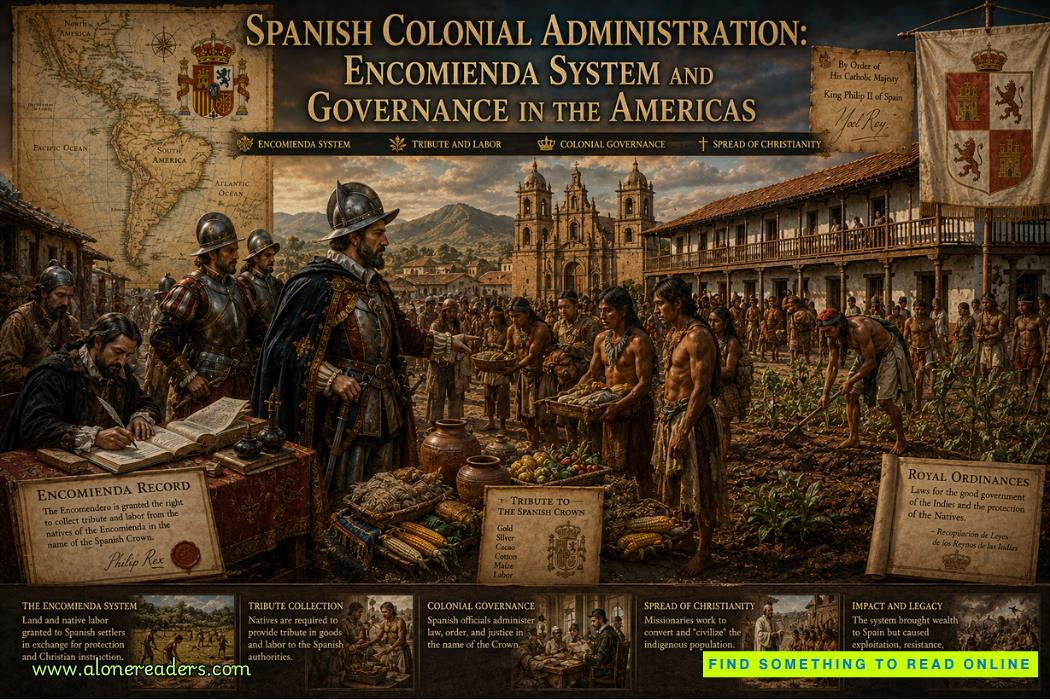
The expansion of Spanish power into the Americas during the late fifteenth and early sixteenth centuries marked one of the most transformative periods in global history. At the heart of this transformation was a carefully constructed system of governance that sought to extend royal authority across vast, unfamiliar territories while extracting wealth and maintaining control over diverse indigenous populations. Among the most significant mechanisms of this system was the encomienda, an institution that became both a tool of imperial organization and a symbol of colonial exploitation.
The Spanish Crown, having completed the Reconquista in 1492, carried forward a strong sense of religious mission and centralized authority into its overseas ventures. When Christopher Columbus reached the Caribbean, Spain quickly moved to assert sovereignty over newly encountered lands, framing its claim through a blend of divine mandate, legal doctrine, and military conquest. Yet conquest alone could not sustain an empire. The Crown needed a governance system capable of organizing labor, collecting tribute, and establishing administrative order across immense distances. This necessity gave rise to a layered and evolving colonial administration in which the encomienda played a central role.
The encomienda system was not entirely new; it had precedents in medieval Spain during the Reconquista. In the Americas, however, it acquired a distinct and far more controversial character. Under this system, Spanish settlers, known as encomenderos, were granted the right to receive tribute and labor from specific indigenous communities. In theory, this was not a grant of land or ownership of people, but rather a delegation of responsibility. The encomendero was expected to protect the indigenous population, ensure their conversion to Christianity, and maintain social order. In return, indigenous people were required to provide labor, goods, or tribute.
In practice, the system often diverged sharply from its theoretical framework. Many encomenderos treated their grants as hereditary property and the indigenous people as a labor force to be exploited. This led to widespread abuse, including forced labor, harsh working conditions, and significant population decline due to overwork and disease. The contradiction between the system’s stated moral obligations and its actual implementation became one of the defining tensions of Spanish colonial rule.
The Spanish Crown, aware of these abuses, attempted to regulate the encomienda system through a series of laws and reforms. The Laws of Burgos in 1512 and the New Laws of 1542 sought to limit exploitation, improve indigenous welfare, and gradually phase out the encomienda. These reforms reflected a broader concern within Spain about the ethical implications of empire, influenced by debates among theologians and jurists such as Bartolomé de las Casas, who argued passionately for the rights of indigenous peoples. Despite these efforts, enforcement was inconsistent, and local conditions often dictated how the system functioned on the ground.
Beyond the encomienda, Spanish colonial governance was characterized by a highly centralized yet flexible administrative structure. At the top stood the Spanish monarch, whose authority was considered absolute in both secular and religious matters. The Council of the Indies, established in Spain, served as the primary body responsible for colonial oversight. It drafted laws, appointed officials, and acted as the highest court for colonial affairs. This institution represented the Crown’s attempt to maintain direct control over distant territories and prevent the emergence of autonomous colonial elites.
In the Americas, the empire was divided into large administrative units known as viceroyalties, the most prominent being New Spain and Peru. Each viceroyalty was governed by a viceroy, who acted as the king’s representative. The viceroy held extensive powers, including military command, judicial authority, and administrative oversight. However, his authority was balanced by other institutions, such as the audiencias, which functioned as high courts and advisory councils. This system of overlapping jurisdictions was deliberately designed to prevent any single official from accumulating too much power.
At the local level, governance was carried out through cabildos, or municipal councils, which were often dominated by Spanish settlers. These councils managed urban affairs, including taxation, public works, and local justice. In rural areas, indigenous communities retained some degree of self-governance under the supervision of colonial authorities. Traditional leaders were often incorporated into the colonial system, serving as intermediaries between Spanish officials and indigenous populations. This approach allowed the Spanish to maintain control while minimizing administrative costs.
The integration of indigenous structures into colonial governance highlights a key feature of Spanish rule: its adaptive pragmatism. Rather than imposing a completely uniform system, the Spanish often adapted existing social and political structures to serve imperial purposes. This strategy facilitated the extraction of resources and the maintenance of order, but it also created complex layers of authority and identity within colonial society.
Economic considerations were central to the functioning of Spanish colonial administration. The encomienda system was initially the primary means of organizing labor, particularly in agriculture and mining. Over time, however, it was supplemented and partially replaced by other labor systems, such as the repartimiento and the mita. These systems sought to regulate labor more directly under state control, reflecting the Crown’s desire to reduce the power of encomenderos and increase its own revenue.
Mining, especially silver extraction in regions like Potosí and Zacatecas, became the backbone of the colonial economy. The demand for labor in these regions intensified the pressures on indigenous populations and shaped the development of labor systems. The Crown implemented policies to ensure a steady flow of silver to Spain, including taxation systems such as the quinto real, which required one-fifth of all precious metals to be given to the monarchy. This economic structure was closely connected to administrative systems, as officials were responsible for supervising production, collecting taxes, and preventing smuggling.
Religion played an equally important role in colonial governance. The Spanish Crown, under the system known as patronato real, exercised strong control over the Church in the Americas. Missionaries, including Franciscans, Dominicans, and Jesuits, played a major role in conversion and cultural transformation. They established missions, schools, and churches, often working closely with colonial authorities. While some missionaries defended the rights of indigenous people, others took part in the wider effort of cultural assimilation and control.
The interaction between secular and religious authorities added another layer of complexity to colonial administration. Conflicts sometimes arose over authority, especially in matters related to indigenous welfare and moral behavior. Despite this, the alliance between Church and state remained a key foundation of Spanish rule, strengthening the legitimacy of colonial authority and helping spread Spanish culture and values.
One of the most lasting legacies of Spanish colonial administration was the creation of a highly structured social hierarchy. At the top were peninsulares, Spaniards born in Spain, who held the most powerful positions. Below them were criollos, people of Spanish descent born in the Americas, who often felt excluded from high office. Further down were mestizos, indigenous peoples, and enslaved Africans, each group facing different levels of discrimination and control. The encomienda system supported this hierarchy by reinforcing the dominance of Spanish settlers over indigenous communities.
Over time, the weaknesses and contradictions of the encomienda system became more visible. Its dependence on forced labor and its connection to abuse weakened its legitimacy, while the decline in indigenous populations reduced its effectiveness. By the late sixteenth century, the system gradually declined and was replaced by more centralized forms of labor control and economic organization. However, its impact on colonial society and indigenous populations remained deep and long-lasting.
The governance systems established by Spain in the Americas proved to be highly durable, lasting for centuries and influencing the development of modern Latin American states. The focus on centralized authority, bureaucratic control, and legal regulation created a structure that continued even after independence. At the same time, reliance on systems like the encomienda revealed the internal tensions of empire, especially the difficulty of balancing economic goals with moral responsibility.
The study of Spanish colonial administration, especially the encomienda system, provides important insights into the dynamics of power, culture, and economy in the early modern world. It shows how empires organized and controlled distant territories, how local conditions influenced policy implementation, and how systems of exploitation became part of broader governance structures. The legacy of these systems continues to shape social, economic, and political patterns in the Americas today.
When examining this history, it becomes clear that the encomienda was not just a labor system but a central part of a larger imperial project. It reflected the ambitions, contradictions, and complexities of Spanish colonial rule, serving both as a method of control and as a source of resistance and reform. Through its development and eventual decline, the encomienda reveals the changing priorities of the Spanish Crown and the lasting impact of colonial governance in the Americas.



 The Hundred Days Offensive: How the Allies Defeated Germany in World War I
 The Second Battle of the Marne: The Turning Point of World War I in 1918
 The Spring Offensive of 1918: Germany's Final Gamble to Win World War I
 The Treaty of Brest-Litovsk: How Russia Left World War I
 The Russian Revolution and World War I: How War Brought Down the Tsar
 The Zimmermann Telegram Explained: Germany's Secret Offer to Mexico in World War I










