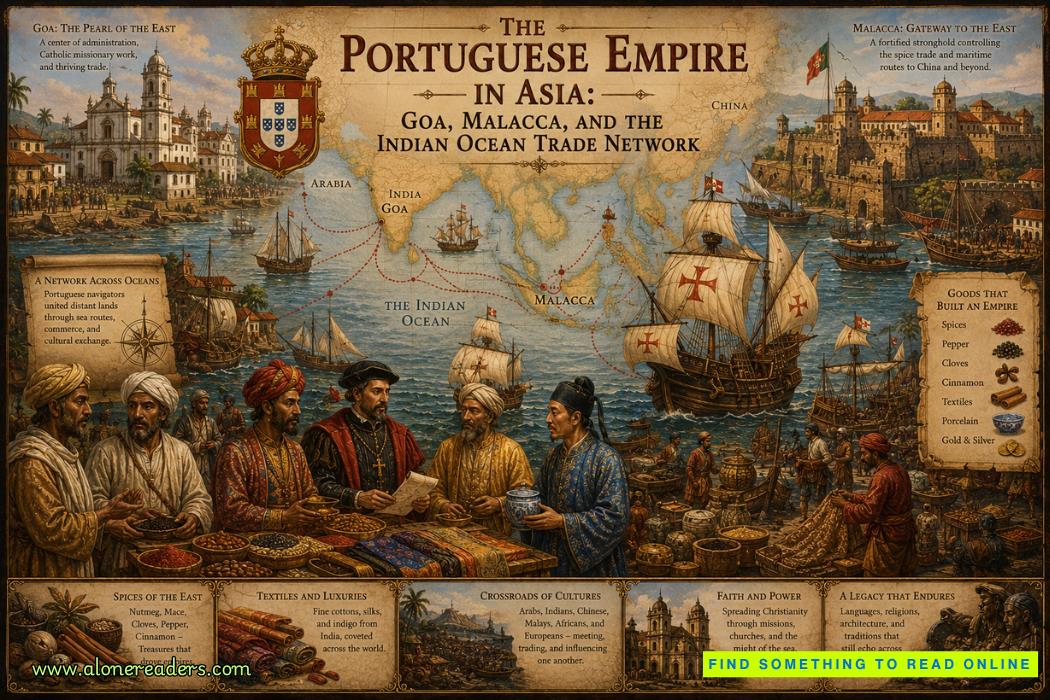
The rise of the Portuguese Empire in Asia during the early sixteenth century marked a dramatic shift in global trade, geopolitics, and cultural exchange. What began as a maritime quest for spices quickly evolved into a calculated strategy of domination over key ports and trade routes. At the heart of this transformation were two critical hubs: Goa on the western coast of India and Malacca at the gateway to Southeast Asia. Together, these centers allowed Portugal to exert unprecedented influence over the Indian Ocean trade network, a system that had long been controlled by Arab, Indian, and Southeast Asian merchants.
Before the arrival of the Portuguese, the Indian Ocean was a thriving commercial zone characterized by relatively open and cooperative trade. Merchants from different regions participated in a loosely regulated system where goods such as spices, textiles, ceramics, and precious metals moved freely across vast distances. The Portuguese, however, introduced a radically different model. Rather than integrating into existing networks, they sought to dominate and militarize trade, using naval power to control key chokepoints and enforce monopolies.
The capture of Goa in 1510 by Afonso de Albuquerque was a defining moment in the establishment of Portuguese power in Asia. Goa was not just another port; it was strategically positioned along the western coast of India, making it an ideal base for controlling maritime traffic in the Arabian Sea. Albuquerque recognized its importance and transformed it into the capital of the Portuguese Estado da Índia. From Goa, the Portuguese administered their Asian territories, coordinated naval expeditions, and regulated commerce.
Goa quickly evolved into more than just a military stronghold. It became a cosmopolitan center where European, Indian, and Middle Eastern cultures intersected. Portuguese settlers, missionaries, and traders lived alongside local populations, creating a unique hybrid society. Churches, fortresses, and administrative buildings reflected European architectural styles, while local customs and traditions continued to shape daily life. The city also became a focal point for Christian missionary activity, particularly by the Jesuits, who sought to convert local populations and extend the cultural influence of Portugal.
Economically, Goa functioned as a redistribution center for goods flowing between Europe and Asia. Spices from the Malabar Coast, textiles from Gujarat, and luxury items from further east all passed through its ports. The Portuguese established a system known as the cartaz, a naval pass that ships were required to carry. This system allowed them to monitor and tax maritime trade while suppressing unauthorized commerce. Ships without a cartaz risked confiscation or destruction, reinforcing Portuguese dominance over the sea lanes.
While Goa secured control over the western Indian Ocean, the conquest of Malacca in 1511 extended Portuguese influence into Southeast Asia. Malacca was one of the most important trading ports in the world at the time, strategically located along the narrow strait that connected the Indian Ocean to the South China Sea. Whoever controlled Malacca effectively controlled the flow of goods between East and West.
The Portuguese understood this perfectly. By capturing Malacca, they gained access to the lucrative spice trade of the Indonesian archipelago, including cloves, nutmeg, and mace. These commodities were in high demand in Europe, and controlling their supply allowed Portugal to generate enormous profits. The city itself was transformed into a fortified colonial outpost, complete with walls, bastions, and a permanent military presence.
Unlike Goa, which became a cultural and administrative center, Malacca functioned primarily as a commercial and strategic hub. It served as a collection point for goods from across Southeast Asia and as a distribution center for exports to India, the Middle East, and Europe. Traders from China, Japan, Siam, and the Malay world continued to operate in the port, although now under Portuguese supervision. This created a complex and often tense environment, where cooperation and conflict coexisted.
The broader Indian Ocean trade network was fundamentally reshaped by Portuguese intervention. Traditionally, trade in this region had been decentralized and relatively peaceful. The Portuguese introduced a system based on naval supremacy and coercion. They deployed heavily armed ships equipped with cannons, which gave them a significant advantage over traditional merchant vessels. This allowed them to enforce blockades, capture rival ships, and establish fortified bases at strategic locations.
Key to their strategy was the control of chokepoints such as the Strait of Hormuz, the entrance to the Red Sea, and the Strait of Malacca. By positioning themselves at these critical junctures, the Portuguese could regulate the flow of goods and extract taxes from passing ships. This effectively turned the Indian Ocean into a controlled maritime empire, where access to trade routes depended on Portuguese approval.
However, this system was not without its challenges. The Portuguese faced constant resistance from established powers such as the Ottoman Empire, which sought to defend its own trade interests in the Red Sea and Persian Gulf. Local rulers and merchants also resisted Portuguese control, leading to frequent conflicts and uprisings. In many cases, the Portuguese relied on alliances with local leaders to maintain their position, creating a delicate balance of power.
Despite these challenges, the Portuguese Empire in Asia achieved remarkable success during the sixteenth century. It established a network of fortified ports and trading posts that stretched from East Africa to Japan. Goa and Malacca were the linchpins of this system, enabling Portugal to connect different regions and facilitate the movement of goods on an unprecedented scale.
Culturally, the impact of Portuguese presence in Asia was profound. In Goa, the spread of Christianity and the establishment of European institutions left a lasting legacy that can still be seen today. In Malacca, the blending of cultures created a diverse and dynamic society, where languages, religions, and traditions intersected. These interactions contributed to the development of new cultural identities and forms of expression.
Economically, the Portuguese reshaped global trade patterns by linking Asian markets directly to Europe via maritime routes. This reduced the reliance on overland routes controlled by Middle Eastern intermediaries and shifted the balance of economic power. The influx of Asian goods into Europe also had significant social and economic effects, influencing consumption patterns and driving demand for luxury items.
Yet, the dominance of the Portuguese Empire was not permanent. By the late sixteenth and early seventeenth centuries, new European powers such as the Dutch and the English began to challenge Portuguese control. These rivals adopted similar strategies of naval power and fortified trading posts, but often operated with greater efficiency and resources. The Dutch, in particular, succeeded in capturing Malacca in 1641, signaling the decline of Portuguese influence in Southeast Asia.
Goa remained under Portuguese control for much longer, serving as a testament to the enduring legacy of their presence in India. However, its importance gradually diminished as global trade patterns continued to evolve and new powers emerged. The Indian Ocean, once dominated by Portuguese ships, became a contested space where multiple powers competed for influence.
The story of the Portuguese Empire in Asia is ultimately one of ambition, innovation, and transformation. It illustrates how a relatively small European nation was able to project power across vast distances and reshape the dynamics of global trade. By establishing control over key ports like Goa and Malacca, the Portuguese created a network that connected different parts of the world in ways that had never been seen before.
At the same time, their approach to trade—characterized by militarization, monopolization, and control—introduced new forms of conflict and competition. The Indian Ocean, once a space of relatively open exchange, became a battleground for imperial ambitions. This shift had far-reaching consequences, influencing the development of global trade and the emergence of modern economic systems.
The legacy of this period can still be felt today. The cities of Goa and Malacca remain important cultural and historical landmarks, reflecting centuries of interaction between different civilizations. The trade routes established by the Portuguese laid the groundwork for the modern global economy, demonstrating the enduring impact of their maritime ventures.
In examining the Portuguese Empire in Asia, it becomes clear that their success was not merely the result of technological superiority or strategic positioning. It was also driven by a willingness to adapt, to forge alliances, and to navigate complex cultural landscapes. This combination of power and flexibility allowed them to establish a presence that, while eventually challenged, left an indelible mark on world history.



 The Hundred Days Offensive: How the Allies Defeated Germany in World War I
 The Second Battle of the Marne: The Turning Point of World War I in 1918
 The Spring Offensive of 1918: Germany's Final Gamble to Win World War I
 The Treaty of Brest-Litovsk: How Russia Left World War I
 The Russian Revolution and World War I: How War Brought Down the Tsar
 The Zimmermann Telegram Explained: Germany's Secret Offer to Mexico in World War I