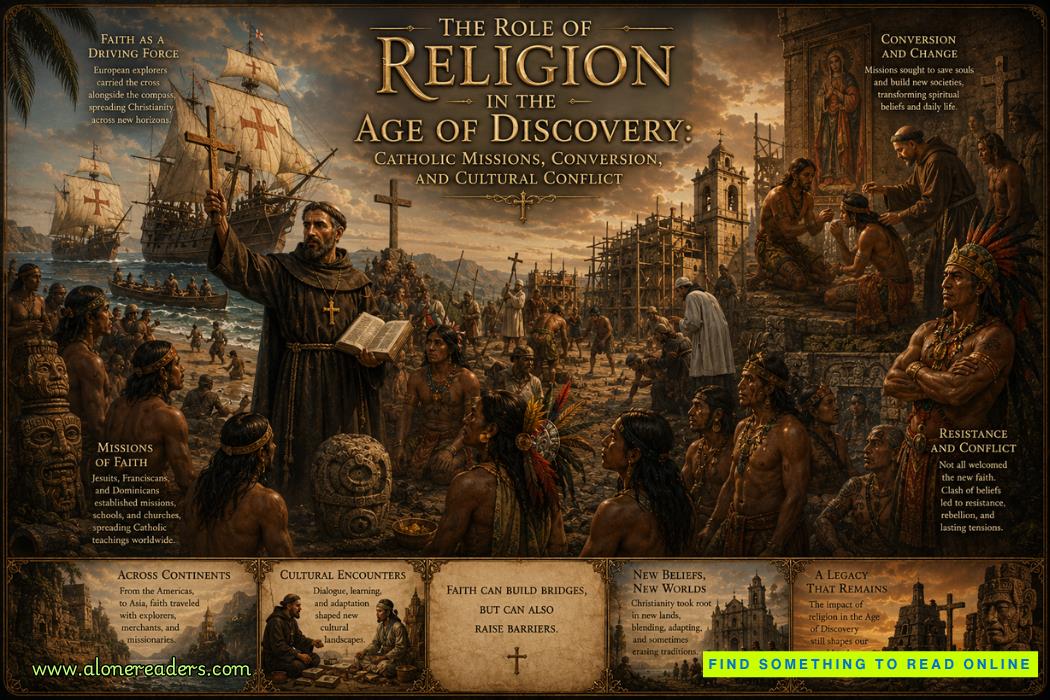
Religion was not simply a companion to exploration during the Age of Discovery; it was one of its most powerful driving forces. As European empires expanded across the Atlantic, Africa, and Asia from the fifteenth to the seventeenth centuries, the spread of Catholicism became inseparable from imperial ambition. Monarchs, missionaries, and merchants operated within a shared worldview that saw religious expansion as both a divine duty and a justification for conquest. The result was a complex and often turbulent process in which Catholic missions sought to convert Indigenous populations, reshape societies, and establish spiritual authority, while simultaneously generating profound cultural conflict.
At the heart of this process was the belief in a universal Christian truth that must be extended to all humanity. European rulers, particularly those of Spain and Portugal, viewed themselves as defenders of the Catholic faith. Their overseas ventures were framed not merely as economic or political enterprises, but as sacred missions. The papacy reinforced this outlook by granting these kingdoms authority over newly discovered lands, effectively linking territorial expansion with religious responsibility. This fusion of faith and empire meant that missionaries often traveled alongside soldiers and settlers, their presence legitimizing imperial control while attempting to transform local populations.
Catholic missions became the primary mechanism through which this transformation was pursued. Orders such as the Franciscans, Dominicans, and later the Jesuits played central roles in establishing mission systems across vast regions. These missionaries were not uniform in their methods or attitudes. Some approached their work with a degree of cultural sensitivity, attempting to learn local languages and adapt Christian teachings to existing traditions. Others imposed rigid structures, seeking to replace Indigenous beliefs entirely. Yet all operated within the assumption that conversion was both necessary and beneficial, a conviction that shaped their interactions with local communities.
Conversion itself was a deeply complex and often ambiguous process. It was rarely a simple matter of replacing one set of beliefs with another. In many cases, Indigenous peoples engaged with Christianity selectively, blending it with their own spiritual traditions in ways that preserved elements of their identity. This phenomenon, often described as syncretism, illustrates the resilience and adaptability of local cultures. For example, in parts of Latin America, Indigenous rituals and symbols were incorporated into Christian practices, creating hybrid forms of worship that reflected both European and native influences.
However, conversion was not always voluntary. In many regions, it was closely tied to systems of coercion and control. Colonial authorities often required Indigenous populations to attend religious instruction, participate in sacraments, and abandon traditional practices. Missions sometimes functioned as instruments of social organization, concentrating dispersed communities into settlements where they could be more easily governed. Within these spaces, daily life was structured around Christian norms, from work routines to moral expectations. While missionaries often justified these measures as necessary for spiritual salvation, they also served the practical needs of colonial administration.
The imposition of Catholicism frequently led to intense cultural conflict. Indigenous belief systems were not merely spiritual frameworks; they were deeply embedded in social structures, political authority, and relationships with the natural world. When missionaries condemned these beliefs as pagan or idolatrous, they were effectively challenging entire ways of life. Sacred sites were destroyed or repurposed, traditional leaders were undermined, and long-standing customs were suppressed. This process generated resistance, both overt and subtle. Some communities openly rejected missionary efforts, while others adopted outward signs of conversion while maintaining their traditions in secret.
In Asia, the dynamics of Catholic missions took on different forms, shaped by the presence of established civilizations with their own sophisticated religious traditions. Jesuit missionaries in China, for instance, adopted a strategy of cultural accommodation. They studied Confucian philosophy, mastered the Chinese language, and presented Christianity in terms that resonated with local intellectual frameworks. This approach achieved some success, particularly among elites, but it also sparked controversy within the Church. Debates over the extent to which missionaries could adapt to local customs revealed tensions between flexibility and doctrinal purity.
Similarly, in Japan, early missionary efforts initially gained traction, leading to significant numbers of converts. However, the association of Christianity with foreign influence eventually provoked suspicion and hostility. Authorities viewed the new religion as a potential threat to social order and political stability, leading to severe persecution of Christians. This illustrates a recurring pattern in the Age of Discovery: the spread of Catholicism often became entangled with issues of power, identity, and sovereignty, producing outcomes that were far from predictable.
In the Americas, the scale and intensity of missionary activity were particularly pronounced. Spanish and Portuguese colonies became major centers of Catholic expansion, with missions established across vast territories. These missions served multiple purposes: they were sites of religious instruction, centers of economic production, and instruments of colonial governance. Indigenous peoples were taught not only Christian doctrine but also European agricultural techniques, crafts, and social norms. While this process facilitated the integration of colonies into global imperial systems, it also led to the erosion of traditional cultures.
One of the most striking aspects of this period is the dual role played by missionaries as both agents of change and, at times, defenders of Indigenous rights. Figures such as Bartolomé de las Casas criticized the abuses of colonial systems and argued for more humane treatment of native populations. His advocacy highlights the internal contradictions within the missionary enterprise. On one hand, missionaries sought to transform Indigenous societies; on the other, some recognized the moral implications of colonial exploitation and attempted to mitigate its worst effects. This tension underscores the complexity of their role, which cannot be reduced to simple narratives of oppression or benevolence.
The cultural conflicts generated by Catholic missions were not limited to interactions between Europeans and Indigenous peoples. They also emerged within European societies themselves, as debates over colonial practices and missionary methods intensified. Questions about the legitimacy of forced conversion, the treatment of native populations, and the relationship between religion and empire sparked ongoing controversies. These debates reveal that the Age of Discovery was not a monolithic project but a contested and evolving process, shaped by competing visions and values.
At a deeper level, the spread of Catholicism during this period reflects broader patterns of cultural exchange and transformation. While the imposition of European religious frameworks often disrupted existing societies, it also created new forms of interaction and synthesis. The encounter between different belief systems led to the emergence of hybrid identities, artistic expressions, and social practices. Churches built in colonial regions often incorporated local architectural styles, while religious art blended European and Indigenous motifs. These developments illustrate how cultural conflict and creativity were intertwined, producing outcomes that were both destructive and generative.
The legacy of Catholic missions in the Age of Discovery continues to shape the modern world. In many regions, Christianity remains a dominant or influential force, reflecting the enduring impact of early missionary efforts. At the same time, the historical experiences of conversion and cultural conflict have left lasting scars, influencing contemporary discussions about identity, heritage, and historical justice. The memory of these encounters is often contested, with different perspectives emphasizing either the spiritual achievements of missionaries or the cultural losses experienced by Indigenous communities.
Understanding this history requires moving beyond simplistic interpretations. The role of religion in the Age of Discovery was neither wholly noble nor entirely oppressive. It was a multifaceted phenomenon that encompassed genuine spiritual aspirations, institutional ambitions, cultural misunderstandings, and human resilience. By examining the interactions between Catholic missions, conversion processes, and cultural conflict, we gain a more nuanced appreciation of how global connections were forged and how they continue to influence our world today.
Ultimately, the story of Catholic missions during this era is one of profound transformation. It reveals how deeply held beliefs can drive exploration and shape encounters between different cultures. It also reminds us that such encounters are rarely straightforward, often involving negotiation, resistance, and adaptation. The Age of Discovery was not just a period of geographic expansion; it was a moment of intense cultural and spiritual exchange, in which the quest to spread faith intersected with the realities of human diversity. Within this intersection lies a history that is as complex as it is consequential, offering insights into the enduring relationship between religion and global change.



 The Hundred Days Offensive: How the Allies Defeated Germany in World War I
 The Second Battle of the Marne: The Turning Point of World War I in 1918
 The Spring Offensive of 1918: Germany's Final Gamble to Win World War I
 The Treaty of Brest-Litovsk: How Russia Left World War I
 The Russian Revolution and World War I: How War Brought Down the Tsar
 The Zimmermann Telegram Explained: Germany's Secret Offer to Mexico in World War I










