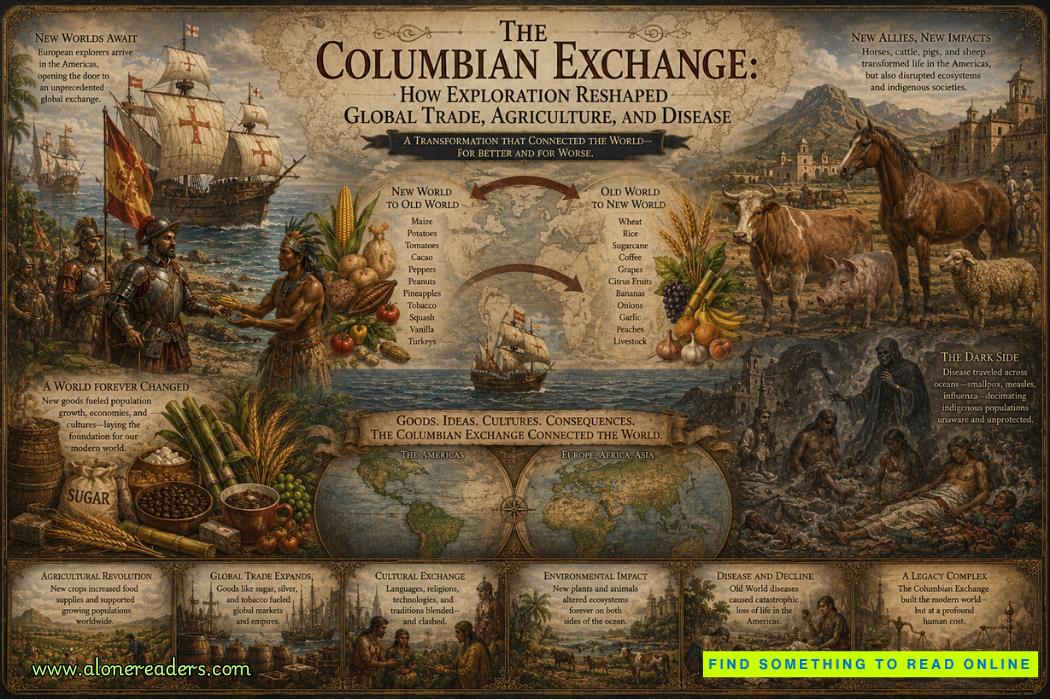
The Columbian Exchange stands as one of the most transformative processes in human history, fundamentally altering the ecological, economic, and social landscapes of the world. Initiated in the late 15th century following Christopher Columbus’s voyages to the Americas, this vast and complex exchange of goods, organisms, people, and ideas between the Eastern and Western Hemispheres reshaped civilizations in ways that still define the modern global system. It was not merely a transfer of commodities but a profound reorganization of life itself across continents, touching everything from what people ate to how they lived and died.
At its core, the Columbian Exchange was a direct consequence of European exploration during the Age of Discovery. Motivated by a desire for new trade routes, wealth, and territorial expansion, European powers such as Spain and Portugal ventured into unknown waters and inadvertently connected ecosystems that had evolved separately for thousands of years. This sudden biological and cultural convergence triggered a cascade of changes that reverberated across the globe.
One of the most visible and enduring impacts of the Columbian Exchange was the transformation of global agriculture. Before 1492, the diets of people in Europe, Africa, Asia, and the Americas were based on entirely different sets of crops and livestock. The Americas contributed a remarkable array of staple crops to the Old World, including maize, potatoes, tomatoes, cassava, peanuts, and cacao. These crops were not just additions to existing diets; they became cornerstones of food security and population growth. For instance, the potato, originally cultivated in the Andes, proved highly adaptable to European climates and soil conditions. Its high caloric yield per acre allowed populations in countries like Ireland and parts of Eastern Europe to expand rapidly.
Similarly, maize became a critical food source in Africa and parts of Asia, where it supported both human populations and livestock. Cassava, another New World crop, became especially important in sub-Saharan Africa due to its resilience in poor soils and drought conditions. These agricultural transformations led to a global redistribution of nutritional resources, enabling societies to sustain larger populations and diversify their food systems.
Conversely, the Old World introduced a variety of crops and domesticated animals to the Americas that would dramatically alter indigenous ways of life. Wheat, barley, rice, sugarcane, and coffee were among the most significant plant introductions. Sugarcane, in particular, became the foundation of plantation economies in the Caribbean and Brazil, driving the demand for labor and contributing to the rise of the transatlantic slave trade. The introduction of livestock such as horses, cattle, pigs, and sheep had equally profound effects. Horses revolutionized transportation, hunting, and warfare for many Native American societies, particularly on the Great Plains, where they enabled new forms of mobility and cultural expression.
However, these benefits came with devastating consequences. The most catastrophic aspect of the Columbian Exchange was the spread of infectious diseases. European explorers and settlers brought with them pathogens such as smallpox, measles, influenza, and typhus—diseases to which indigenous populations in the Americas had no prior exposure or immunity. The result was one of the deadliest demographic collapses in human history. In some regions, up to 90 percent of the native population perished within a century of contact.
This massive loss of life had far-reaching implications. Entire communities were wiped out, traditional knowledge systems were disrupted, and social structures collapsed. The labor vacuum created by this demographic catastrophe led European colonizers to import enslaved Africans to work on plantations, further entrenching systems of exploitation and inequality. The Columbian Exchange thus became deeply intertwined with the emergence of global systems of forced labor and racial hierarchy.
While the flow of diseases from the Old World to the New World was overwhelmingly destructive, the exchange was not entirely one-sided. Some scholars argue that syphilis may have originated in the Americas and spread to Europe, although this remains a topic of debate. Regardless, the overall impact of disease exchange was asymmetrical, with the Americas bearing the brunt of the devastation.
Trade networks expanded dramatically as a result of the Columbian Exchange, linking continents in a web of economic interdependence that marked the beginnings of globalization. Precious metals such as silver and gold flowed from the Americas to Europe, fueling economic growth and enabling further exploration and conquest. The influx of American silver into Spain, and subsequently into global markets, played a crucial role in the development of early modern capitalism. It also facilitated trade with Asia, particularly China, where silver became a key medium of exchange.
At the same time, the introduction of new commodities reshaped consumer habits and economic priorities. Products like tobacco, sugar, and coffee became highly sought after in Europe, leading to the establishment of vast plantation systems in the Americas. These plantations relied heavily on enslaved labor and were integrated into a triangular trade network that connected Europe, Africa, and the Americas. This system not only generated immense wealth for European powers but also entrenched patterns of inequality and exploitation that continue to have lasting effects.
Culturally, the Columbian Exchange fostered a blending of traditions, languages, and beliefs. European settlers, African slaves, and indigenous peoples interacted in complex ways, leading to the emergence of new cultural identities and practices. This cultural syncretism is evident in everything from cuisine and music to religion and language across the Americas. Foods like chocolate, once a sacred drink among the Aztecs, became a global delicacy, while dishes combining Old and New World ingredients became staples in many regions.
Environmental changes were another significant consequence of the Columbian Exchange. The introduction of new species often disrupted local ecosystems, leading to unintended consequences. European livestock, for example, sometimes overgrazed land, altering vegetation patterns and contributing to soil erosion. Invasive plant species could outcompete native flora, reducing biodiversity. These ecological shifts highlight the fragility of interconnected ecosystems and the long-term impact of human activity on the natural world.
The Columbian Exchange also played a crucial role in shaping modern economic systems. By linking distant regions through trade and resource flows, it laid the groundwork for the globalized economy we see today. The movement of goods, capital, and labor across continents created new opportunities but also introduced new vulnerabilities. Economic dependence on cash crops, for instance, made some regions susceptible to market fluctuations and environmental challenges.
Despite its many consequences, the Columbian Exchange is often misunderstood as a simple or inevitable process. In reality, it was driven by specific historical choices, power dynamics, and human actions. European expansion was not merely a quest for knowledge but a strategic effort to dominate and exploit new territories. The resulting exchanges were shaped by inequality, coercion, and conflict, as much as by curiosity and innovation.
Understanding the Columbian Exchange requires recognizing both its transformative potential and its human cost. It brought about unprecedented levels of connectivity and exchange, enabling the spread of ideas, technologies, and resources across the globe. At the same time, it caused immense suffering, particularly for indigenous populations and enslaved Africans. This dual legacy underscores the complexity of historical processes and the importance of examining them from multiple perspectives.
Today, the effects of the Columbian Exchange are visible in everyday life. The foods we eat, the diseases we encounter, and the economic systems we participate in all bear the imprint of this historical phenomenon. The global circulation of crops like potatoes, maize, and tomatoes has become so normalized that it is easy to forget their origins and the processes that enabled their spread. Similarly, the interconnectedness of global markets and the persistence of inequality can be traced back, in part, to the systems established during this period.
In examining the Columbian Exchange, one gains insight into the origins of the modern world and the forces that continue to shape it. It serves as a powerful reminder of how exploration and contact can lead to both innovation and destruction, progress and suffering. By studying this complex history, we can better understand the challenges and opportunities of an increasingly interconnected world and strive to create systems that are more equitable and sustainable.



 The Hundred Days Offensive: How the Allies Defeated Germany in World War I
 The Second Battle of the Marne: The Turning Point of World War I in 1918
 The Spring Offensive of 1918: Germany's Final Gamble to Win World War I
 The Treaty of Brest-Litovsk: How Russia Left World War I
 The Russian Revolution and World War I: How War Brought Down the Tsar
 The Zimmermann Telegram Explained: Germany's Secret Offer to Mexico in World War I