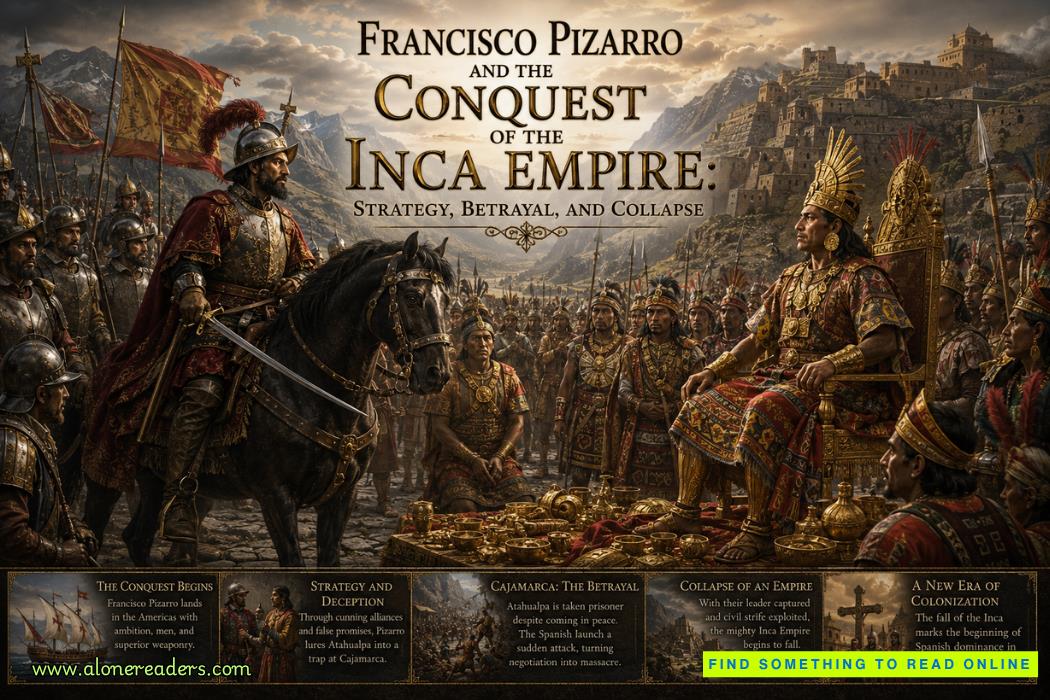
The conquest of the Inca Empire by Francisco Pizarro stands as one of the most dramatic and consequential episodes in the history of the Age of Discovery. It is a story shaped by ambition, opportunism, cultural misunderstanding, and ruthless execution. While often simplified into a tale of European superiority over indigenous civilizations, the reality is far more complex and layered. The fall of the Inca Empire was not merely the result of Spanish military strength, but a convergence of internal divisions, strategic alliances, and calculated deception. At the center of this transformative moment was Francisco Pizarro, a man of humble origins who would rise to immense power through boldness and brutality.
Born around 1474 in Trujillo, Spain, Pizarro came from modest beginnings, lacking formal education and noble status. Unlike many of his contemporaries, he did not inherit wealth or influence, which likely fueled his relentless pursuit of fortune and recognition. His early years in the New World exposed him to the possibilities of exploration and conquest, particularly after witnessing the success of Hernán Cortés in Mexico. The idea that vast, wealthy civilizations existed beyond the known territories of Spanish control ignited Pizarro’s ambitions.
The Inca Empire, known as Tawantinsuyu, was the largest and most sophisticated empire in pre-Columbian America. Stretching along the western coast of South America, it encompassed present-day Peru, Ecuador, Bolivia, Chile, and parts of Colombia and Argentina. The Incas had developed an advanced administrative system, extensive road networks, agricultural terraces, and a centralized government under the authority of the Sapa Inca. Despite lacking iron tools or a written language, their engineering and organizational capabilities were remarkable. However, beneath this impressive structure lay vulnerabilities that would soon be exploited.
One of the most critical factors contributing to the empire’s downfall was the civil war between Atahualpa and Huáscar, two sons of the previous emperor, Huayna Capac. This conflict weakened the political unity of the empire and divided loyalties among its people. Atahualpa emerged victorious, but the empire was left fractured and unstable. This internal strife created an opening that Pizarro would seize with extraordinary precision.
Pizarro’s first expeditions along the Pacific coast of South America were marked by hardship and limited success. However, they provided crucial intelligence about the wealth and organization of the Inca Empire. By the time he launched his decisive expedition in 1531, Pizarro had secured royal authorization from Spain, granting him the right to conquer and govern new territories. With a relatively small force of around 168 men, including cavalry and firearms, he set out to confront one of the largest empires in the world.
The encounter between Pizarro and Atahualpa in the city of Cajamarca in November 1532 remains one of the most pivotal moments in history. Despite being vastly outnumbered by thousands of Inca troops, Pizarro orchestrated a carefully planned ambush. He invited Atahualpa to a meeting under the pretense of diplomacy, a move that demonstrated both cunning and audacity. During the meeting, a Spanish friar presented Atahualpa with a Bible, demanding that he accept Christianity and recognize the authority of the Spanish crown. When Atahualpa rejected this demand, it provided the Spanish with a justification to attack.
What followed was a swift and devastating assault. The Spanish forces, equipped with horses, steel weapons, and firearms, launched a surprise attack on the unarmed Inca attendants. The psychological impact of the attack was immense, as the Incas had never encountered such technology before. Within hours, thousands of Inca soldiers were killed, and Atahualpa himself was captured. This single event effectively decapitated the leadership of the empire.
Atahualpa’s captivity marked a turning point in the conquest. Recognizing his value, the Spanish demanded an enormous ransom for his release. In one of the most extraordinary episodes of the conquest, Atahualpa offered to fill a room with gold and silver. The Incas complied, delivering vast quantities of precious metals from across the empire. However, despite fulfilling the ransom, Atahualpa was ultimately executed in 1533. This act of betrayal shattered any remaining trust and further destabilized the empire.
After the death of Atahualpa, Pizarro moved toward Cusco, the capital of the Inca Empire. On the way, he used existing conflicts within the empire to his advantage. He made alliances with groups who were against Inca rule. These partnerships were very important because they gave the Spanish extra soldiers and valuable local knowledge. The Spanish did not conquer the empire alone; they used internal divisions to succeed.
The capture of Cusco marked the real end of the Inca Empire as a united power. However, resistance did not completely stop. Manco Inca, who was first placed as a puppet ruler by the Spanish, later led a major rebellion against them. Even though he had some early victories, the rebellion eventually failed. After that, the Spanish strengthened their control over the region. The founding of Lima as the new capital showed the clear shift from Inca rule to Spanish control.
Pizarro’s success was not due to just one reason. It happened because of several factors working together, including better technology, clever planning, and the use of internal conflicts. The Spanish had weapons and fighting methods that were new to the Incas, but that alone was not enough to guarantee victory. Pizarro’s skill in using situations to his advantage and acting at the right time played a key role.
Another important factor was disease. Even before Pizarro arrived, European diseases like smallpox had spread across the Americas. These diseases killed many people and weakened the population. They also damaged the political and social systems of the Inca Empire, making it harder to resist invasion. The death of the emperor Huayna Capac, likely caused by disease, had already started the civil war that helped Pizarro succeed.
The effects of the conquest were deep and long-lasting. The fall of the Inca Empire led to Spanish colonial rule in South America. This changed the region’s politics, culture, and economy. Indigenous systems of leadership were destroyed, and resources were taken for the benefit of Spain. Christianity and European customs were introduced, often by force, which changed the lives and identities of native people.
At the same time, the conquest raised serious questions about morality and justice. Some people, like Bartolomé de las Casas, spoke against the cruelty of the Spanish and supported the rights of indigenous people. These debates show the moral challenges of the Age of Discovery and question simple ideas of heroism and progress.
Francisco Pizarro did not enjoy his success for long. In his later years, he faced conflicts with former allies, especially Diego de Almagro, who had also helped in the conquest. These conflicts led to Pizarro’s assassination in 1541. His violent death reflected the same ambition and conflict that shaped his life.
The story of Pizarro and the fall of the Inca Empire is not just about winning and losing. It is a powerful example of how ambition, power, and cultural differences can shape history. It shows how a small group of people can change the course of events when the conditions are right. At the same time, it highlights the strength and complexity of the societies that were affected.
To fully understand this event, we must look beyond simple explanations. The Inca Empire was strong, and the Spanish were not unbeatable. The result came from a mix of chance, strategy, and human decisions. This reminds us that history is not fixed; it is shaped by actions, conflicts, and changing power.
Today, the impact of the conquest can still be seen across South America. Places like Machu Picchu and Cusco remain as symbols of Inca greatness, while also showing the effects of Spanish rule. The story of Pizarro continues to be studied and discussed, as it represents one of the most important turning points in world history.



 The Hundred Days Offensive: How the Allies Defeated Germany in World War I
 The Second Battle of the Marne: The Turning Point of World War I in 1918
 The Spring Offensive of 1918: Germany's Final Gamble to Win World War I
 The Treaty of Brest-Litovsk: How Russia Left World War I
 The Russian Revolution and World War I: How War Brought Down the Tsar
 The Zimmermann Telegram Explained: Germany's Secret Offer to Mexico in World War I










