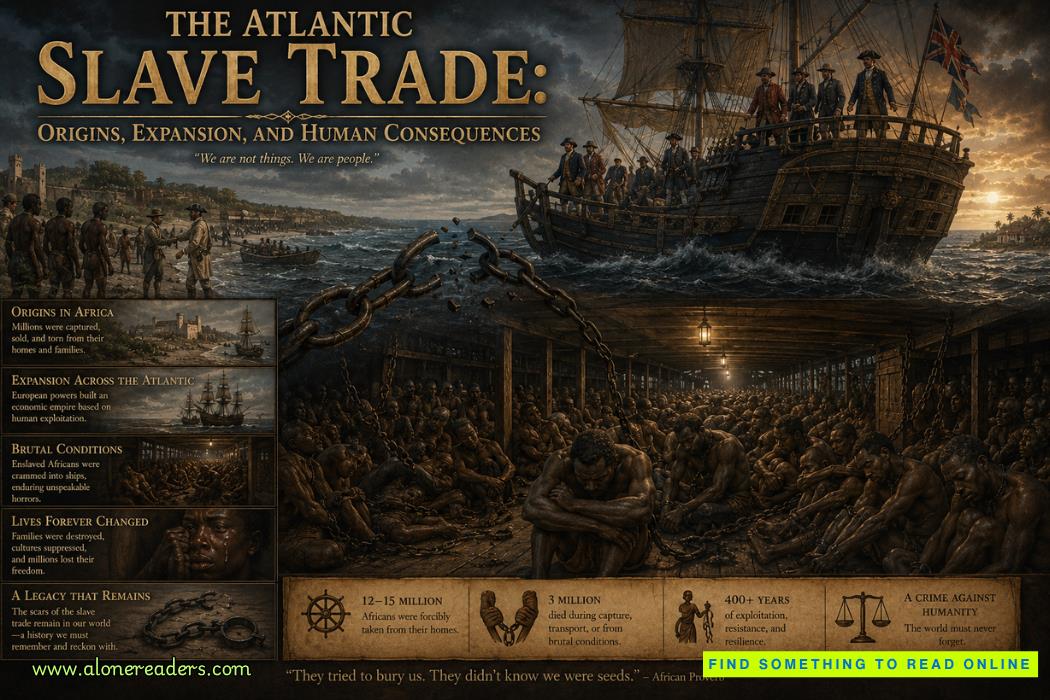
The Atlantic Slave Trade stands as one of the most devastating and transformative systems in human history, fundamentally reshaping continents, economies, and societies over the course of more than four centuries. Emerging during the late fifteenth century and expanding rapidly alongside European maritime exploration, this system forcibly transported millions of Africans across the Atlantic Ocean to labor in the Americas under brutal conditions. It was not merely a trade network but a complex global system of exploitation, driven by economic ambition, sustained by racial ideologies, and marked by profound human suffering.
The origins of the Atlantic Slave Trade are closely tied to the Age of Discovery, when European powers such as Portugal and Spain began exploring the West African coast in the fifteenth century. Initially, these expeditions were motivated by a desire to access gold, spices, and alternative trade routes that bypassed established Mediterranean networks. However, as European settlements expanded into the Atlantic islands—such as Madeira, the Canary Islands, and Cape Verde—there arose a growing demand for labor to sustain plantation economies. Sugar cultivation, in particular, proved to be labor-intensive and highly profitable, setting the stage for the large-scale exploitation of enslaved labor.
Before the transatlantic system took shape, forms of slavery already existed within Africa, Europe, and the Islamic world. However, these systems differed significantly from what would later emerge in the Atlantic context. African systems of servitude were often non-hereditary and integrated into social structures, while the Atlantic system would evolve into a rigid, racialized form of chattel slavery where individuals and their descendants were treated as property. The Portuguese were among the first Europeans to engage in the direct purchase and transport of enslaved Africans, initially bringing them to Europe and later to Atlantic island colonies.
The turning point came with the European colonization of the Americas following Christopher Columbus’s voyages in 1492. As indigenous populations in the Caribbean and mainland Americas declined rapidly due to disease, warfare, and exploitation, European colonizers turned increasingly to Africa as a source of labor. The transatlantic slave trade thus emerged as a triangular trading system linking Europe, Africa, and the Americas. European goods such as textiles, firearms, and metalware were exchanged in Africa for enslaved individuals, who were then transported across the Atlantic—the infamous Middle Passage—to be sold in the Americas. The final leg of the triangle involved the export of plantation products like sugar, tobacco, cotton, and coffee back to Europe.
The expansion of the Atlantic Slave Trade during the sixteenth to eighteenth centuries was unprecedented in scale and organization. It is estimated that over twelve million Africans were forcibly transported across the Atlantic, with millions more dying during capture, transit, or resistance. The trade was dominated by several European powers at different times, including Portugal, Spain, Britain, France, and the Netherlands. Each established fortified trading posts along the West African coast, such as Elmina Castle and Gorée Island, which became central nodes in the network of human trafficking.
African societies were not merely passive victims in this process, although the overall system was imposed and driven by European demand. Some African rulers and intermediaries participated in the trade by capturing and selling prisoners of war or marginalized individuals in exchange for European goods. This involvement, however, often destabilized regions, fueled conflicts, and contributed to long-term social fragmentation. The demand for enslaved people created a cycle of violence and insecurity that reshaped political structures across West and Central Africa.
The Middle Passage represents one of the most harrowing aspects of the Atlantic Slave Trade. Enslaved Africans were packed tightly into ships under inhumane conditions, with little ventilation, minimal food and water, and rampant disease. Mortality rates during these voyages were extremely high, with estimates suggesting that between 10 and 20 percent of captives died at sea. Survivors endured not only physical suffering but also profound psychological trauma, as they were forcibly separated from their families, cultures, and homelands.
Upon arrival in the Americas, enslaved individuals were subjected to systems of labor that varied by region but were uniformly brutal. Plantation economies in the Caribbean and Brazil relied heavily on enslaved labor for sugar production, while in North America, enslaved people were employed in tobacco, rice, and later cotton cultivation. The legal framework of slavery in these regions codified the dehumanization of African people, defining them as property and denying them basic rights. Over time, slavery became hereditary and race-based, embedding racial hierarchies into the social fabric of colonial societies.
Despite the oppressive conditions, enslaved Africans resisted in numerous ways, both overt and subtle. Acts of resistance included revolts, escape attempts, and the formation of maroon communities—settlements of escaped enslaved people who established independent societies in remote areas. Cultural resistance was equally significant, as enslaved individuals preserved elements of their languages, religions, music, and traditions, contributing to the rich cultural heritage of the African diaspora. These acts of resilience underscore the agency and humanity of those who endured unimaginable hardship.
The economic impact of the Atlantic Slave Trade was immense and far-reaching. It played a crucial role in the development of European economies, providing capital that fueled industrialization and global trade networks. Ports such as Liverpool, Bristol, and Nantes prospered from their involvement in the trade, while plantation economies generated vast wealth for colonial elites. At the same time, the trade contributed to the underdevelopment of African regions by draining populations, disrupting economies, and perpetuating cycles of violence.
The human consequences of the Atlantic Slave Trade are perhaps its most enduring legacy. The forced displacement of millions of Africans led to the creation of the African diaspora, shaping the demographic and cultural landscapes of the Americas. However, this diaspora was born out of trauma, and its effects continue to resonate today. The legacy of slavery is evident in persistent racial inequalities, social injustices, and cultural identities across the Atlantic world. Understanding this history is essential for addressing its long-term consequences and fostering meaningful dialogue about race and justice.
The abolition of the Atlantic Slave Trade began in the late eighteenth century, driven by a combination of moral, political, and economic factors. Abolitionist movements in Britain and other countries campaigned vigorously against the trade, highlighting its brutality and inhumanity. Britain abolished the slave trade in 1807, followed by other nations, although illegal trading continued for decades. The institution of slavery itself persisted longer, with emancipation occurring at different times across the Americas, often through struggle and resistance.
An illustrative example of the trade’s human impact can be seen in the story of Olaudah Equiano, a formerly enslaved African who became a prominent abolitionist writer. His autobiography provides a vivid account of his capture, the Middle Passage, and his eventual journey to freedom. Through narratives like his, the abstract scale of the slave trade becomes deeply personal and human, reminding us that each number represents an individual life marked by suffering and resilience.
The Atlantic Slave Trade was not an isolated phenomenon but a central component of the broader processes of globalization that began during the Age of Discovery. It connected continents in a system of exchange that was both economically dynamic and morally catastrophic. By examining its origins, expansion, and human consequences, we gain a clearer understanding of how historical systems of power and exploitation continue to shape the modern world.
Ultimately, the study of the Atlantic Slave Trade is not only about the past but also about the present. It challenges us to confront uncomfortable truths about human behavior, economic ambition, and the capacity for both cruelty and resistance. It also highlights the importance of historical memory and accountability, ensuring that the voices and experiences of those who suffered are not forgotten.



 The Hundred Days Offensive: How the Allies Defeated Germany in World War I
 The Second Battle of the Marne: The Turning Point of World War I in 1918
 The Spring Offensive of 1918: Germany's Final Gamble to Win World War I
 The Treaty of Brest-Litovsk: How Russia Left World War I
 The Russian Revolution and World War I: How War Brought Down the Tsar
 The Zimmermann Telegram Explained: Germany's Secret Offer to Mexico in World War I










