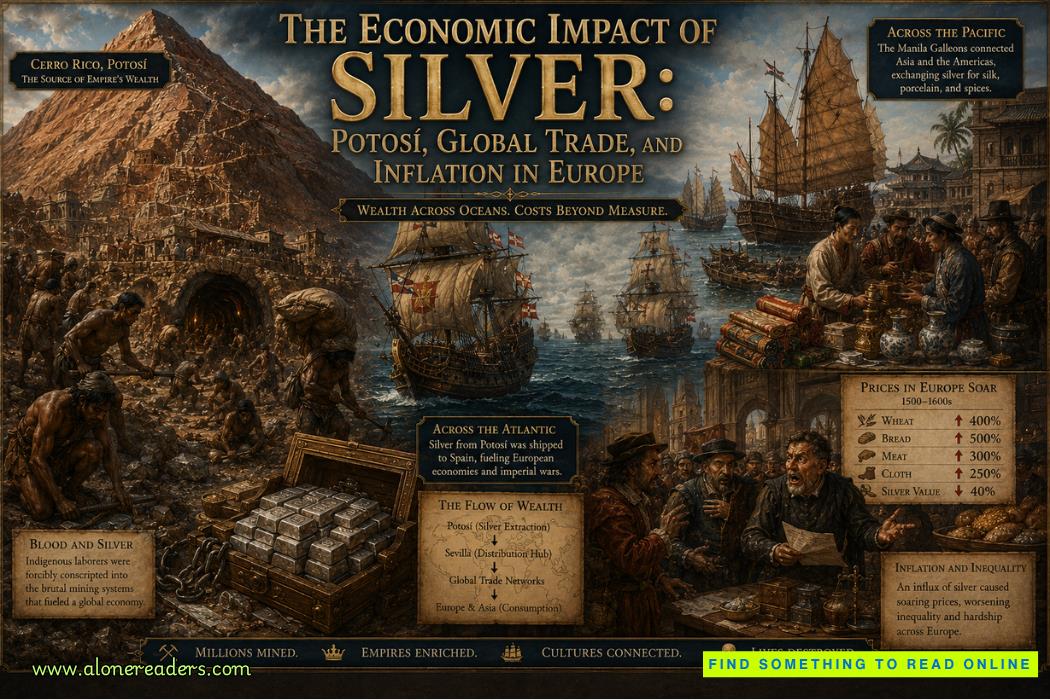
The impact of this silver flood on Europe was immediate and devastating, manifesting as what historians call the Price Revolution, a sustained period of inflation that lasted from the second half of the 16th century through the first half of the 17th century. Between 1520 and 1640, prices across Western Europe rose on average sixfold, representing an annual inflation rate of approximately 1.2 percent compounded—relatively low by modern standards but extraordinarily high for an economy that had experienced price stability for centuries following the Black Death. Spain, as the direct recipient of American silver, suffered the most severe inflation, with prices doubling in the first half of the 16th century alone before continuing their upward trajectory. The mechanism was straightforward yet profound: the massive influx of precious metals into Spain's economy increased the money supply dramatically, causing the purchasing power of silver to decline relative to agricultural and craft products. This was not merely a Spanish phenomenon; as Spanish silver flowed through the balance of payments deficit into allied European territories and eventually throughout Western Europe, inflation became a continent-wide crisis that doubled or even quadrupled prices in countries from England to France to the German states.
The human cost of this inflation was distributed brutally across social classes, creating winners and losers that reshaped European society. Those who lived on fixed incomes—the lower clergy, government officials, small hidalgo landowners, and nobles bound by traditional rent structures—found their standard of living destroyed as commodity prices rose beyond their means. Wages consistently lagged behind prices, meaning that ordinary workers could purchase significantly less with their earnings as the century progressed. Conversely, merchants, manufacturers, and those who owed fixed debts prospered enormously, as the real value of their obligations diminished each year while they could sell their goods at inflated prices. The middle class, particularly those who had borrowed money at pre-inflation interest rates, effectively saw their debts lessen in value each year while their commercial fortunes expanded. This economic redistribution weakened the traditional aristocracy while strengthening commercial classes, creating social tensions that would contribute to political upheavals across Europe in subsequent centuries.
In 1545, at an altitude of fifteen thousand feet in the frigid Andes mountains of what is now Bolivia, Spanish conquistadors discovered something that would fundamentally alter the course of human economic history: Cerro Rico, the "Rich Mountain" of Potosí, containing what would become the world's richest silver deposit. This discovery did not merely create a wealthy mining town; it ignited a global economic transformation that connected continents, triggered continent-wide inflation, and established the first truly global economy in human history. The silver extracted from Potosí would flow across oceans, fund empires, destabilize currencies, and ultimately make the world go round through its unprecedented role in international trade.
The scale of Potosí's production was almost incomprehensible to contemporaries. During its peak in the late 16th and early 17th centuries, Potosí produced nearly 60 percent of all the world's silver, a concentration of wealth that no single location had ever achieved before or since. By 1600, the city surrounding the mine housed approximately 160,000 people, making it larger than London and one of the most populous cities in the world at that time. This was not merely a mining operation but a complete urban ecosystem built entirely upon the extraction and export of silver, where indigenous laborers worked under the brutal mita system, Spanish merchants accumulated fortunes, and mercury from Huancavelica enabled the revolutionary amalgamation process that multiplied output six-fold between 1575 and 1590. The mercury amalgamation technique, invented by Spaniards in the 1550s, allowed miners to extract silver from lower-grade ore that would have been previously uneconomical, dramatically accelerating production just as European and Asian demand for silver reached critical levels.
The Spanish Crown itself became both beneficiary and victim of the silver boom, trapped in a vicious cycle of borrowing and bankruptcies that would ultimately contribute to the empire's decline. King Charles V, who served as both King of Spain and Holy Roman Emperor, borrowed enormous sums from German bankers like the Fuggers and Welsers, as well as Genoese banking families, to finance his imperial ambitions and election as Emperor. He relied primarily on the vast stream of bullion from Spanish America to repay these loans, with treasure ships arriving from Mexico and Peru carrying Aztec and Inca wealth that was typically minted into coins in Seville and transferred to German bankers in Antwerp. However, the rising costs of Habsburg wars meant that one campaign in the 1550s cost as much as an entire war in the 1520s, forcing Charles V to borrow even more at interest rates that grew from 17 percent to 48 percent. Despite the continuous flow of silver, Spain declared sovereign default in 1557, and between 1557 and 1647, Spanish kings would write off state debt multiple times, undermining confidence in the government and leaving the economy in shambles. This paradox—an empire flooded with silver yet chronically bankrupt—became a defining characteristic of Spanish imperialism in the Age of Discovery.
Yet the story of Potosí's silver extends far beyond Europe, reaching into Asia where it would find its ultimate destination and exercise its most profound economic influence. China dominated the global silver trade, absorbing approximately half of the world's silver production between 1500 and 1800. This immense demand resulted from China's monetary evolution: after the failure of paper money systems like Hong Wu Tong Bao and Da Ming Tong Bao Chao due to self-imposed inflation and counterfeiting, combined with difficulties producing copper coins, silver became the dominant currency in China by the 1540s. The Ming dynasty's shift to silver monetization, culminating in the Single Whip Reform that required taxes to be paid in silver, meant that silver eventually backed all of China's economy. The market value of silver in Ming territory was double its value elsewhere, creating enormous arbitrage profits for European and Japanese merchants who could purchase silver cheaply in the Americas or Japan and sell it at premium prices in China.
The global flow of silver created two distinct trade cycles that connected continents in unprecedented ways. The Potosí/Japan Cycle, lasting from the 1540s to the 1640s, saw silver from the Andes and Japanese mines flowing to China through multiple routes, with the Manila galleon trade reaching its peak in 1597 when trade quantity surpassed 1.2 million pesos in a single year. Spanish merchants discovered that they could exchange American silver for Chinese silk, porcelain, and other luxury goods that commanded enormous profits in European markets, creating a multiple arbitrage system that generated gross profits ranging from 100 percent to 300 percent. The second cycle, the Mexican Cycle beginning in the first half of the 1700s, emerged as Japanese mines became depleted and Mexico became China's primary silver source, coinciding with China's population boom driven by American crops like sweet potatoes, corn, and peanuts. Through these cycles, approximately 30 percent of all American silver eventually ended up in China, transforming the Middle Kingdom into the gravitational center of global commerce.
The Manila galleons exemplified the truly global nature of this silver trade, sailing annually from Acapulco in New Spain to Manila in the Philippines for 250 years, carrying American silver to exchange for Chinese goods. These massive ships, some displacing over 2,000 tons, created the first direct trade link between the Americas and Asia, bypassing European intermediaries and establishing Manila as the primary outpost for exchange between Americas, Japan, India, Indonesia, and China. Portuguese traders similarly acted as crucial middlemen, partnering with Chinese smugglers to bypass Ming maritime embargoes and transport Japanese silver to Chinese markets, with their profits from 1583 to 1591 financing Macao as Portugal's toehold off the southeast coast of China. The silver-commodities trade became essentially multiple arbitrages, where Europeans profited from price differences between Chinese silver and the rest of the world while simultaneously earning enormous profits from trading Chinese silks, ceramics, and other goods.
The economic consequences of this silver-driven global trade extended beyond mere price changes, fundamentally restructuring political power and economic systems worldwide. Adam Smith, in The Wealth of Nations (1776), analyzed how American silver discoveries affected European price levels and was impressed by the way this single commodity brought together the New and Old Worlds, noting that silver "went round the world and made the world go round." Many historians argue that silver was responsible for the birth of global economics and trade, with global trade commencing in 1571 when Manila was founded as the first trading post linking America and Asia. The silver trade put into motion wide-ranging political transformations, with New World mines supporting the Spanish empire and acting as the linchpin of Spanish economic power for over a century. However, this predominance proved temporary, as the sudden ban on Spanish silver imports to China imposed by the Qing dynasty after 1644, combined with Spain's economic stagnation and devastating losses in the Thirty Years' War, precipitated the significant decline of the Spanish Empire in the second half of the 17th century and its eclipse by France and later Great Britain.
The labor systems that enabled Potosí's extraordinary production were themselves transformative and brutal, relying heavily on indigenous Amerindian labor under the mita system in Bolivia and the repartimiento system in Mexico. Natives under the mita system were paid much less than wage laborers, which was necessary for silver production to continue in Bolivia where costs were relatively high compared to Mexico. The presence of mercury at Huancavelica coupled with cheap rotational labor made the intense production possible, with the ratio of mercury to silver produced being about two to one, and much of the mercury had to be shipped from Almadén in Spain. This exploitation of indigenous labor, combined with the environmental devastation of mercury contamination, created a human and ecological cost that accompanied the economic transformation, with tens of thousands of indigenous workers dying in the mines over the centuries of operation.
The legacy of Potosí's silver extends into the modern era in ways that continue to shape global economics. The Spanish silver peso, minted from Potosí's output, became the world's first global currency, so widespread that even the United States accepted it as valid until the Coinage Act of 1857. In the two centuries following Potosí's discovery in 1545, Spanish American silver mines produced 40,000 tons of silver, and altogether more than 150,000 tons were shipped from Potosí by the end of the 18th century. From 1500 to 1800, Bolivia and Mexico produced about 80 percent of the world's silver, creating a concentration of production that has never been replicated. The global silver trade created both economic opportunities and challenges, increasing the wealth of Spain and China while simultaneously triggering inflation that impoverished millions across Europe, demonstrating that economic globalization is neither inherently beneficial nor uniformly distributed.
The Price Revolution eventually petered out with the end of the initial rush of New World bullion, with prices remaining around or slightly below early 17th-century levels until new inflationary pressures emerged in the latter decades of the 18th century. However, the structural changes wrought by silver endured: the shift of economic power from traditional aristocracy to commercial classes, the establishment of global trade networks connecting continents, the monetization of China's economy, and the creation of financial systems based on international credit and bullion flows. The Great Potosí Mint Fraud of 1649, where officials discovered that nearly half the silver coins produced contained significantly less silver than claimed, revealed how deeply corruption and economic manipulation had penetrated the system built upon silver. Yet despite scandals, bankruptcies, and social upheaval, the silver from Potosí had already accomplished its historical mission: it had forged the first genuinely global economy, linking the Andes mountains to European cities and Asian markets in a commercial network that reorganized political structures across multiple continents and established patterns of international trade that would endure for centuries. The mountain of silver that the Spanish found accidentally when searching for El Dorado proved more valuable than any legendary city of gold, for it made the world economically interconnected in ways that fundamentally transformed human civilization and created the economic foundations for the modern global economy.



 The Hundred Days Offensive: How the Allies Defeated Germany in World War I
 The Second Battle of the Marne: The Turning Point of World War I in 1918
 The Spring Offensive of 1918: Germany's Final Gamble to Win World War I
 The Treaty of Brest-Litovsk: How Russia Left World War I
 The Russian Revolution and World War I: How War Brought Down the Tsar
 The Zimmermann Telegram Explained: Germany's Secret Offer to Mexico in World War I