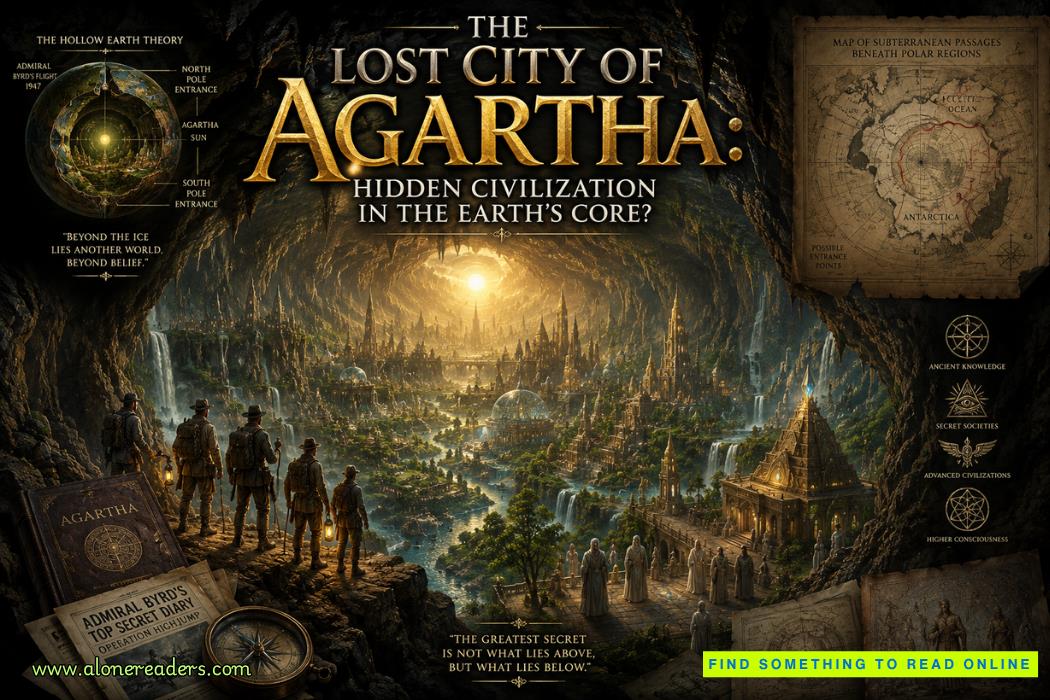
The story of Agartha occupies a unique place in the world of historical conspiracy theories. Unlike legends centered on lost treasures, vanished rulers, or hidden manuscripts, Agartha proposes something far more extraordinary: the existence of an advanced civilization living deep beneath the surface of the Earth. According to believers, this hidden kingdom lies within a vast subterranean world connected by tunnels, caverns, and secret entrances concealed in remote regions of the planet. Some versions of the legend describe Agartha as a utopian society governed by enlightened beings, while others portray it as the headquarters of mysterious powers that have secretly influenced human history for centuries.
The fascination surrounding Agartha stems from its ability to blend ancient mythology, religious traditions, esoteric philosophy, exploration narratives, and modern conspiracy theories into a single compelling narrative. Although mainstream science rejects the possibility of a habitable civilization existing within the Earth's interior, the legend continues to attract followers, researchers of the paranormal, and enthusiasts of unexplained mysteries.
The origins of Agartha are difficult to trace because the concept evolved through multiple cultural traditions over many centuries. Elements resembling the Agartha myth appear in ancient stories about hidden kingdoms, underground realms, and secret spiritual worlds. In many civilizations, underground domains were believed to exist beyond ordinary human perception. These realms often served as places of wisdom, divine knowledge, or supernatural power.
Some researchers link Agartha to ancient Buddhist and Hindu traditions. In certain interpretations of Tibetan and Central Asian folklore, references are made to hidden spiritual kingdoms inhabited by enlightened beings. One frequently cited example is the legendary kingdom of Shambhala. In Buddhist tradition, Shambhala is often described as a sacred realm where wisdom and spiritual knowledge are preserved until humanity is ready to receive them. Over time, some occult writers began connecting Shambhala with Agartha, suggesting that both referred to the same underground civilization.
The modern concept of Agartha began to take shape during the nineteenth century when European explorers, mystics, and occultists became increasingly interested in Eastern religions and hidden knowledge. During this period, numerous books and speculative works appeared claiming that ancient civilizations possessed secret information about the Earth's interior. These writings often blurred the line between mythology and supposed historical fact.
One of the most influential figures associated with the Agartha legend was the French occultist Alexandre Saint-Yves d'Alveydre. In the late nineteenth century, he described a hidden subterranean kingdom called Agartha that allegedly governed world affairs from behind the scenes. According to his account, Agartha possessed advanced scientific knowledge, spiritual wisdom, and a sophisticated social system. He claimed that its rulers maintained contact with selected individuals throughout history and subtly guided the development of civilization.
Saint-Yves portrayed Agartha as a place of extraordinary technological and spiritual advancement. Its inhabitants supposedly lived in harmony, free from war, poverty, and political corruption. The kingdom was said to preserve ancient knowledge lost to surface civilizations and serve as a repository of wisdom accumulated over thousands of years.
The idea gained additional popularity through the works of other occult writers during the late nineteenth and early twentieth centuries. These authors expanded the narrative, adding elaborate descriptions of underground cities, hidden tunnels, advanced technologies, and secret entrances located near the North and South Poles.
A central component of the Agartha myth is its connection to the Hollow Earth Theory. This theory proposes that the Earth is not entirely solid but contains vast internal spaces capable of supporting life. Some versions suggest that the planet is completely hollow, while others propose networks of enormous caverns beneath the surface.
Advocates of Hollow Earth theories often argued that the poles contained giant openings leading into the planet's interior. According to these claims, explorers who ventured far enough north or south could discover entrances to hidden worlds. Stories circulated about mysterious warm regions near the poles, unusual magnetic phenomena, and unexplained geographical observations that supposedly supported the theory.
Within this framework, Agartha became the principal civilization inhabiting the Earth's interior. Believers envisioned a sprawling network of cities connected by tunnels stretching beneath continents and oceans. Some descriptions even claimed that Agartha maintained colonies beneath major mountain ranges and deserts across the world.
The supposed inhabitants of Agartha vary depending on the source. Some accounts describe them as ordinary humans descended from ancient civilizations that retreated underground following catastrophic events. Others portray them as highly evolved beings possessing extraordinary intelligence, advanced psychic abilities, and lifespans extending hundreds or even thousands of years.
Many versions of the story claim that Agarthans developed technologies far beyond anything available on the Earth's surface. They are often said to possess advanced energy systems, anti-gravity vehicles, telepathic communication methods, and scientific knowledge capable of solving humanity's greatest challenges.
According to believers, these inhabitants deliberately remain hidden because they view surface civilization as immature, violent, and spiritually underdeveloped. Contact with humanity is supposedly restricted until the world reaches a higher level of moral and intellectual development.
Another fascinating element of the Agartha narrative involves its alleged connection to ancient civilizations. Some conspiracy theorists argue that legendary cultures such as Atlantis and Lemuria did not disappear entirely but survived by relocating underground. According to this interpretation, Agartha serves as the refuge of these lost civilizations.
In this version of events, catastrophic floods, volcanic eruptions, or global disasters destroyed surface societies thousands of years ago. Anticipating these events, advanced populations supposedly constructed underground cities and escaped into the Earth's interior. Over generations, these communities developed into the civilization now known as Agartha.
This theory attempts to explain why many ancient cultures possess myths about hidden worlds, divine teachers, and advanced knowledge appearing suddenly in human history. Believers argue that occasional contact between surface civilizations and Agartha may account for mysterious achievements in architecture, astronomy, and engineering.
The legend became even more elaborate during the twentieth century when some writers connected Agartha to secret military expeditions and geopolitical conspiracies. One of the most controversial claims involved alleged links between Agartha and Nazi Germany.
According to certain conspiracy theories, high-ranking members of the Nazi regime were deeply interested in occult knowledge and believed that hidden civilizations existed beneath the Earth. These theories claim that German expeditions to remote polar regions were secretly searching for entrances to Agartha rather than conducting ordinary scientific research.
Some versions go further, alleging that secret alliances were formed between Nazi leaders and subterranean beings. These stories often describe hidden bases, advanced flying machines, and underground facilities connected to a larger network extending beneath the globe.
Despite their popularity in conspiracy literature, no credible historical evidence supports these claims. Most historians view them as imaginative myths that emerged after World War II through a mixture of speculation, misinformation, and sensational storytelling.
The persistence of the Agartha legend raises an important question: why do people continue to believe in it despite overwhelming scientific evidence against the existence of a habitable underground world?
Part of the answer lies in humanity's enduring fascination with hidden places. Throughout history, unexplored territories have inspired stories of lost kingdoms, secret treasures, and mysterious civilizations. As the surface of the Earth became increasingly mapped and studied, the underground realm remained one of the few frontiers still capable of inspiring wonder and speculation.
The concept of Agartha also appeals to psychological and spiritual desires. The idea of a hidden civilization preserving wisdom, peace, and knowledge offers a hopeful alternative to the conflicts and challenges of modern society. In many ways, Agartha functions as a symbolic utopia—a place where humanity's highest aspirations have already been achieved.
Another factor contributing to the legend's popularity is the appeal of secret knowledge. Conspiracy theories often attract followers because they suggest access to information hidden from the general public. Believing in Agartha can create a sense of participation in a deeper reality beyond official explanations.
From a scientific perspective, the existence of Agartha faces insurmountable challenges. Modern geology provides extensive evidence regarding the structure of the Earth. Seismic waves generated by earthquakes allow scientists to study the planet's interior with remarkable precision.
These observations indicate that the Earth consists of a crust, mantle, outer core, and inner core. Temperatures increase dramatically with depth, reaching thousands of degrees Celsius in the core. Pressures become immense, making conditions unsuitable for large underground civilizations.
Furthermore, no evidence exists for the vast internal cavities required by Hollow Earth theories. Geological surveys, seismic data, and decades of scientific research consistently support the current understanding of the Earth's internal structure.
Modern exploration technologies have also significantly reduced the likelihood of hidden entrances to massive subterranean worlds. Satellite imaging, aerial surveys, and advanced mapping techniques have examined remote regions of the planet in unprecedented detail.
Despite these scientific findings, the Agartha myth remains resilient. Books, documentaries, online forums, podcasts, and social media continue to spread new interpretations of the legend. Some modern versions incorporate extraterrestrial themes, suggesting that Agartha serves as a base for alien visitors or interdimensional beings.
Others reinterpret the story metaphorically, viewing Agartha not as a physical location but as a symbol of hidden consciousness, spiritual awakening, or humanity's untapped potential. In these interpretations, the underground kingdom represents an inner journey rather than a geographical destination.
The legend has also influenced popular culture. Numerous novels, films, television series, and video games draw inspiration from the idea of hidden worlds beneath the Earth. These fictional adaptations often blend elements of Agartha, Hollow Earth theories, lost civilizations, and ancient mysteries to create compelling narratives.
What makes Agartha particularly enduring among historical conspiracy theories is its remarkable flexibility. It can function simultaneously as mythology, spiritual allegory, adventure story, occult doctrine, alternative history, and modern conspiracy theory. Each generation adapts the legend to reflect contemporary interests and concerns.
In an age dominated by scientific discovery and technological advancement, Agartha continues to remind us that mystery still holds a powerful place in human imagination. Whether viewed as a literal hidden civilization, a symbolic representation of lost wisdom, or simply an entertaining legend, the story reflects humanity's enduring desire to believe that extraordinary secrets remain undiscovered.
Ultimately, the Lost City of Agartha remains one of history's most fascinating conspiracy legends. There is no scientific evidence supporting the existence of a vast civilization beneath the Earth's surface, nor is there credible proof of hidden entrances leading to a subterranean kingdom. Yet the myth persists because it speaks to something deeper than geology or archaeology. It embodies the timeless hope that beyond the known world lies a realm of wonder, wisdom, and possibility waiting to be revealed. As long as people continue to dream of hidden kingdoms and forgotten knowledge, the legend of Agartha will likely remain alive, captivating those who dare to imagine what might exist beneath their feet.




 The Hundred Days Offensive: How the Allies Defeated Germany in World War I
 The Second Battle of the Marne: The Turning Point of World War I in 1918
 The Spring Offensive of 1918: Germany's Final Gamble to Win World War I
 The Treaty of Brest-Litovsk: How Russia Left World War I
 The Russian Revolution and World War I: How War Brought Down the Tsar
 The Zimmermann Telegram Explained: Germany's Secret Offer to Mexico in World War I