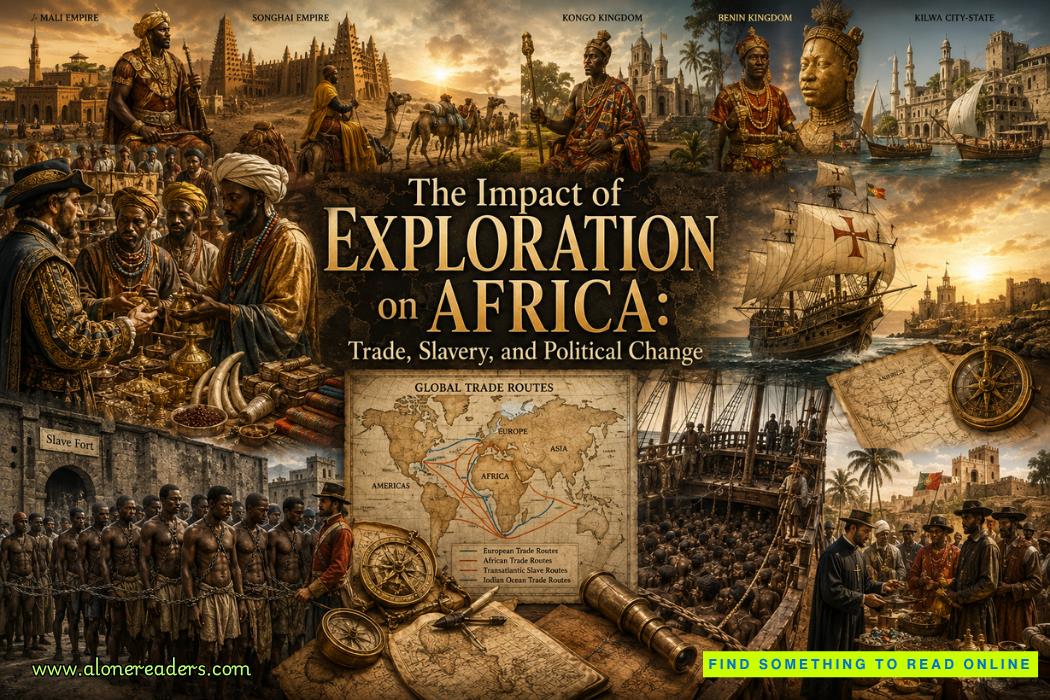
When European explorers began sailing along the African coast during the fifteenth century, they entered a continent that was already home to powerful kingdoms, flourishing commercial networks, sophisticated political systems, and vibrant cultural traditions. Africa was not an isolated land waiting to be discovered. For centuries, its merchants had traded across the Sahara Desert, the Red Sea, the Nile Valley, and the Indian Ocean. Kingdoms such as Mali, Songhai, Benin, Kongo, Ethiopia, and the Swahili city-states had accumulated wealth through commerce, agriculture, mining, and diplomacy. The arrival of Portuguese navigators and, later, Spanish, Dutch, English, and French merchants dramatically altered these established systems. European exploration transformed Africa into a central component of an emerging global economy, bringing new commercial opportunities while also unleashing one of history's greatest human tragedies through the transatlantic slave trade.
Before European maritime exploration expanded along the African coastline, trade routes across the Sahara had connected West Africa with North Africa and the Mediterranean for centuries. Gold mined from regions such as Bambuk and Bure traveled north in exchange for salt, horses, textiles, and luxury goods. Meanwhile, East African ports including Kilwa, Mombasa, Sofala, and Zanzibar maintained profitable trade with Arabia, Persia, India, and China through the Indian Ocean monsoon system. African merchants exported ivory, gold, timber, animal skins, iron, and precious stones while importing ceramics, silk, spices, and manufactured goods. These commercial systems had already integrated many African societies into international trade long before European ships appeared.
Portuguese exploration under Prince Henry the Navigator marked the beginning of sustained European contact with sub-Saharan Africa. Portuguese captains gradually explored farther south, establishing trading relationships along the coast rather than immediately attempting territorial conquest. Their primary objectives included locating gold sources, bypassing Muslim-controlled overland trade routes, spreading Christianity, and ultimately finding a sea route to Asia. Coastal trading posts were established at strategic locations, allowing Portugal to purchase African commodities directly without relying on intermediaries.
Initially, European interest focused primarily on gold, ivory, pepper, and other valuable commodities rather than territorial expansion. Portuguese merchants traded textiles, metal tools, firearms, beads, and manufactured goods in exchange for African resources. This commerce generated enormous profits while strengthening commercial links between Europe and Africa. Some African rulers welcomed these new trading opportunities because they diversified existing markets and increased royal revenues. Diplomatic exchanges became increasingly common, with ambassadors traveling between African kingdoms and European courts.
Among the most significant political partnerships developed during this period was the relationship between Portugal and the Kingdom of Kongo. King Nzinga a Nkuwu accepted Christianity in the late fifteenth century, and his successor, King Afonso I, actively promoted Christian institutions while maintaining diplomatic correspondence with the Portuguese monarchy. European missionaries introduced literacy based on the Latin alphabet, Christian education, and administrative practices that influenced parts of the royal government. These exchanges demonstrated that African rulers often negotiated with Europeans as sovereign political equals rather than passive subjects.
However, the nature of European-African relations changed profoundly as demand for labor in the Americas increased following the discovery and colonization of the New World. Sugar plantations in the Atlantic islands and later in Brazil and the Caribbean required an enormous labor force. Indigenous American populations suffered catastrophic declines because of disease, warfare, and forced labor, leading European colonists to seek alternative sources of workers. Africa gradually became the principal supplier of enslaved labor for expanding plantation economies.
The transatlantic slave trade soon became the defining feature of European involvement in much of West and Central Africa. European merchants established fortified coastal trading posts where enslaved Africans were purchased from local intermediaries before being transported across the Atlantic Ocean. Unlike earlier forms of slavery that had existed in various societies throughout history, the Atlantic slave trade operated on an unprecedented industrial scale. Millions of African men, women, and children were forcibly removed from their homes, permanently altering the demographic, economic, and social development of entire regions.
Many African societies became increasingly involved in this expanding slave economy, although participation varied considerably between kingdoms and regions. Some rulers attempted to restrict or regulate slave exports, while others actively participated because the trade generated substantial wealth and provided access to European firearms and manufactured goods. Political leaders often used imported weapons to strengthen their military forces, defend territories, or expand their influence over neighboring communities. As a result, competition between states intensified, and warfare increasingly became linked to capturing prisoners for sale into slavery.
The introduction of firearms significantly changed regional power dynamics. European weapons allowed some kingdoms to dominate rivals, creating cycles of conquest and retaliation. States that controlled access to coastal trade frequently gained military and economic advantages over inland competitors. Political authority increasingly depended upon controlling commercial routes, maintaining European alliances, and participating in Atlantic commerce. While some kingdoms experienced periods of remarkable prosperity, others suffered fragmentation, repeated invasions, and long-term instability.
The Kingdom of Benin presents an important example of selective engagement with European trade. Initially renowned for exporting ivory, pepper, coral, and magnificent bronze artworks, Benin carefully managed its commercial relationships with Portuguese merchants. The kingdom restricted certain forms of trade and maintained considerable political independence for centuries. This demonstrated that African states possessed agency and could shape foreign interactions according to their own interests, at least during the early phases of European expansion.
In contrast, the Kingdom of Kongo increasingly struggled to control Portuguese influence. King Afonso I repeatedly complained about unauthorized slave traders who ignored royal authority and kidnapped free subjects. His letters reveal growing frustration as the slave trade undermined political stability and weakened centralized government. Despite efforts to regulate commerce, European demand for enslaved labor continued to expand, making effective control increasingly difficult.
Along Africa's eastern coast, Portuguese naval power disrupted long-established Indian Ocean trade networks. Several Swahili city-states faced military attacks, forced tribute, or direct occupation as Portugal sought to monopolize maritime commerce. Portuguese fortresses were constructed at strategic ports to control shipping routes connecting East Africa with India. Although local merchants continued participating in regional trade, Portuguese interference altered commercial patterns that had existed for centuries under Arab, Persian, African, and Indian merchants.
The economic consequences of exploration were deeply complex. Coastal regions connected to Atlantic commerce often accumulated imported goods, new technologies, and foreign wealth. European textiles, metal products, firearms, alcohol, and luxury items became increasingly common in many trading centers. Yet the emphasis on exporting enslaved people rather than developing local industries diverted human resources away from agriculture, craftsmanship, and technological innovation. Productive populations declined in many regions as millions of working-age individuals disappeared through slavery.
Demographic losses represented one of the most devastating long-term consequences. Entire villages were abandoned as communities fled slave raids or migrated into more defensible territories. Agricultural production declined in affected regions, while family structures and traditional leadership systems suffered severe disruption. The constant fear of capture reshaped settlement patterns, encouraging fortified towns and reducing economic cooperation between neighboring societies. Generations of skilled farmers, artisans, soldiers, scholars, and community leaders were permanently removed from African societies.
European exploration also introduced new religious and cultural influences. Christian missionaries established churches, schools, and religious communities in several African kingdoms, particularly where rulers embraced diplomatic relations with European powers. While Christianity spread successfully in some areas, traditional African beliefs remained deeply rooted and often blended with Christian practices, producing unique forms of religious expression. Cultural exchanges occurred through language, education, architecture, and artistic traditions, although these developments varied significantly across different regions.
Politically, exploration marked the beginning of increasing European involvement in African affairs. During the fifteenth and sixteenth centuries, Europeans generally lacked the military capacity to conquer large inland territories and instead relied upon negotiation with African rulers. However, the economic dependence created by Atlantic commerce gradually expanded European influence. Coastal forts, commercial monopolies, naval superiority, and diplomatic alliances established patterns that later facilitated nineteenth-century colonial expansion. The Age of Discovery therefore laid many of the foundations upon which European imperialism would later be built.
It is important to recognize that Africa's experience during the Age of Discovery was neither uniform nor entirely negative. Many kingdoms demonstrated remarkable adaptability, negotiating profitable commercial relationships while preserving political independence for extended periods. African merchants remained active participants in global trade, and numerous societies continued flourishing despite external pressures. Nevertheless, the overwhelming expansion of the slave trade produced consequences that ultimately overshadowed many earlier commercial benefits.
The impact of European exploration on Africa was therefore profoundly transformative. New maritime routes connected African economies more directly to Europe, Asia, and the Americas than ever before, expanding international commerce and introducing new goods, technologies, and diplomatic relationships. At the same time, the rise of the transatlantic slave trade fundamentally reshaped African political systems, economies, and societies, causing demographic devastation and encouraging prolonged conflict. The Age of Discovery integrated Africa into an increasingly interconnected world, but it did so under conditions that generated both opportunity and immense human suffering. Its legacy remains visible in the continent's political boundaries, economic structures, cultural diversity, and historical memory, making it one of the most consequential chapters in both African history and the history of global exploration.




 The Hundred Days Offensive: How the Allies Defeated Germany in World War I
 The Second Battle of the Marne: The Turning Point of World War I in 1918
 The Spring Offensive of 1918: Germany's Final Gamble to Win World War I
 The Treaty of Brest-Litovsk: How Russia Left World War I
 The Russian Revolution and World War I: How War Brought Down the Tsar
 The Zimmermann Telegram Explained: Germany's Secret Offer to Mexico in World War I










