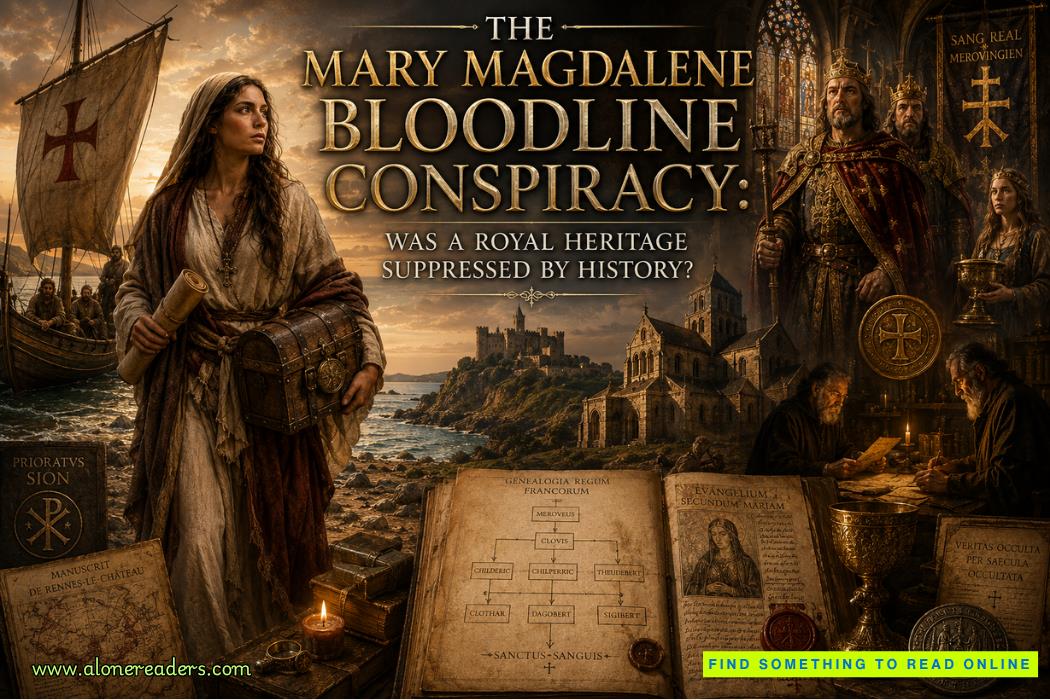
The story of Mary Magdalene occupies a unique place in Christian history. For nearly two thousand years she has been remembered as one of the most devoted followers of Jesus, a witness to his crucifixion, and according to Christian tradition, one of the first people to encounter the resurrected Christ. Yet beyond the accepted historical and religious accounts lies a much more controversial narrative—one that has inspired books, documentaries, films, and countless debates. This alternative narrative claims that Mary Magdalene was not merely a disciple but the wife of Jesus, the mother of his children, and the ancestor of a hidden royal bloodline that survived through the centuries. According to proponents of the theory, this lineage was deliberately concealed by powerful religious and political institutions. The resulting idea has become known as the Mary Magdalene Bloodline Conspiracy.
The conspiracy theory combines elements of religion, medieval legends, secret societies, European royal history, and alleged cover-ups by powerful institutions. While mainstream historians reject the theory due to the lack of credible evidence, it remains one of the most fascinating and enduring historical conspiracies of modern times.
At the center of the theory stands Mary Magdalene herself, a figure whose historical identity has long been surrounded by misunderstanding. In the canonical Christian Gospels, Mary Magdalene appears as a devoted follower of Jesus. She is present during crucial moments of his ministry and is portrayed as an important witness to events surrounding his death and resurrection. However, the Gospels do not describe her as Jesus' wife, nor do they mention any children.
Supporters of the bloodline theory argue that the absence of such information does not necessarily prove it never existed. They suggest that early Church authorities intentionally removed or suppressed references that would have revealed a familial relationship between Jesus and Mary Magdalene. According to this interpretation, the emerging Christian Church preferred a theological image of Jesus that emphasized his divine nature and celibacy, making any mention of marriage politically and doctrinally inconvenient.
The theory gained significant momentum through interpretations of certain ancient texts discovered outside the traditional biblical canon. Among these are several Gnostic writings dating from the early centuries of Christianity. Some of these texts portray Mary Magdalene as a particularly close companion of Jesus and suggest that she held an important leadership role among his followers.
Advocates of the conspiracy frequently point to passages that describe Jesus showing special affection toward Mary Magdalene. They argue that these references indicate a marital relationship. However, most scholars caution against such conclusions, noting that the language used in these texts often carries symbolic or spiritual meanings rather than romantic implications.
Despite scholarly skepticism, these writings helped create fertile ground for alternative theories. Over time, the image of Mary Magdalene evolved from devoted disciple to potential spouse, and eventually to the alleged mother of a sacred bloodline.
According to the conspiracy narrative, events took a dramatic turn following the crucifixion of Jesus. The theory claims that Mary Magdalene, pregnant with Jesus' child, fled the Holy Land to escape persecution. Her destination was supposedly southern Gaul, a region corresponding to modern-day southern France.
Legends from parts of France have long suggested that Mary Magdalene arrived on the Mediterranean coast after crossing the sea in a small boat. Local traditions in Provence preserve stories connecting her to the region, and several churches and pilgrimage sites are dedicated to her memory.
Bloodline theorists expand these legends considerably. They claim that Mary arrived in France carrying not only sacred teachings but also the unborn child of Jesus. In this version of history, she established a new life in Gaul, and her descendants eventually merged with influential local families.
The next stage of the theory involves one of Europe's most mysterious royal dynasties—the Merovingians. The Merovingian kings ruled large portions of what would become France and Germany between the fifth and eighth centuries. Their origins are surrounded by legends, myths, and unusual stories that have intrigued historians for centuries.
Conspiracy proponents argue that the Merovingians were not merely another royal family. Instead, they claim the dynasty descended directly from Jesus and Mary Magdalene through generations of hidden ancestry. This alleged connection supposedly gave the Merovingian kings a unique and sacred legitimacy.
Within the conspiracy framework, the Merovingians represented the continuation of a bloodline that powerful forces sought both to protect and conceal. Their eventual decline is often interpreted as part of a broader struggle over control of this secret heritage.
One of the most influential elements of the bloodline conspiracy emerged during the twentieth century through writings that connected the theory to the concept of the Holy Grail. Traditionally, the Holy Grail was understood as the cup used by Jesus during the Last Supper. However, alternative interpretations proposed a radically different meaning.
According to this theory, the Holy Grail was not a physical object at all. Instead, it symbolized Mary Magdalene herself. The word "grail" was reinterpreted as representing a sacred bloodline. In this view, the true treasure was not a cup but the descendants of Jesus.
This reinterpretation transformed medieval Grail legends into alleged clues pointing toward a hidden royal lineage. Ancient stories, knightly quests, and mysterious symbols were reexamined through this lens, leading believers to conclude that generations of secret guardians had protected the bloodline.
The notion of hidden guardians introduced another key element of the conspiracy: secret societies. Among these organizations, none has received more attention than the alleged Priory of Sion.
According to conspiracy literature, the Priory of Sion was a secret organization dedicated to protecting the descendants of Jesus and Mary Magdalene. It supposedly preserved genealogical records, safeguarded ancient documents, and worked behind the scenes throughout European history.
The organization was claimed to have included famous historical figures among its leaders, including artists, scientists, and intellectuals. These assertions added further intrigue to the story and suggested that influential individuals had long been aware of hidden truths unavailable to the public.
However, investigations eventually revealed that many of the documents supporting the existence of the Priory of Sion were modern fabrications. Historians uncovered evidence indicating that the organization itself was largely the creation of twentieth-century individuals rather than an ancient secret society.
Despite these revelations, the Priory of Sion remains deeply embedded in popular versions of the bloodline conspiracy.
Another important aspect of the theory concerns the role of the institutional Church. Advocates frequently claim that Church authorities intentionally suppressed evidence relating to Mary Magdalene's status and descendants.
According to this argument, acknowledging a bloodline descending from Jesus would challenge traditional theological doctrines and potentially undermine ecclesiastical authority. Therefore, Church leaders allegedly destroyed documents, altered records, and promoted alternative narratives to conceal the truth.
Supporters point to historical examples of religious censorship, doctrinal disputes, and the exclusion of certain writings from the biblical canon as evidence that such suppression was possible.
Critics respond that extraordinary claims require extraordinary evidence. While historical institutions have certainly controlled information at various times, no reliable documentation has emerged demonstrating a coordinated effort to hide a bloodline descended from Jesus.
The debate highlights a recurring feature of conspiracy theories: the idea that missing evidence is itself evidence of suppression. This reasoning makes such theories difficult to disprove because any lack of proof can be interpreted as confirmation of a successful cover-up.
The popularity of the Mary Magdalene bloodline conspiracy increased dramatically during the late twentieth and early twenty-first centuries. Books exploring alternative religious histories attracted widespread audiences, while television documentaries introduced millions of viewers to the theory.
The phenomenon reached unprecedented levels with the publication of The Da Vinci Code, which presented many of the bloodline concepts within a fictional thriller narrative. The novel suggested that Mary Magdalene and Jesus had descendants whose existence was protected by secret societies and concealed by powerful institutions.
Although the book openly described itself as fiction, its blend of historical references and conspiracy themes led many readers to investigate the underlying claims. As a result, public awareness of the theory expanded far beyond academic or fringe circles.
The enormous success of such works demonstrates the enduring appeal of hidden-history narratives. People are often drawn to stories that promise secret knowledge, challenge accepted accounts, and offer dramatic reinterpretations of familiar events.
From a historical perspective, however, significant problems remain. Professional historians emphasize that no contemporary evidence supports the claim that Jesus was married to Mary Magdalene or that they had children. Likewise, no verified genealogical records connect the Merovingian dynasty to first-century Judea.
The chronological gaps are substantial, and the documentary evidence presented by conspiracy proponents is generally considered unreliable or speculative. Many alleged proofs rely on symbolic interpretations, legends recorded centuries after the supposed events, or documents whose authenticity has been questioned.
Scholars also note that ancient sources frequently elevated important religious figures through symbolic language. Close relationships described in spiritual texts should not automatically be interpreted as evidence of marriage or biological descent.
Nevertheless, the persistence of the conspiracy reveals something important about human curiosity. The theory appeals because it addresses enduring questions about faith, power, secrecy, and identity. It invites people to imagine that beneath the official version of history lies another story waiting to be uncovered.
In many ways, the Mary Magdalene bloodline conspiracy functions as a modern myth. It combines historical figures, legendary traditions, political intrigue, and hidden knowledge into a narrative that resonates with contemporary audiences. Whether viewed as speculative history, cultural folklore, or imaginative storytelling, it continues to inspire fascination.
The enduring mystery surrounding Mary Magdalene contributes significantly to the theory's survival. Unlike many historical figures whose lives are extensively documented, she remains partially obscured by limited evidence and centuries of interpretation. This uncertainty creates space for alternative narratives to flourish.
Ultimately, the question of whether a royal bloodline descended from Jesus and Mary Magdalene was deliberately suppressed remains firmly within the realm of conspiracy theory rather than established history. No credible evidence has emerged to verify the existence of such a lineage, and mainstream scholarship overwhelmingly rejects the claim.
Yet the theory endures because it sits at the crossroads of religion, history, mystery, and imagination. It challenges accepted narratives, invites speculation about hidden truths, and transforms one of Christianity's most important figures into the centerpiece of an extraordinary secret-history narrative. Whether regarded as a genuine possibility, a cultural legend, or a fascinating modern myth, the Mary Magdalene Bloodline Conspiracy remains one of the most compelling and widely discussed historical conspiracy theories ever created.




 The Hundred Days Offensive: How the Allies Defeated Germany in World War I
 The Second Battle of the Marne: The Turning Point of World War I in 1918
 The Spring Offensive of 1918: Germany's Final Gamble to Win World War I
 The Treaty of Brest-Litovsk: How Russia Left World War I
 The Russian Revolution and World War I: How War Brought Down the Tsar
 The Zimmermann Telegram Explained: Germany's Secret Offer to Mexico in World War I










