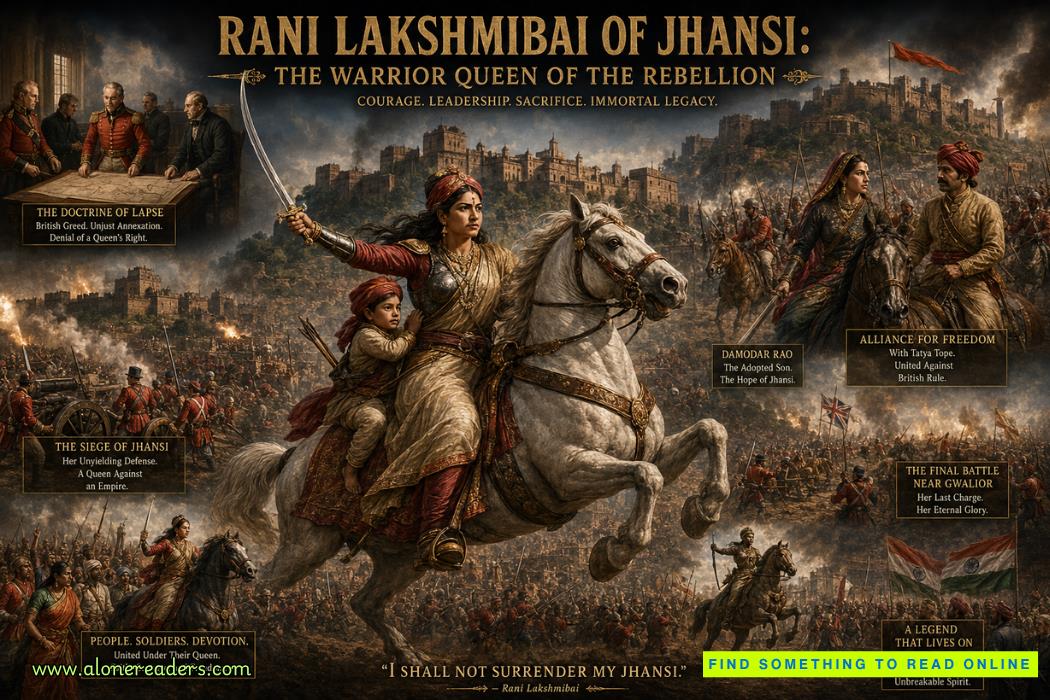
Rani Lakshmibai of Jhansi occupies a unique place in the history of the Indian Rebellion of 1857. Few figures from the uprising have achieved such enduring fame, both within India and beyond. During her lifetime, she was a regional ruler confronted by a political crisis created by the expansion of British power. After her death, she became a legend whose story transcended the immediate circumstances of the rebellion. To supporters, she embodied courage, loyalty, and resistance against foreign domination. To many British observers of the nineteenth century, she was a formidable and dangerous adversary whose military skill demanded reluctant respect. The enduring fascination with Lakshmibai arises not only from her dramatic battlefield exploits but also from the larger questions her life raises about empire, sovereignty, gender, and memory.
The story of Lakshmibai cannot be understood without examining the changing political landscape of India in the decades preceding the rebellion. By the middle of the nineteenth century, the British East India Company had become the dominant political power across much of the Indian subcontinent. Through military conquest, alliances, and administrative expansion, the Company steadily absorbed territories previously ruled by Indian dynasties. One of the most controversial policies associated with this expansion was the Doctrine of Lapse, strongly promoted by Governor-General Lord Dalhousie. According to this principle, if a ruler of a princely state died without a natural male heir, the Company could annex the territory and refuse recognition of an adopted successor.
Jhansi, located in the Bundelkhand region of central India, became one of the states affected by this policy. Lakshmibai was born as Manikarnika Tambe around 1828 in Varanasi. Raised in an environment that differed from conventional expectations for girls of the period, she received training in horse riding, swordsmanship, and martial exercises. These skills would later contribute significantly to her reputation. Following her marriage to Maharaja Gangadhar Rao Newalkar of Jhansi, she became known as Lakshmibai, the queen of the state.
The turning point in her political life came after the death of her infant son and the deteriorating health of her husband. Shortly before his death in 1853, Gangadhar Rao adopted a young boy named Damodar Rao as his heir. The adoption followed long-established Indian traditions and was formally communicated to British authorities. Nevertheless, Dalhousie refused to recognize the adopted child as the legitimate successor. In 1854, Jhansi was annexed by the East India Company. Lakshmibai was granted a pension and ordered to surrender administrative control. According to later accounts, she protested vigorously against the decision and is often associated with the declaration that she would not give up her kingdom.
The annexation created deep resentment, but Lakshmibai initially did not openly rebel. For several years she attempted to negotiate with British authorities and preserve her position through legal and diplomatic channels. This aspect of her story is important because it challenges simplistic portrayals that depict her as an immediate revolutionary. Like many Indian rulers affected by British expansion, she first sought accommodation before circumstances pushed her toward armed resistance.
The outbreak of the Indian Rebellion of 1857 transformed the political environment. The uprising began among Indian soldiers of the East India Company army and rapidly spread across northern and central India. Discontent over military grievances, fears regarding religious interference, economic pressures, and political annexations combined to produce a widespread revolt.
In June 1857, the situation in Jhansi became volatile. Indian soldiers stationed in the town rebelled against British authority. Several British officers and civilians were killed during the disturbances. The precise role of Lakshmibai in these events remains one of the most debated issues in the historiography of the rebellion. Some British accounts accused her of involvement in the killings. Other evidence suggests that she was unable to control the mutinous troops and may even have attempted to maintain order. Modern historians remain divided, though many argue that definitive proof of direct responsibility is lacking.
Following the collapse of British authority in Jhansi, Lakshmibai found herself governing a state surrounded by uncertainty and conflict. She organized administrative structures, raised military forces, strengthened fortifications, and sought to preserve stability. Her position was precarious. Neighboring rulers viewed Jhansi as vulnerable, while British authorities increasingly regarded her with suspicion.
During the following months, Lakshmibai emerged as one of the most capable leaders in central India. She recruited soldiers, assembled artillery, and worked to strengthen the defenses of Jhansi Fort. Contemporary accounts suggest that she personally reviewed troops and participated actively in military preparations. Her leadership was notable not merely because she was a woman in a predominantly male political and military world, but because she demonstrated administrative competence during an exceptionally turbulent period.
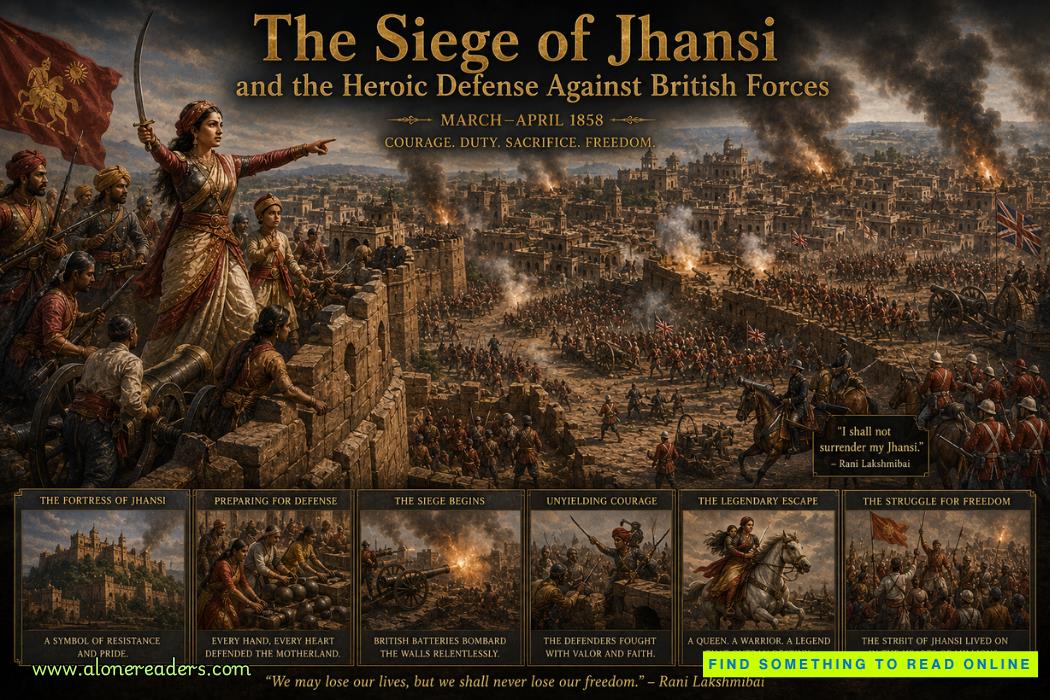
The decisive confrontation came in March 1858, when British forces under Sir Hugh Rose advanced toward Jhansi as part of a broader campaign to suppress the rebellion in central India. Rose commanded experienced troops equipped with artillery and supported by a disciplined military structure. Jhansi faced a formidable challenge.
The Siege of Jhansi, fought between March and April 1858, became one of the most famous episodes of the rebellion. British artillery bombarded the city's defenses while defenders attempted to repel repeated attacks. Lakshmibai coordinated resistance efforts and became the symbolic center of the defense. Reports from both Indian and British sources describe extraordinary determination among the defenders.
The siege demonstrated the broader dynamics of the rebellion. While rebel forces often possessed courage and local support, they frequently struggled against British advantages in organization, logistics, and military resources. Lakshmibai understood the importance of external assistance and sought aid from other rebel leaders.
One of the most significant figures to answer this call was Tatya Tope, among the leading military commanders associated with the rebellion and a close ally of Nana Sahib. Tatya Tope attempted to relieve Jhansi by advancing with a substantial force. However, British troops intercepted and defeated his army before it could break the siege. This failure left Jhansi isolated.
As British troops breached the defenses in early April, the city faced imminent collapse. Lakshmibai made the decision that would become one of the defining moments of her legend. Rather than surrender, she escaped from the fort with a small group of followers. Popular tradition holds that she carried her adopted son Damodar Rao with her during the escape, though details vary among accounts. Whether embellished or entirely accurate, the story became a powerful symbol of maternal devotion and heroic resistance.
After escaping Jhansi, Lakshmibai joined forces with Tatya Tope and other rebel leaders. Together they continued resistance across central India. The rebellion had by this stage entered a new phase. Major centers such as Delhi had fallen to British forces, but resistance persisted in several regions.
In May and June 1858, rebel forces achieved one of their most significant successes by capturing Gwalior, one of the most important cities in central India. The ruler of Gwalior, Maharaja Jayajirao Scindia, was allied with the British, but portions of his army defected to the rebels. The capture of the city provided the rebellion with a temporary political and military boost.
Lakshmibai played a crucial role in these operations. British observers increasingly viewed her as one of the rebellion's most dangerous leaders. Her ability to inspire troops, coordinate military action, and maintain resistance despite repeated setbacks distinguished her from many contemporaries.
The success at Gwalior, however, proved short-lived. British forces quickly regrouped and launched a counteroffensive. The final chapter of Lakshmibai's life unfolded during the battles around the city in June 1858.
On 17 June 1858, near Kotah-ki-Serai outside Gwalior, Lakshmibai fought what became her last battle. Accounts differ regarding the exact circumstances of her death. Most agree that she participated directly in combat and was mortally wounded while resisting advancing British troops. According to several traditions, her supporters cremated her body quickly to prevent its capture.
Her death at approximately thirty years of age transformed her from a political leader into a martyr figure. Even British officers who fought against her acknowledged her courage. Hugh Rose famously described her as one of the most remarkable leaders produced by the rebellion. Such praise from an adversary contributed significantly to her posthumous reputation.
The principal figures associated with Lakshmibai's story illuminate the complex political world of 1857. Lord Dalhousie represented the aggressive expansionism of Company rule. Gangadhar Rao's death triggered the succession dispute that destabilized Jhansi. Damodar Rao symbolized the contested legitimacy at the heart of the conflict. Tatya Tope embodied the military dimension of rebel resistance, while Hugh Rose represented the determined British effort to restore imperial authority.
Historical interpretations of Lakshmibai have evolved considerably over time. Nineteenth-century British narratives often portrayed her through the lens of imperial conflict, emphasizing alleged involvement in violence against Europeans. Early Indian nationalist writers, by contrast, celebrated her as a heroic patriot who consciously fought for national freedom. Modern scholarship generally adopts a more nuanced position.
Many historians argue that Lakshmibai's initial objective was the preservation of Jhansi's sovereignty rather than the creation of a unified Indian nation-state, a concept that had not yet fully emerged. From this perspective, her actions reflected the concerns of a regional ruler defending dynastic rights against colonial expansion. Yet it would be equally misleading to reduce her motivations solely to personal interests. As the rebellion expanded, broader questions of political autonomy, resistance to foreign rule, and defense of traditional authority became intertwined.
Another important debate concerns gender and leadership. Lakshmibai's prominence challenges assumptions about women's roles in nineteenth-century South Asian politics. While exceptional, she was not entirely without precedent. Women had exercised authority in various Indian states before her. Nevertheless, the scale of her military leadership during a major conflict made her remarkable even by contemporary standards. Her image as a queen leading cavalry charges became central to later representations of female courage and political agency.
The immediate consequences of her death reflected the broader fate of the rebellion. British forces soon regained control of Gwalior, and organized resistance in central India steadily collapsed. By mid-1858, the rebellion had largely been suppressed. The East India Company itself was abolished, and governance of India passed directly to the British Crown under the provisions of the Government of India Act of 1858. The uprising prompted major changes in military organization, administrative policy, and imperial governance.
Yet Lakshmibai's influence extended far beyond these immediate outcomes. During the late nineteenth and early twentieth centuries, her memory became increasingly important within emerging Indian nationalist movements. Writers, poets, and political activists portrayed her as a symbol of resistance against colonial rule. Her story appeared in literature, popular culture, educational materials, and political speeches.
Perhaps no representation proved more influential than the patriotic poetry that celebrated her courage and sacrifice. These works helped transform historical memory into national mythology. By the time the struggle for Indian independence intensified during the twentieth century, Lakshmibai had become one of its most powerful historical icons.
Her legacy also transcended political symbolism. She came to represent ideals of bravery, determination, and leadership that resonated across generations. Military units, educational institutions, public monuments, and commemorative events have preserved her memory throughout India. Historians continue to debate aspects of her career, but few question her significance.
The enduring appeal of Lakshmibai lies partly in the dramatic nature of her life. She was a queen denied recognition of her adopted heir, a ruler forced to confront imperial expansion, a military leader who defended her state against overwhelming odds, and a warrior who died on the battlefield rather than surrender. These elements combine to create a narrative of extraordinary power.
Within the broader history of the Indian Rebellion of 1857, Rani Lakshmibai stands as one of its defining figures. Her story illustrates the complex interplay of local grievances, imperial ambitions, personal leadership, and military conflict that shaped the uprising. Whether viewed as a defender of dynastic rights, a regional resistance leader, a proto-nationalist heroine, or a symbol of female empowerment, her historical importance remains undeniable. More than a century and a half after her death, the Warrior Queen of Jhansi continues to embody the courage, sacrifice, and determination that made the rebellion of 1857 one of the most consequential events in the history of modern India.



 The Hundred Days Offensive: How the Allies Defeated Germany in World War I
 The Second Battle of the Marne: The Turning Point of World War I in 1918
 The Spring Offensive of 1918: Germany's Final Gamble to Win World War I
 The Treaty of Brest-Litovsk: How Russia Left World War I
 The Russian Revolution and World War I: How War Brought Down the Tsar
 The Zimmermann Telegram Explained: Germany's Secret Offer to Mexico in World War I