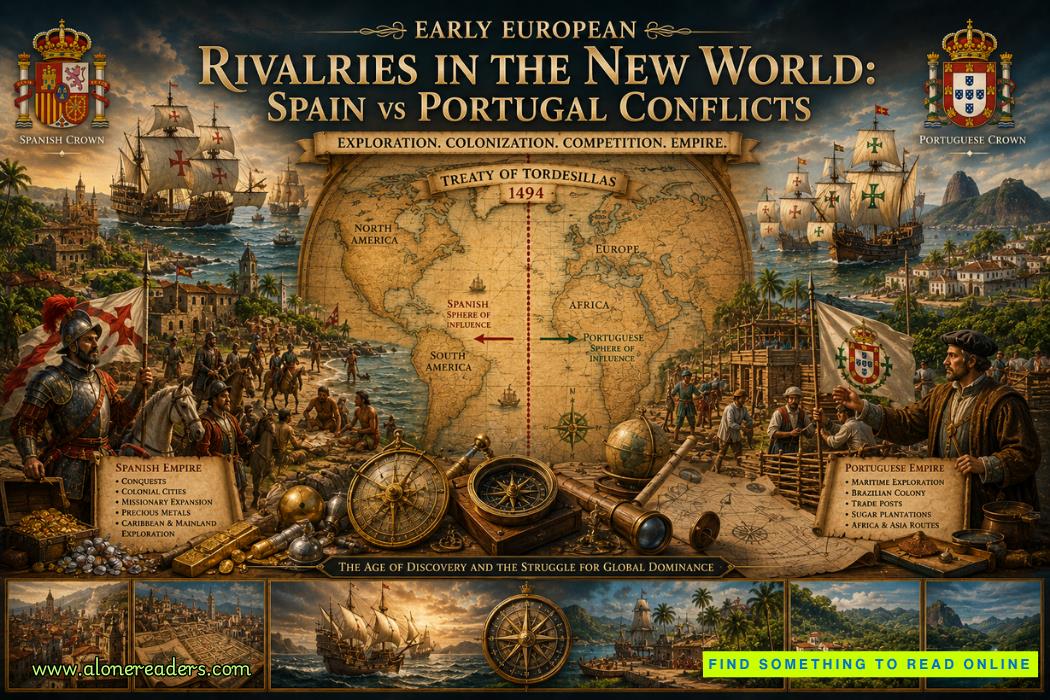
The European discovery of the Americas unleashed one of the most significant geopolitical rivalries in world history. Among the first powers to compete for influence in the newly revealed lands were Spain and Portugal, two neighboring kingdoms located on the Iberian Peninsula. Their competition was not merely a struggle for territory. It was a contest over trade, wealth, prestige, religious influence, maritime supremacy, and the future shape of the emerging global order. During the late fifteenth and sixteenth centuries, these two kingdoms transformed from regional powers into vast overseas empires, and their rivalry in the New World helped define the Age of Discovery.
The roots of the conflict stretched back before the discovery of the Americas. During the fifteenth century, Portugal had established itself as Europe's leading maritime power. Under the guidance of Prince Henry the Navigator and later Portuguese monarchs, explorers gradually advanced down the western coast of Africa. Portuguese navigators developed new sailing techniques, improved maps, and expanded knowledge of ocean currents. Their goal was to reach the riches of Asia by sailing around Africa while avoiding traditional land routes controlled by rival powers.
Spain, meanwhile, emerged from the long Reconquista against Muslim states on the Iberian Peninsula. The marriage of Ferdinand of Aragon and Isabella of Castile unified much of Spain and created a powerful kingdom eager to compete with Portugal's maritime achievements. After the conquest of Granada in 1492, Spain turned its attention toward overseas expansion.
The same year witnessed the voyage of Christopher Columbus, whose expedition under the Spanish Crown transformed world history. Columbus believed he had found a western route to Asia. Instead, he encountered lands previously unknown to Europeans. News of these discoveries immediately raised concerns in Portugal. Portuguese leaders feared that Spain's newly discovered territories might threaten their own commercial ambitions and undermine decades of investment in exploration.
At the center of the emerging dispute was a simple but explosive question: Who owned the newly discovered lands? Both kingdoms claimed divine and legal authority to expand Christianity and establish overseas dominions. Since there was no established international law governing such discoveries, both crowns sought support from the Papacy.
Pope Alexander VI issued several papal bulls in 1493 granting Spain rights over many newly discovered territories west of a designated meridian. Portugal strongly objected. Portuguese rulers believed the proposed division unfairly favored Spain and threatened Portuguese interests in the Atlantic Ocean and beyond.
These tensions resulted in one of the most important diplomatic agreements in global history: the Treaty of Tordesillas of 1494. Under this agreement, Spain and Portugal established an imaginary north-south line approximately 370 leagues west of the Cape Verde Islands. Lands discovered west of the line would belong to Spain, while territories east of the line would belong to Portugal.
The treaty represented an extraordinary attempt to divide the non-European world between two kingdoms. Although no one at the time possessed accurate knowledge of global geography, both governments accepted the agreement because it reduced the risk of direct war. The Treaty of Tordesillas became one of the earliest examples of international diplomacy shaping global imperial expansion.
Ironically, the treaty's imperfect geography produced consequences that neither side fully anticipated. When Portuguese explorer Pedro Álvares Cabral reached Brazil in 1500, portions of the South American coastline fell within Portugal's side of the dividing line. This fortunate circumstance provided Portugal with its most significant possession in the Americas and laid the foundation for modern Brazil.
Despite the treaty, rivalry remained intense. The agreement resolved certain territorial disputes but could not eliminate competition. Explorers, merchants, soldiers, and colonial administrators frequently challenged boundaries in pursuit of wealth and opportunity.
Spanish expansion proceeded rapidly across the Caribbean and mainland America. Conquistadors established colonies, extracted precious metals, and conquered powerful Indigenous states. The conquests of the Aztec and Inca empires generated immense wealth for Spain. Massive quantities of silver and gold flowed across the Atlantic, strengthening Spanish power and attracting the attention of rival nations.
Portuguese leaders observed Spain's success with both admiration and concern. Although Portugal possessed extensive trading networks in Africa, India, and Southeast Asia, the extraordinary mineral wealth of Spanish America threatened to shift the balance of power. Portuguese authorities increasingly focused on developing Brazil as a profitable colony capable of supporting their broader imperial system.
Unlike Spain's early emphasis on precious metals, Portuguese Brazil initially developed around agriculture. Sugar became the foundation of the colonial economy. Vast plantations emerged along Brazil's northeastern coast, producing sugar for European markets. The profitability of sugar transformed Brazil into a crucial component of Portugal's empire.
This economic divergence created a unique dimension to the rivalry. Spain's empire was heavily dependent on mining, while Portugal relied extensively on trade networks and plantation agriculture. Both models generated immense wealth, but each faced distinct challenges and vulnerabilities.
Maritime competition represented another source of conflict. Control of shipping routes was essential for maintaining colonial empires. Spanish treasure fleets transported precious metals from the Americas to Europe, while Portuguese vessels connected Brazil, Africa, India, and Asia through an extensive commercial network.
As navigation improved, disputes increasingly arose concerning the exact location of territorial boundaries. Since longitude remained difficult to calculate accurately, determining ownership of newly discovered regions often proved contentious. Cartographers from both kingdoms produced maps supporting their respective claims, creating a diplomatic environment where geography itself became a political weapon.
The rivalry extended beyond the Atlantic. The division established by the Treaty of Tordesillas theoretically continued around the globe, creating uncertainty regarding territories in Asia and the Pacific. This issue became particularly important after Ferdinand Magellan's expedition demonstrated the vast extent of the Pacific Ocean.
The discovery of the Moluccas, or Spice Islands, intensified tensions between Spain and Portugal. These islands were among the world's most valuable sources of cloves and other spices. Both kingdoms claimed rights to the region under their interpretations of the treaty. Since precise global measurements remained impossible, determining which side of the dividing line encompassed the islands became extraordinarily difficult.
The dispute eventually led to the Treaty of Zaragoza in 1529. Under this agreement, Spain accepted Portuguese control over the Moluccas in exchange for financial compensation. The treaty demonstrated that diplomacy remained preferable to open warfare, even when valuable economic interests were at stake.
Although direct military conflict between Spain and Portugal remained relatively limited during much of the sixteenth century, competition manifested through colonial expansion, commercial rivalry, and strategic maneuvering. Both empires sought to strengthen their positions without provoking a costly war that could weaken their broader international standing.
Religion also played a significant role in shaping the rivalry. Both kingdoms viewed themselves as defenders of Christianity and participants in a divine mission to spread the faith. Missionaries accompanied explorers and colonists throughout the New World. However, religious objectives often intersected with political and economic ambitions.
The establishment of colonial societies further complicated relations. Settlers frequently expanded beyond officially recognized boundaries. In South America, Portuguese colonists gradually pushed westward beyond the original limits established by the Treaty of Tordesillas. These frontier movements reflected the practical realities of colonial expansion, where settlers often acted independently of distant governments.
The growth of Brazil illustrates this process clearly. Over time, Portuguese settlers, missionaries, explorers, and slave hunters penetrated deeper into the South American interior. Their activities extended Portuguese influence far beyond the territory initially granted by the treaty. Eventually, Portugal controlled a much larger portion of South America than originally envisioned.
Spanish authorities often protested these encroachments, but enforcing territorial claims across vast and poorly mapped regions proved extremely difficult. The immense size of the continent, combined with limited communication and transportation, allowed local realities to override diplomatic agreements.
A major turning point occurred in 1580 when a dynastic crisis transformed the relationship between the two powers. Following the death of the Portuguese king without a direct heir, Philip II of Spain claimed the Portuguese throne. This event created the Iberian Union, placing both empires under a single monarch.
For sixty years, Spain and Portugal technically shared a ruler, although their empires remained administratively separate. The union temporarily reduced direct rivalry between the two kingdoms, but it also created new challenges. Portuguese colonies became targets for Spain's enemies, including England and the Dutch Republic. Foreign powers that had previously respected Portuguese neutrality now attacked Portuguese possessions as part of broader conflicts with Spain.
The Iberian Union demonstrated both the strengths and weaknesses of imperial integration. While it reduced tensions between Spain and Portugal themselves, it exposed Portuguese commercial networks to unprecedented external threats. Dutch and English forces increasingly challenged Iberian dominance across the Atlantic and Indian Oceans.
When Portugal restored its independence in 1640, the global balance of power had already begun to change. New European competitors had entered the colonial race, and the exclusive dominance once enjoyed by Spain and Portugal was fading. Nevertheless, the foundations established during their early rivalry continued to shape the political geography of the Americas.
One of the most enduring consequences of the Spain-Portugal rivalry is visible in modern South America. Brazil remains Portuguese-speaking, while most neighboring countries speak Spanish. This linguistic division directly reflects the territorial arrangements and colonial developments that emerged from the rivalry during the Age of Discovery.
The conflict also influenced the development of international law. The treaties negotiated between Spain and Portugal represented early attempts to regulate territorial claims through diplomacy rather than warfare. While imperfect and often ignored in practice, these agreements established precedents for future international negotiations concerning colonial possessions and global boundaries.
Furthermore, the rivalry accelerated exploration and geographic knowledge. Competition encouraged both kingdoms to sponsor voyages, improve navigation, develop cartography, and expand maritime capabilities. The desire to secure strategic advantages pushed explorers into previously unknown regions and contributed to the creation of an increasingly interconnected world.
Economically, the competition transformed global trade. Precious metals from Spanish America and agricultural products from Portuguese Brazil became central components of emerging international markets. These colonial economies linked Europe, Africa, and the Americas through networks of commerce that profoundly altered world history.
The human consequences were equally significant. Indigenous societies experienced dramatic transformations as European powers competed for territory and resources. Colonial expansion reshaped demographics, economies, cultures, and political structures throughout the Americas. The rivalry between Spain and Portugal therefore extended far beyond diplomatic negotiations and imperial ambitions; it affected millions of lives across multiple continents.
The struggle between Spain and Portugal was not merely a border dispute between neighboring kingdoms. It was the first great geopolitical contest of the modern global age. Through treaties, exploration, colonization, commercial competition, and imperial ambition, the two powers established patterns that later European empires would follow. Their rivalry helped define the Age of Discovery, shaped the political and cultural map of the Americas, and contributed to the emergence of a truly interconnected world.
By the seventeenth century, Spain and Portugal were no longer the only contenders in overseas expansion. Yet their early competition had already changed history forever. The imaginary lines drawn across oceans, the colonies founded in distant lands, and the global networks created by their ambitions became lasting legacies of a rivalry that transformed the New World and reshaped the course of human civilization.




 The Hundred Days Offensive: How the Allies Defeated Germany in World War I
 The Second Battle of the Marne: The Turning Point of World War I in 1918
 The Spring Offensive of 1918: Germany's Final Gamble to Win World War I
 The Treaty of Brest-Litovsk: How Russia Left World War I
 The Russian Revolution and World War I: How War Brought Down the Tsar
 The Zimmermann Telegram Explained: Germany's Secret Offer to Mexico in World War I










