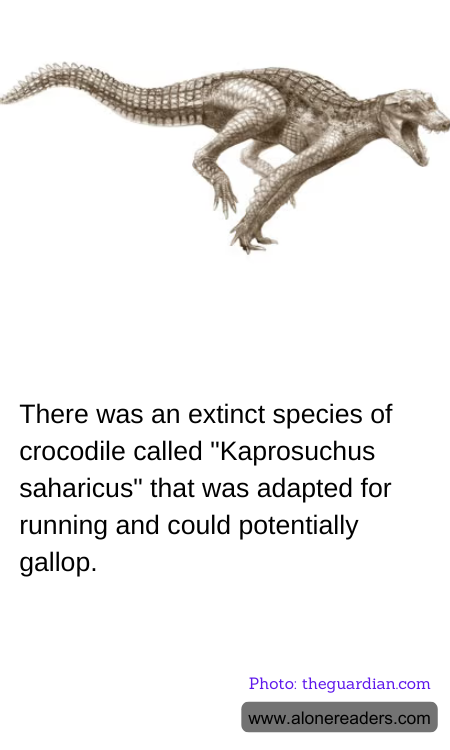
Kaprosuchus saharicus, often referred to as the "Boar Croc," was a prehistoric crocodile that roamed the Sahara Desert of what is now Africa during the Late Cretaceous period, around 95 million years ago. Unlike modern crocodiles, this formidable creature exhibited several distinctive characteristics that suggested it was uniquely adapted for a terrestrial lifestyle, particularly one that involved a lot of running, and possibly even the ability to gallop.
Measuring up to 6 meters in length, Kaprosuchus saharicus was a fearsome predator. One of its most notable adaptations were the three sets of large, tusk-like teeth protruding from its skull, much like those of a boar, which likely helped it to effectively catch and consume a diverse array of prey, including dinosaurs. These teeth were different from those of most other crocodilians, which generally have uniform, conical teeth designed for gripping rather than slicing.
Perhaps the most intriguing aspect of Kaprosuchus is its limbs. Unlike the sprawling legs of contemporary aquatic crocodiles, Kaprosuchus had more erect, robust legs positioned underneath its body. This limb structure is indicative of a creature capable of achieving greater speed and maneuverability on land. Some paleontologists speculate that this design not only allowed Kaprosuchus to run but also potentially to gallop, making it a terrifying predator not just in water but also on land.
Moreover, the overall body configuration of Kaprosuchus, including a heavily armored back and a more streamlined body shape, supported its lifestyle as an active land-based predator. This physicality would have given Kaprosuchus an advantage in its terrestrial habitat, where speed and agility would have been key to catching faster and potentially agile dinosaurs upon which it might have preyed.
The discovery of Kaprosuchus saharicus has provided valuable insights into the diversity and adaptability of crocodyliforms, a group that includes all modern crocodiles, alligators, and their extinct relatives. This extinct species challenges our understanding of crocodile evolution, indicating that some ancient crocodiles were not just aquatic ambush predators but also capable terrestrial hunters. The ability of Kaprosuchus to potentially gallop adds a fascinating layer to our comprehension of prehistoric life and underscores the adaptability and ecological diversity of crocodyliforms during the age of dinosaurs.
