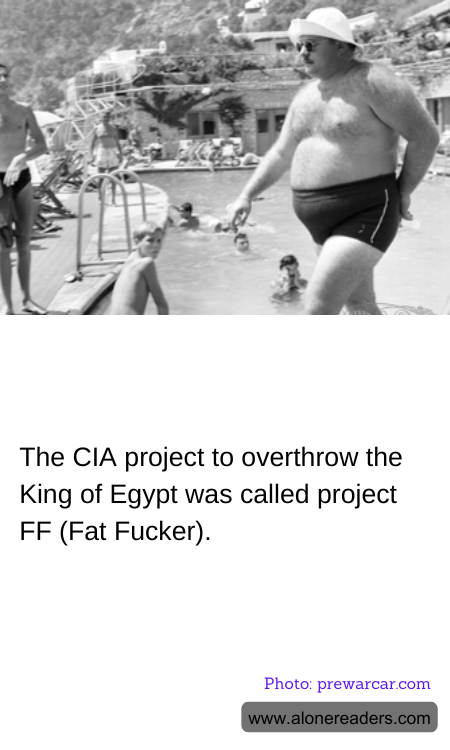
In the intricate web of Cold War politics, the United States and its intelligence agency, the CIA, were involved in numerous covert operations aimed at influencing global power dynamics. One lesser-known episode in this era was the CIA's project to overthrow King Farouk of Egypt, humorously codenamed "Project FF" or "Fat Fucker." This operation, though not widely publicized, played a significant role in shaping the political landscape of the Middle East.
King Farouk, who reigned from 1936 until his abdication in 1952, was a controversial figure. His lavish lifestyle and perceived incompetence made him unpopular among many Egyptians. As the Cold War intensified, the United States viewed Egypt as a strategic location due to its proximity to the Soviet Union and its control over the Suez Canal, a vital maritime route. The CIA, therefore, saw an opportunity to replace Farouk with a more favorable regime that could align with Western interests.
Project FF was conceived as a means to destabilize Farouk's rule and facilitate a transition of power. The operation involved a combination of propaganda, political maneuvering, and support for opposition groups within Egypt. The CIA aimed to exploit the growing discontent among the Egyptian populace and military, who were frustrated with Farouk's governance and the country's declining economic conditions.
The project eventually found its catalyst in the Free Officers Movement, a group of nationalist military officers led by Gamal Abdel Nasser. The CIA provided indirect support to this movement, which culminated in the successful coup d'état on July 23, 1952. King Farouk was forced to abdicate and went into exile, marking the end of the monarchy in Egypt and the beginning of a new era under Nasser's leadership.
While Project FF was never officially acknowledged by the CIA, declassified documents and historical analyses suggest that the agency played a crucial role in the events leading up to Farouk's downfall. The operation is a testament to the lengths to which the United States was willing to go to secure its interests during the Cold War, even if it meant meddling in the internal affairs of sovereign nations.
The overthrow of King Farouk had lasting implications for Egypt and the broader Middle East. It set the stage for Nasser's rise to power, which brought about significant social and economic reforms in Egypt, as well as a shift towards non-alignment in the Cold War. The success of Project FF also demonstrated the effectiveness of covert operations in achieving political objectives, a strategy that would be employed by the CIA in various forms throughout the latter half of the 20th century.
In retrospect, Project FF highlights the complex interplay of international politics, intelligence operations, and national sovereignty. It serves as a reminder of the often-hidden forces that shape world events and the enduring impact of historical decisions on contemporary geopolitics.
