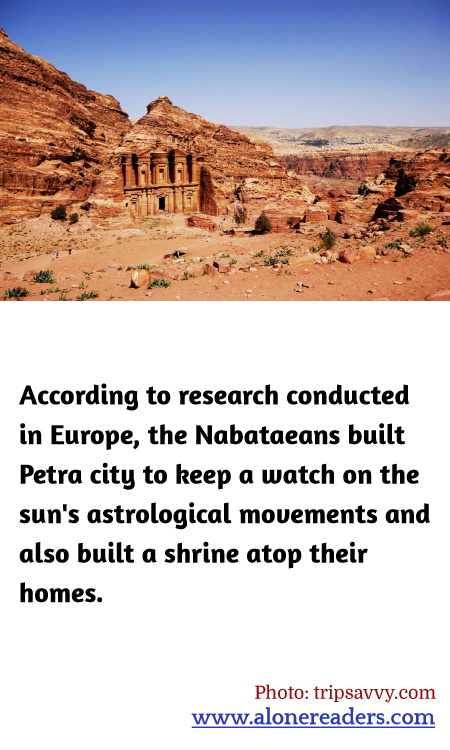
The ancient city of Petra, carved directly into the rose-red sandstone hills of southern Jordan, stands as a testament not just to the architectural prowess of the Nabataeans but also to their sophisticated understanding of the cosmos. Recent European research highlights that Petra's construction was significantly influenced by astrological phenomena, suggesting that its location and orientation were strategically chosen to monitor solar movements.
The Nabataeans, an Arab people who flourished from the 4th century BC to the 2nd century AD, were not only skilled traders managing the incense trade routes across the region but also keen observers of the sky. The alignment of the city’s structures, such as the famous Al-Khazneh (The Treasury) and the Monastery, demonstrates an advanced knowledge of the sun’s patterns. These edifices are perfectly positioned to capture the most dramatic effects of sunlight at the solstices and equinoxes, potentially serving ritualistic purposes that aligned astronomical events with religious or social festivities.
In addition to the solar alignment of their city, the Nabataeans also incorporated their reverence for the celestial into their homes. Excavations and studies reveal that many dwellings in Petra had shrines dedicated to the stars and planets. These domestic shrines likely played a role in daily spiritual life, offering a personal space for reflection on the mysteries held by the heavens, and asking for protection or blessings. They reflect a culture deeply engaged with astronomical phenomena, seeing the movements of the heavens as integral to their fortune and well-being.
These findings contribute significantly to our understanding of the Nabataeans. Far from merely being traders or builders, they emerge as a people for whom the cosmos was a source of guidance and inspiration. This celestial influence is evident not only in the grandeur of Petra's public monuments but also in the sanctity of its private spaces, providing a fascinating glimpse into the spiritual life of this ancient civilization. As researchers continue to decipher Petra’s stones, they unravel the complex layers of meaning that defined the Nabataean relationship with the universe—a relationship that was as practical as it was mystical, guiding both their calendar and their culture.
