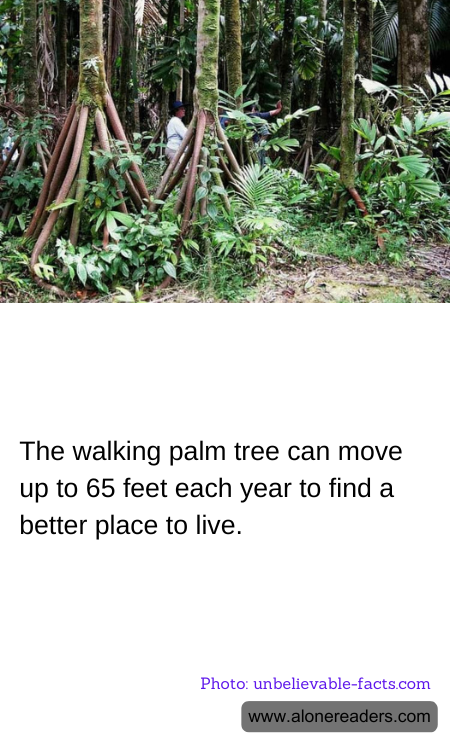
The walking palm tree, scientifically known as Socratea exorrhiza, is a marvel of the plant kingdom that exhibits a unique method of locomotion. Unlike the static existence of most trees, the walking palm is said to be capable of moving up to 65 feet each year. This movement allows the tree to thrive in the dense, competitive environments of tropical rainforests by relocating to areas with more favorable sunlight and nutrient availability.
The walking palm’s mobility stems from its unusual root system. Instead of having a single taproot, this tree has a series of stilt-like aerial roots that can grow out of the old roots at the base. These new roots stretch out and downward from up to 16 feet above the soil, probing the forest floor for better ground. When the tree identifies a more suitable spot, these roots can gradually lift the trunk and pivot it toward better conditions. Meanwhile, older roots on the opposite side slowly decompose, facilitating the tree's slow but steady movement.
This fascinating ability is not just a quirky attribute but rather an essential survival strategy in the dense undergrowth of the rainforest. By 'walking', the tree can escape from the shadows of larger trees and avoid areas where resources are already depleted. This adaptability is crucial in environments where light and soil nutrients are patchily distributed and highly coveted.
Despite the captivating concept of a ‘walking’ tree, some scientists argue the extent to which the tree actually ‘walks’ or whether the movement is merely a growth adaptation towards favorable light conditions. The speed of the movement and the distances covered are also debated among experts. While it is generally agreed that walking palm trees move more than most trees, the actual distances and the mechanisms behind such movements require further study.
Overall, the walking palm remains a symbol of the incredible adaptability and diversity found in nature, particularly within the rich ecosystems of tropical rainforests. Whether it moves many feet or just repositions slightly over time, the tree's ability to navigate its environment is another example of the remarkable survival strategies employed by species to thrive in competitive ecological niches.
