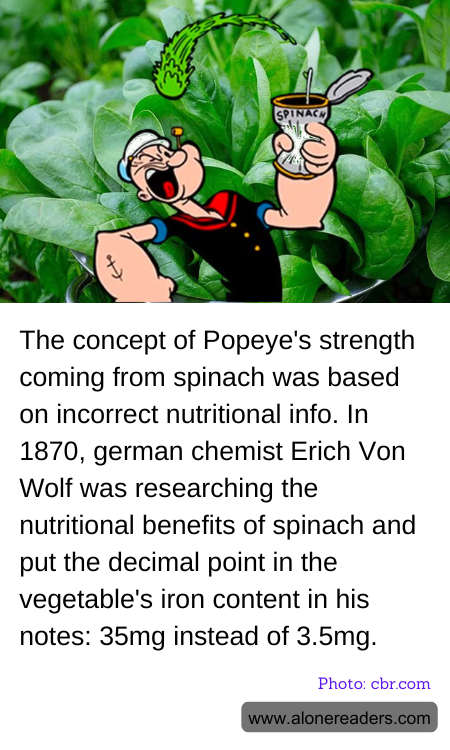
The iconic image of Popeye the Sailor Man gulping down a can of spinach to instantly gain bulging muscles and superhuman strength is a staple of the classic cartoon series. This concept was not just a random choice but was rooted in the perceived health benefits of spinach, particularly its iron content. However, the extraordinary emphasis on spinach as a powerhouse of iron was actually based on a scientific error.
In 1870, German chemist Erich von Wolf was conducting research on the iron content of various foods and compiled data that would considerably impact dietary recommendations for decades. During his analysis, Von Wolf mistakenly placed the decimal point in the wrong position when recording the iron content of spinach. He noted that spinach contained a remarkably high 35 milligrams of iron per 100 grams instead of the correct 3.5 milligrams—a tenfold error. This significant decimal slip-up wasn't caught for many years.
As a result of this error, spinach was hailed as one of the best sources of iron, which led to its celebrated status in popular culture, most famously used by the creators of Popeye in the 1930s. The cartoon was initially created by Elzie Crisler Segar and first appeared in comic strips before making its way to animated cartoons. Popeye's consumption of spinach to gain strength was intended to promote the vegetable to children, but with the underlying misconception of its iron content fortifying the storyline.
The myth of spinach's extraordinary iron powers due to Von Wolf’s error persisted until it was debunked decades later. Despite the correction, the association between spinach and strength has endured as a cultural symbol, illustrating how scientific inaccuracies can sometimes become deeply embedded in popular culture. Even today, although spinach is indeed nutritious—providing vitamin A, vitamin C, calcium, and iron—the levels are far from the miraculous amounts once believed. Nevertheless, Popeye's legacy continues to encourage generations to eat their greens, albeit for a mix of valid nutritional reasons and enduring mythological charm.
