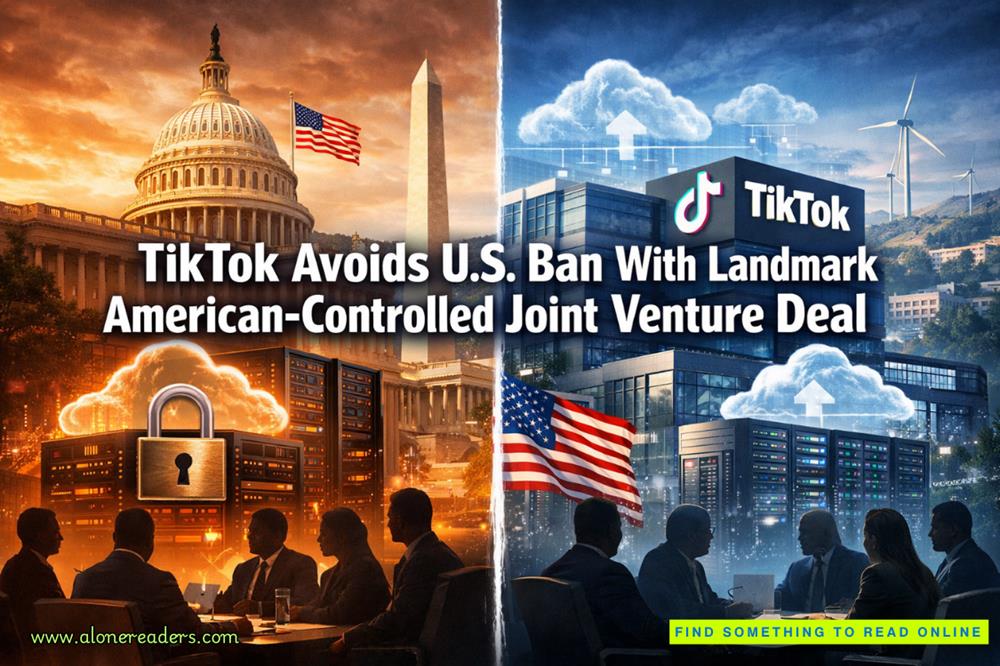
After years of escalating regulatory pressure, legal brinkmanship, and geopolitical tension, TikTok’s long-running battle to remain operational in the United States has entered a decisive new phase. Its Chinese parent, ByteDance, has agreed to place TikTok’s U.S. business into a newly formed American-based joint venture that will be majority-owned and controlled by U.S. and other non-Chinese investors. The move is designed to neutralize national-security concerns that have threatened to ban the app outright and represents one of the most consequential corporate restructurings ever undertaken by a global consumer-technology platform.
The new entity, to be known as TikTok USDS Joint Venture LLC, will assume responsibility for all of TikTok’s U.S. operations. Binding agreements have already been signed, and the transaction is expected to close around January 22, 2026, subject to regulatory approvals on both sides of the Pacific. While TikTok has previously attempted partial compromises to address Washington’s concerns, this deal goes significantly further by re-engineering ownership, governance, data control, and operational authority in ways explicitly designed to meet U.S. national-security thresholds.
At the heart of the arrangement is a fundamental shift in control. Roughly 50 percent of the joint venture will be held by a consortium led by Oracle, Silver Lake, and MGX, each taking a 15 percent stake. ByteDance itself will retain approximately 19.9 percent ownership, with an additional 30.1 percent held by affiliates of existing ByteDance investors. This structure keeps ByteDance’s total influence below the 20 percent threshold that U.S. policymakers have repeatedly emphasized as a red line for national-security compliance.
Governance is equally central to the deal. TikTok USDS will be overseen by a newly constituted seven-member board of directors, the majority of whom will be American citizens. This board will exercise decisive authority over strategic direction, operational policy, and oversight mechanisms within the U.S. business. The intent is to sever any plausible chain of command that could allow the Chinese parent to exert covert or indirect control over the platform’s American operations, particularly in areas such as content moderation, algorithmic prioritization, and data access.
This governance framework addresses one of Washington’s core anxieties: that TikTok’s recommendation algorithms and moderation systems could be subtly influenced by a foreign government through corporate leverage. By placing algorithm security, software assurance, and content oversight within a U.S.-controlled entity, the joint venture aims to ring-fence TikTok’s American user experience from external political pressure. While ByteDance will remain an investor, it will no longer have the authority to dictate how TikTok operates inside the United States.
Data security is the other pillar of the restructuring, and it is here that Oracle’s role becomes pivotal. Under the terms of the deal, Oracle will serve as the trusted security partner for TikTok’s U.S. business. Sensitive U.S. user data will be stored exclusively within Oracle’s U.S.-based cloud data centers, with strict access controls and continuous auditing. Oracle will also be responsible for verifying compliance with the national-security commitments embedded in the joint venture agreement, including safeguards around data flows, code integrity, and system updates.
This arrangement builds on earlier initiatives but significantly expands their scope and enforceability. Rather than acting merely as a cloud host, Oracle will function as an independent security gatekeeper, empowered to monitor, audit, and report on TikTok’s adherence to agreed standards. For U.S. regulators, this creates a tangible enforcement mechanism rather than a trust-based assurance model, which has long been viewed as insufficient in the context of high-risk technology platforms.
The restructuring also reflects the political realities of the current U.S. regulatory environment. Lawmakers and national-security officials have grown increasingly skeptical of foreign-controlled digital platforms, particularly those with massive influence over public discourse and youth culture. TikTok’s enormous reach, combined with its opaque ownership structure and Chinese origins, made it an unusually prominent target. By accepting a minority stake and relinquishing operational control, ByteDance is effectively acknowledging that continued access to the U.S. market requires unprecedented concessions.
From a corporate-strategy perspective, the deal is a calculated trade-off. The United States represents one of TikTok’s most lucrative and culturally influential markets. An outright ban would not only have eliminated significant revenue but also weakened TikTok’s global brand and competitive position. By contrast, the joint venture allows TikTok to preserve its presence while insulating ByteDance from the reputational and financial fallout of a forced exit. The price of that survival is diminished control, but the alternative was existential.
The Chinese government’s response underscores the broader diplomatic context surrounding the transaction. China’s Ministry of Commerce has publicly acknowledged the framework agreement, noting that economic and trade teams from both countries have reached a basic understanding on handling issues related to TikTok’s U.S. operations. While this statement stops short of full approval, it signals a willingness to engage pragmatically rather than reflexively oppose the restructuring. That stance is notable given Beijing’s historical sensitivity to technology transfers and foreign regulatory pressure on Chinese firms.
Nonetheless, the deal still requires formal regulatory sign-off from Chinese authorities as well as U.S. regulators. On the Chinese side, approval will likely hinge on assurances that proprietary technologies, particularly recommendation algorithms, are adequately protected from unauthorized transfer. On the U.S. side, regulators will scrutinize the joint venture’s governance documents, data-security protocols, and enforcement mechanisms to ensure they are robust enough to withstand political and legal challenge.
Beyond TikTok itself, the implications of this agreement ripple across the global technology sector. The joint venture model may become a template for other foreign-owned platforms seeking to operate in geopolitically sensitive markets. It suggests that outright bans are no longer the only regulatory endpoint; instead, governments may increasingly demand structural reconfiguration as a condition of access. For multinational tech companies, this introduces a new layer of complexity into global expansion strategies.
The deal also recalibrates the balance of power between states and platforms. By compelling a company as influential as TikTok to reorganize its ownership and governance, U.S. regulators have demonstrated their capacity to impose structural remedies on digital giants. This could embolden other jurisdictions to pursue similar approaches, particularly in Europe and parts of Asia where concerns about data sovereignty and foreign influence are intensifying.
Critics, however, argue that the restructuring does not entirely eliminate risk. ByteDance’s continued minority stake and the involvement of its existing investors mean that some degree of indirect influence may persist. Others question whether algorithmic transparency and content governance can truly be isolated within national boundaries in a globally integrated platform. These concerns are likely to fuel ongoing oversight and periodic reassessment of the joint venture’s compliance.
Supporters counter that perfection is neither realistic nor necessary. From their perspective, the joint venture dramatically reduces risk relative to the status quo by placing enforceable controls in the hands of U.S. entities. They view the deal as a pragmatic compromise that preserves user access, protects national interests, and avoids the economic and cultural disruption of a ban affecting millions of American creators and businesses.
For TikTok’s U.S. users, the transition is expected to be largely invisible in the short term. The app’s interface, features, and content ecosystem are unlikely to change overnight. Behind the scenes, however, the operational shift will be profound, as teams transition into the new corporate structure, compliance systems are implemented, and governance processes are formalized. Over time, these changes may subtly influence how content is moderated, how data is handled, and how the platform responds to political pressure.
Ultimately, the TikTok USDS Joint Venture marks a watershed moment in the evolving relationship between technology, sovereignty, and global commerce. It illustrates how digital platforms have become strategic assets subject to state-level negotiation and control. Whether the model proves durable will depend on regulatory follow-through, corporate discipline, and the shifting currents of U.S.–China relations. What is clear is that TikTok’s future in America will now be shaped less by Beijing and more by boardrooms, regulators, and data centers firmly rooted on U.S. soil.



 Top 10 Highest-Paid Professions in the United States (2025): Salaries, Roles, and Career Paths
 Top 10 Largest U.S. Companies by Revenue in 2025 (Fortune 500 Analysis)
 Top 10 Highest-Earning Global Tech Companies in 2025: Revenue, Strategy, and Market Power
 Top 10 Highest-Earning Mobile Apps in 2025: Revenue, Monetization, and Market Dominance
 ZombieAgent: Inside the Zero-Click AI Attack That Turns ChatGPT Agents into Persistent Data-Leaking Zombies
 China’s Urban Air Is a Hidden Plastic Reservoir: Inside the Microplastic Clouds Over Megacities










