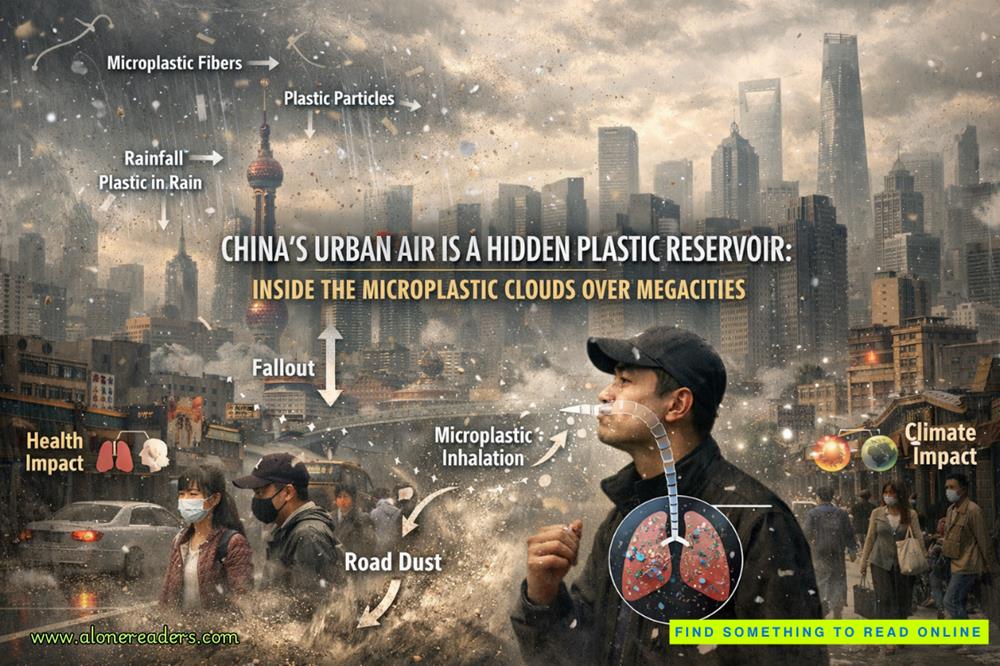
A newly publicized study from the Chinese Academy of Sciences has placed an uncomfortable spotlight on something urban residents breathe every day but rarely think about: plastic. Not bottles or bags, but microscopic fragments suspended in the air of modern cities. According to this research, the urban atmosphere in major Chinese megacities does not merely receive microplastics from surrounding sources. It actively stores, recycles, and redistributes them, functioning as a central reservoir where particles circulate continuously between air, dust, rain, and resuspension.
This finding marks a significant shift in how airborne plastic pollution is understood. For years, attention focused on oceans, rivers, and soils as the main sinks for microplastics. Air was often treated as a transient pathway, a means by which particles moved from one place to another. The new evidence suggests the opposite is true in dense urban environments. The atmosphere itself becomes a dynamic compartment where plastics accumulate, linger, and repeatedly re-enter human breathing zones.
The research team concentrated on Guangzhou and Xi’an, two megacities with very different climates, urban forms, and industrial profiles. By tracking plastic particles across multiple environmental “compartments” — suspended aerosols, dry deposition, wet deposition from rainfall, and resuspended road and soil dust — the researchers were able to observe how plastics move through the urban system rather than treating each pathway in isolation. This multi-compartment approach is what makes the study stand out. It shows not only how much plastic is present, but how actively it circulates.
Crucially, the team employed a semi-automated microanalytical method capable of detecting particles down to roughly 200 nanometers. This is well below the size range covered by most earlier atmospheric studies, which often miss the smallest and potentially most biologically active particles. By capturing both microplastics and nanoplastics, the researchers revealed a far denser and more persistent plastic burden than previously documented.
One of the most striking results is the scale of variability between compartments. Fluxes of micro- and nanoplastics differed by two to five orders of magnitude depending on whether particles were suspended in air, deposited onto surfaces, washed down by rain, or kicked back into the atmosphere by traffic and wind. Despite this variability, a consistent pattern emerged: urban air acted as the central hub. Dust and rain removed plastics from the air, but resuspension rapidly returned large fractions back into the breathing zone. Instead of being flushed away, plastics were effectively recycled within the city.
The physical characteristics of these particles explain much of this behavior. Many of the detected plastics were extremely small, lightweight, and irregularly shaped, including fibers shed from textiles and fragments generated by tire wear, packaging degradation, and construction materials. Their low settling velocities allow them to remain suspended for long periods, sometimes days or weeks, especially in urban canyons where airflow is complex and turbulent. Once aloft, these particles are not passive. The study suggests that micro- and nanoplastics can act as cloud condensation nuclei or ice nuclei, meaning they may influence how clouds form and how precipitation develops over cities.
This raises a largely unexplored question: could plastic pollution subtly alter urban weather and climate processes? While the Guangzhou–Xi’an study does not quantify these effects directly, it adds weight to a growing body of evidence that anthropogenic aerosols, including plastics, play roles beyond air quality alone. In heavily polluted atmospheres, the addition of persistent plastic particles may change cloud microphysics, rainfall timing, or even local heat balance. These are not distant, abstract concerns. They relate directly to how megacities experience heat waves, smog episodes, and extreme weather.
The new findings align with, and significantly deepen, insights from other Chinese urban campaigns. A year-long monitoring effort in Hangzhou measured atmospheric microplastic concentrations ranging from about 0.37 to 8.9 particles per cubic meter of air. Fibers dominated the counts, reflecting the influence of clothing, upholstery, and industrial textiles. From these measurements, researchers estimated that nearly 17 tons of microplastics are deposited over the city each year. The Guangzhou–Xi’an work suggests that much of this deposited material does not represent a permanent removal. Instead, a substantial fraction may be resuspended and re-inhaled.
Human exposure data underscore why this matters. Studies involving volunteers in Shanghai have detected dozens of microplastic particles per cubic meter in inhaled indoor air. Indoor environments often contain higher concentrations than outdoors due to limited ventilation, synthetic furnishings, and constant mechanical disturbance. When these data are combined with time-activity patterns, emerging estimates suggest that people may inhale tens of thousands of fine airborne microplastic particles per day, particularly in urban apartments, offices, and transit systems.
From a toxicological perspective, particle size is critical. Microplastics in the 1–10 micrometer range can penetrate deep into the lungs, reaching the bronchioles and alveolar regions where gas exchange occurs. Nanoplastics, even smaller, may cross cellular barriers entirely. Laboratory and animal studies have linked inhaled plastic particles to inflammatory responses, oxidative stress, and disruption of normal immune signaling in lung tissue. While definitive long-term epidemiological links in humans are still being established, the mechanistic evidence is increasingly difficult to ignore.
Another layer of risk lies in what plastics carry with them. Micro- and nanoplastics have large surface areas relative to their volume, making them efficient carriers for heavy metals, polycyclic aromatic hydrocarbons, and other organic pollutants common in urban air. Once inhaled, these combined particles can deliver a complex chemical payload directly to sensitive lung tissues. This raises the possibility that plastics act not only as physical irritants but also as vectors that amplify exposure to other toxic substances.
What makes the Guangzhou–Xi’an study particularly important is its implication that exposure is not merely episodic. In cities where air serves as a plastic reservoir, residents may be exposed continuously, even when external sources fluctuate. Traffic slows, construction pauses, rainfall cleans the air — yet resuspension ensures that plastics return. This persistence challenges conventional air pollution control strategies, which often assume that reducing emissions will quickly translate into lower ambient concentrations.
The research also reframes how Chinese megacities are positioned in the global plastic cycle. Rather than functioning solely as sources exporting pollution downwind or downstream, these urban areas appear capable of retaining and recycling large plastic loads locally. This has direct policy implications. Measures aimed at reducing plastic waste, textile shedding, and tire wear within cities could yield immediate local health benefits, not just long-term environmental ones.
At the same time, the findings expose gaps in current regulatory frameworks. Air quality standards typically focus on particulate matter mass, such as PM2.5 or PM10, without regard to composition. Micro- and nanoplastics contribute little to mass but may contribute disproportionately to biological impact. Without targeted monitoring and risk assessment, their presence remains effectively invisible to policymakers and the public.
The picture emerging from Chinese urban research is therefore both detailed and unsettling. Modern megacities are enveloped in persistent clouds of microscopic plastic, generated by everyday activities and sustained by the very structure of urban life. These particles circulate between air, dust, and rain, infiltrate indoor spaces, and enter human lungs with every breath. They may even influence clouds overhead.
The Guangzhou–Xi’an study does not claim to have all the answers. Instead, it provides a framework — a way of seeing urban air as an active, plastic-rich system rather than a passive conduit. As analytical methods improve and detection limits fall further into the nanoscale, the true extent of atmospheric plastic pollution is likely to become even clearer. What is already clear is that the air over cities is no longer just a mixture of gases and soot. It is, increasingly, a finely divided archive of our plastic age.



 Top 10 Highest-Paid Professions in the United States (2025): Salaries, Roles, and Career Paths
 Top 10 Largest U.S. Companies by Revenue in 2025 (Fortune 500 Analysis)
 Top 10 Highest-Earning Global Tech Companies in 2025: Revenue, Strategy, and Market Power
 Top 10 Highest-Earning Mobile Apps in 2025: Revenue, Monetization, and Market Dominance
 ZombieAgent: Inside the Zero-Click AI Attack That Turns ChatGPT Agents into Persistent Data-Leaking Zombies
 John Ternus and Apple’s CEO Succession: Why the Hardware Chief Is the Leading Contender After Tim Cook










