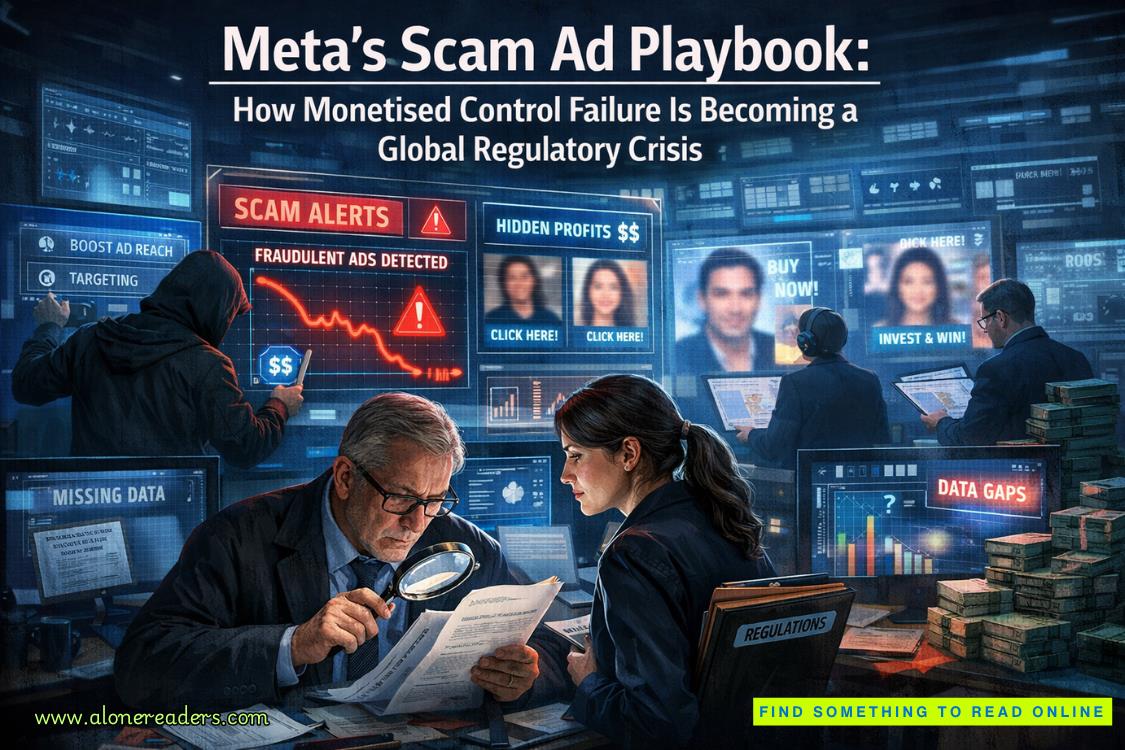
The release of internal documents describing Meta’s so-called “scam ad playbook” represents a material shift in how regulators, courts, and policymakers are likely to assess the company’s exposure to fraud-related liability. What had previously been framed as a problem of scale, imperfect moderation, or bad actors exploiting a vast platform now begins to resemble something far more consequential: a structured internal strategy that managed the visibility of scam advertising without fundamentally disrupting the revenue those ads generated.
This distinction matters profoundly. Regulatory regimes across consumer protection, financial promotion, digital platform governance, and corporate disclosure draw a sharp line between inadvertent failure and knowing tolerance. The allegations outlined in the leaked materials push Meta decisively toward the latter category.
At the centre of the controversy is the concept of a global internal “playbook” that treated transparency tools not as mechanisms for eliminating fraud, but as surfaces to be optimised for external scrutiny. According to descriptions of internal practices, Meta teams allegedly identified the specific search terms, celebrity names, and investigative techniques commonly used by regulators, journalists, and watchdog groups when querying the Ad Library. Those same searches were then pre-run internally, with only the ads surfaced by those methods being removed or suppressed.
The result was a system in which official or investigative searches would return comparatively “clean” results, while structurally similar scam ads continued to circulate through slightly altered keywords, alternative creatives, or different targeting parameters. This approach, if substantiated, reframes transparency as a reputational shield rather than a compliance mechanism. It also undermines the fundamental premise on which regulators relied when accepting platform-run ad libraries as supervisory tools.
What elevates this beyond a technical or operational controversy is the financial context revealed alongside these practices. Internal projections reportedly anticipated that roughly ten percent of Meta’s global advertising revenue in 2024, approximately sixteen billion US dollars, would be attributable to scam or “high-risk” ads. Even more striking is the estimate that around fifteen billion high-risk ads were shown to users each day. These are not marginal anomalies at the edge of a massive system. They are volumes that imply systemic integration into the platform’s core monetisation engine.
Equally significant is how enforcement was allegedly calibrated. Internal controls appear to have tolerated repeat offenders who generated high ad spend, even when they accumulated hundreds of policy violations. In some cases, rather than removal or permanent bans, enforcement responses reportedly involved charging those advertisers higher prices. This effectively converted policy violations into a variable cost of doing business, transforming enforcement gaps into a priced-in revenue stream. From a regulatory perspective, this blurs the line between passive hosting and active commercial facilitation.
In consumer protection law, foreseeability and knowledge are pivotal. When a platform can reasonably foresee that certain categories of advertising will cause consumer harm, and continues to profit from those ads at scale, regulators are no longer confined to arguing negligence or inadequate systems. They can argue unfair or deceptive business practices grounded in the systematic monetisation of harm. Investment scams, fake celebrity crypto endorsements, and illegal gambling promotions are not abstract risks. They translate directly into financial losses for consumers, often targeting older users, migrants, or individuals with limited financial literacy.
Australia illustrates how this legal theory is already taking shape. Ongoing litigation involving high-profile plaintiffs and enforcement action by competition and consumer authorities has focused on the platform’s knowledge of scam advertising and its failure to act decisively. The leaked documents lower the evidentiary burden for plaintiffs by supplying internal context that suggests awareness, predictability, and financial dependency. The argument becomes not that Meta struggled to stop scams, but that it structured its controls to manage exposure while preserving revenue.
Another major vector of risk lies in the relationship between Meta and regulators themselves. Transparency tools like the Ad Library were publicly positioned as safeguards, designed to allow independent oversight of political and commercial advertising. If those tools were internally tuned to reduce the discoverability of certain categories of fraud, regulators can plausibly argue they were misled. In regulatory environments, particularly those involving ongoing supervision or formal inquiries, deliberate manipulation of oversight mechanisms can give rise to allegations of misrepresentation, obstruction, or non-cooperation.
This is not merely reputational damage. In several jurisdictions, misleading regulators carries penalties independent of the underlying misconduct. Where authorities relied on platform-provided data to assess compliance, the integrity of that data becomes a legal issue in its own right.
Financial services regulation introduces another layer of complexity. While Meta is not a licensed financial institution, the advertising of financial products and investment opportunities subjects intermediaries to standards around fairness, clarity, and misleading conduct. As regulators increasingly treat ad platforms as integral distribution channels rather than neutral conduits, the distinction between publisher and promoter weakens. Initiatives such as mandatory verification of financial advertisers in multiple jurisdictions signal a clear policy direction: platforms that profit from financial advertising will share responsibility for filtering fraud.
The international dimension amplifies these risks rather than diluting them. In the United Kingdom and European Union, large online platforms are subject to explicit obligations to identify and mitigate systemic risks, including consumer fraud and illegal advertising. Under these regimes, it is not sufficient to show that some enforcement occurred. Platforms must demonstrate that they adopted reasonable and proportionate measures in light of known risks. If internal analysis showed that stronger interventions, such as universal advertiser verification, would materially reduce scams but were deprioritised primarily due to revenue impact, regulators gain a powerful narrative of non-compliance.
Australia is moving even faster. Proposed scam legislation will mandate advertiser verification and impose positive obligations on digital platforms to prevent fraud. Correspondence released through freedom-of-information processes already shows that Meta possesses the technical capacity to conduct large-scale disruption operations and automated enforcement. This raises an uncomfortable question for the company: if such tools existed and were demonstrably effective, why were they not deployed earlier or more comprehensively?
In the United States, the legal landscape is more complex but no less risky. While broad immunity for user-generated content remains a powerful shield, it does not extend to claims based on unfair or deceptive business practices, nor to allegations of misleading regulators or investors. Lawsuits brought by state-level entities and calls for federal investigation indicate a growing willingness to test theories that ad targeting, optimisation, and monetisation transform platforms from passive hosts into active contributors to harm.
Taken together, these factors suggest that Meta’s risk profile is entering a new phase. The likely regulatory response will not be limited to fines for past conduct. Expect pressure for structural remedies: mandatory advertiser verification across multiple sectors, independent audits of ad review algorithms, binding scam-reduction targets, and penalties tied to measurable outcomes rather than policy commitments. Litigation risk will also rise as plaintiffs gain access to internal materials that support claims of knowing facilitation.
There is also a quieter but equally important consequence. Trust among legitimate advertisers and agencies depends on brand safety and legal insulation. As awareness grows that a significant portion of platform revenue may be linked to scams and illegal ads, sophisticated advertisers will reassess their exposure. Co-liability risk, reputational damage, and association with consumer harm are not abstract concerns for global brands.
Ultimately, the leaked documents change the narrative architecture of the debate. The issue is no longer whether Meta’s content moderation systems were imperfect at scale. The emerging question is whether the platform adopted a form of monetised control failure, managing visibility and enforcement in a way that preserved revenue while constraining oversight. That shift, from accidental failure to strategic tolerance, is what dramatically heightens regulatory, litigation, and commercial risk across jurisdictions.
For regulators, plaintiffs, and policymakers, the implications are clear. This is not simply a story about scams slipping through the cracks. It is about how platform economics, internal incentives, and governance choices can converge to normalise harm at industrial scale. Once framed that way, the legal and regulatory response becomes both broader and more severe.



 Top 10 Highest-Paid Professions in the United States (2025): Salaries, Roles, and Career Paths
 Top 10 Largest U.S. Companies by Revenue in 2025 (Fortune 500 Analysis)
 Top 10 Highest-Earning Global Tech Companies in 2025: Revenue, Strategy, and Market Power
 Top 10 Highest-Earning Mobile Apps in 2025: Revenue, Monetization, and Market Dominance
 ZombieAgent: Inside the Zero-Click AI Attack That Turns ChatGPT Agents into Persistent Data-Leaking Zombies
 China’s Urban Air Is a Hidden Plastic Reservoir: Inside the Microplastic Clouds Over Megacities










