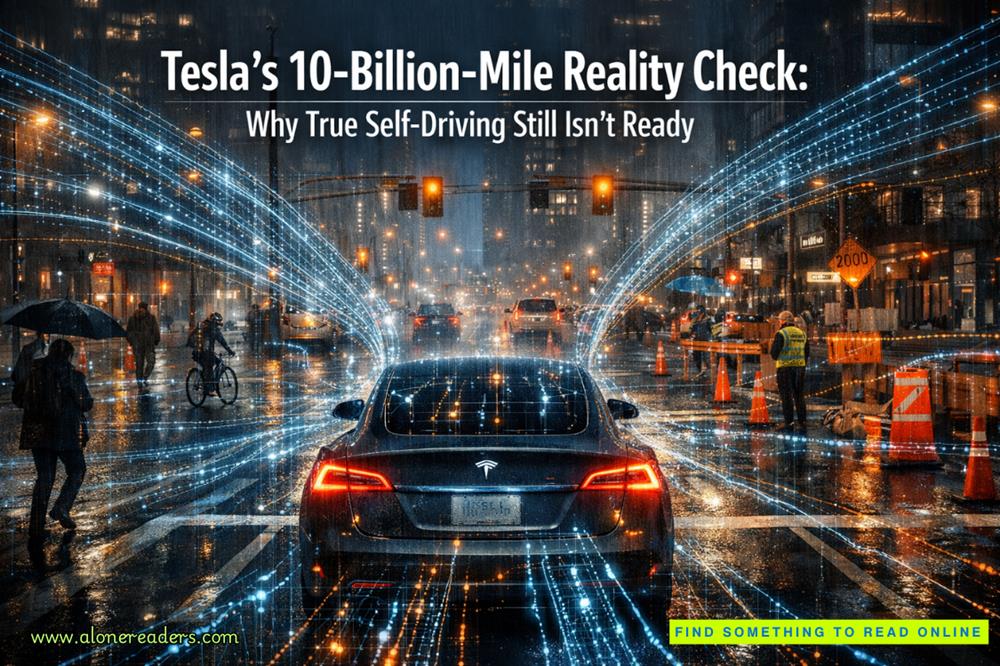
When Elon Musk publicly stated that Tesla still needs roughly 10 billion miles of Full Self-Driving training data before unsupervised autonomy can be considered safe, it marked a rare moment of restraint in a narrative long defined by aggressive timelines and bold promises. The number itself is not just a technical benchmark; it is a tacit acknowledgment of how difficult real-world autonomy remains, even for the company that arguably possesses the largest driving dataset on the planet.
At present, Tesla has accumulated approximately 6.7 to 7 billion miles of FSD-specific driving data. That figure alone is staggering. It exceeds the total lifetime mileage of most human drivers by several orders of magnitude and dwarfs the datasets available to competitors relying on limited pilot programs or geo-fenced fleets. Yet, according to Musk, it is still not enough.
The reason lies in what autonomy engineers refer to as the long tail problem. While common driving scenarios—lane keeping, following traffic, stopping at signals—are quickly mastered by modern neural networks, rare events are disproportionately dangerous. These include unusual pedestrian behavior, unexpected road debris, ambiguous construction zones, poorly marked rural intersections, or erratic actions by other drivers. Individually, each scenario may occur only once in tens of millions of miles. Collectively, they define the true risk envelope of autonomous driving.
Musk’s emphasis on 10 billion miles reflects a belief that statistical confidence, not anecdotal performance, is what ultimately separates supervised assistance from genuine autonomy. The jump from his earlier suggestion that roughly six billion miles might suffice is significant. It implies that real-world testing has revealed more edge cases than anticipated, or that the safety bar for unsupervised operation has been set higher—by regulators, by public scrutiny, or by Tesla’s own internal analysis.
To understand why this matters, it is important to distinguish between Tesla’s different data pools. Tesla vehicles have logged around nine billion miles using Autopilot features over the years. However, Musk’s new benchmark refers specifically to Full Self-Driving training data, not general driver-assistance usage. FSD data is richer, more behaviorally complex, and more relevant to autonomy because it captures how the system attempts to handle full driving tasks rather than partial assistance.
Even with seven billion miles recorded, Tesla’s current product remains explicitly branded Full Self-Driving (Supervised). This wording is not cosmetic. It is a legal and technical acknowledgment that the system cannot be trusted to operate without an alert human driver. Drivers must remain attentive, keep their hands available, and be prepared to intervene at any moment. The system’s name may suggest autonomy, but its operational reality is still collaborative.
What makes Tesla’s position unique is its fleet-based learning model. Unlike competitors that rely on specialized sensor arrays and limited test fleets, Tesla gathers data from hundreds of thousands of customer vehicles operating in everyday conditions. Every disengagement, correction, and unusual scenario feeds back into the training pipeline. This approach allows Tesla to scale data acquisition faster than any rival, but it also exposes the system to an almost endless variety of unpredictable environments.
Musk’s 10-billion-mile estimate should therefore be interpreted less as a countdown clock and more as a risk-reduction curve. Each additional billion miles does not merely add quantity; it increases the probability that rare, dangerous scenarios are encountered, labeled, and learned from. In autonomy, safety improvements are asymptotic. Progress slows as systems approach human-level reliability because the remaining failures are the hardest to eliminate.
Analysts tracking Tesla’s fleet engagement rates estimate that, if current trends continue, the company could cross the 10-billion-mile FSD threshold sometime around mid-2026. This projection assumes sustained growth in daily FSD usage, which Tesla is actively encouraging through free trials, promotional access, and expansion into new markets such as Australia and New Zealand. Each new geography introduces fresh variables—different road markings, driving cultures, weather patterns, and regulatory environments—that enrich the dataset but also complicate training.
From a technical standpoint, reaching 10 billion miles does not automatically unlock unsupervised driving. It simply provides a statistical foundation robust enough to argue that the system has encountered most classes of real-world scenarios at least once. The remaining challenge is generalization: ensuring that lessons learned in one context apply reliably in another. Neural networks excel at pattern recognition but struggle with causal reasoning, which is often required in rare, ambiguous situations.
This reality helps explain why regulatory approval for unsupervised “robotaxi” operation has not yet been granted. Regulators are not interested in marketing claims or cumulative mileage alone. They require demonstrable safety outcomes, clear accountability frameworks, and transparent validation processes. Musk’s updated threshold implicitly acknowledges that regulators will demand overwhelming evidence before allowing vehicles to operate without human oversight.
There is also a reputational dimension. Tesla’s earlier autonomy timelines, some of which suggested imminent robotaxi fleets years ago, have created skepticism. By raising the bar to 10 billion miles, Musk appears to be recalibrating expectations—both internally and externally. This shift may reduce short-term hype, but it strengthens Tesla’s long-term credibility by aligning public statements more closely with engineering realities.
Critically, even human drivers benefit from cumulative experience measured in millions of miles across populations, not individuals. No single driver accumulates the equivalent of seven billion miles, yet society accepts human driving because collective experience has shaped rules, norms, and infrastructure. Tesla’s ambition is to compress that collective learning into a machine system, but doing so safely requires orders of magnitude more data than many initially assumed.
The implication for consumers is nuanced. Tesla’s FSD today is undeniably more capable than it was even two years ago. Lane selection, intersection handling, and urban navigation have improved dramatically. However, Musk’s statement is a reminder that capability does not equal autonomy. The system can perform impressive feats while still being fundamentally untrustworthy in edge conditions.
For investors and industry watchers, the 10-billion-mile figure reframes the autonomy race. Tesla remains ahead in raw data volume, but the finish line has moved. Competitors pursuing alternative strategies—such as heavier reliance on high-definition maps or lidar-centric perception—may not need equivalent mileage, but they face scalability and cost challenges of their own. There is no clear shortcut to safety.
In practical terms, the next 18 to 24 months will likely be defined by incremental gains rather than revolutionary leaps. Expect smoother driving, fewer disengagements, and better handling of unusual scenarios—but not a sudden switch to hands-off robotaxis everywhere. Musk’s own words suggest that Tesla sees autonomy as a probabilistic milestone, not a binary feature toggle.
Ultimately, the significance of the 10-billion-mile target lies in what it says about the maturity of the field. Autonomous driving is no longer limited by basic perception or control. It is limited by rare events, ethical risk tolerance, and societal acceptance. By acknowledging how much data is still required, Musk has inadvertently delivered one of the clearest assessments yet of how far the industry still has to go.
In that sense, the statement is less a delay than a clarification. Tesla is not failing to achieve autonomy; it is confronting the reality that true unsupervised self-driving is one of the most complex engineering problems ever attempted. Ten billion miles is not a finish line. It is the minimum evidence required to even begin claiming that machines can drive as safely as humans—without anyone watching.



 Top 10 Highest-Paid Professions in the United States (2025): Salaries, Roles, and Career Paths
 Top 10 Largest U.S. Companies by Revenue in 2025 (Fortune 500 Analysis)
 Top 10 Highest-Earning Global Tech Companies in 2025: Revenue, Strategy, and Market Power
 Top 10 Highest-Earning Mobile Apps in 2025: Revenue, Monetization, and Market Dominance
 ZombieAgent: Inside the Zero-Click AI Attack That Turns ChatGPT Agents into Persistent Data-Leaking Zombies
 China’s Urban Air Is a Hidden Plastic Reservoir: Inside the Microplastic Clouds Over Megacities










