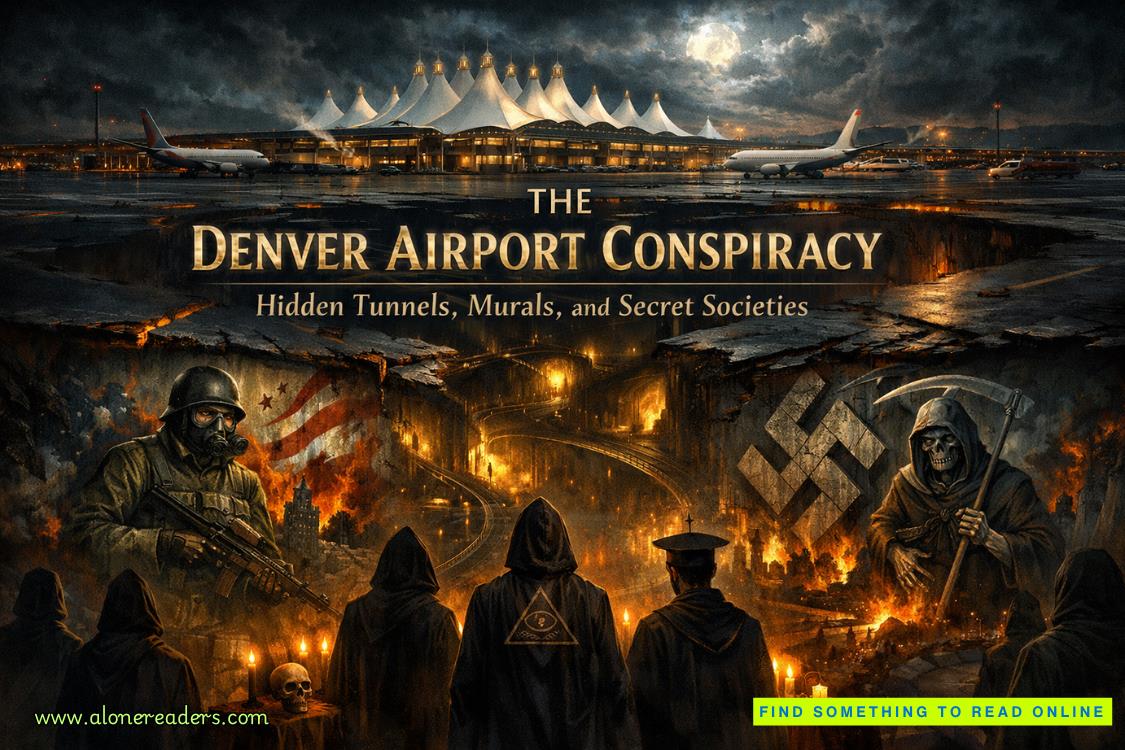
Few modern infrastructure projects have generated as much sustained suspicion, speculation, and cultural fascination as Denver International Airport. Opened in the mid-1990s, the airport was designed to be a state-of-the-art aviation hub for the American West. Yet from the moment its doors opened, whispers began circulating that something far more secretive lay beneath its concrete and steel. Over the years, these whispers evolved into one of the most elaborate and enduring conspiracy theories of the modern era, blending hidden tunnels, coded symbols, secret societies, and apocalyptic imagery into a narrative that refuses to fade.
The origins of the Denver Airport conspiracy are inseparable from the airport’s troubled construction history. The project ran massively over budget and opened years behind schedule, immediately raising public suspicion. Cost overruns alone do not create conspiracies, but in this case they coincided with unusual architectural choices and unexplained features that seemed to invite speculation. For critics and conspiracy theorists alike, the airport appeared less like a transportation facility and more like a carefully disguised fortress, designed with purposes far beyond commercial aviation.
One of the most persistent elements of the conspiracy revolves around the airport’s underground infrastructure. Denver International Airport sits atop an extensive network of tunnels and sublevels, far larger than what most travelers would expect. While airports do require service corridors for baggage handling, utilities, and security operations, the sheer scale of the underground construction at Denver has fueled decades of speculation. According to conspiracy narratives, these tunnels form a vast subterranean complex, allegedly capable of housing thousands of people or facilitating secret military and governmental operations.
Some versions of the theory claim the tunnels connect to underground bunkers designed for global elites in the event of a catastrophic collapse of civilization. Others suggest the tunnels serve as transportation corridors for shadow organizations operating beyond public oversight. The secrecy surrounding certain closed-off areas and restricted access points only deepens suspicion. To believers, the explanation of “unfinished baggage systems” sounds like a convenient cover story, masking something far more deliberate and ominous.
The conspiracy intensifies when observers turn their attention from what lies beneath the airport to what is displayed openly on its walls. Perhaps no aspect of Denver International Airport has generated more controversy than its massive murals. These artworks, commissioned as part of the airport’s public art program, depict scenes that many interpret as disturbingly apocalyptic. Images of soldiers wearing gas masks, children mourning amid ruins, and symbols associated with war, death, and rebirth have fueled interpretations that the murals represent a planned global catastrophe.
For conspiracy theorists, these murals are not random or symbolic art pieces but coded messages. Some argue they depict the destruction of the old world order and the emergence of a new authoritarian regime. Others claim the imagery reflects the ideology of secret societies believed to influence global events. The emotional intensity of the murals, combined with their placement in a major international airport, raises uncomfortable questions for visitors who encounter them without context.
Adding another layer to the mystery is a dedication marker near the airport’s entrance referencing the “New World Airport Commission.” The name itself has become a lightning rod for speculation. Conspiracy narratives interpret this phrase as a thinly veiled reference to the so-called New World Order, a term long associated with theories about global elites orchestrating world events from behind the scenes. Although the commission was reportedly a ceremonial entity linked to the airport’s opening, its cryptic name has ensured it remains a central piece of conspiracy lore.
Symbols engraved on the dedication marker further fuel speculation. References to Masonic imagery, including compass-like designs and geometric forms, have led many to associate the airport with Freemasonry. From there, theories often escalate to include the Illuminati, secret brotherhoods, and ancient power structures that allegedly guide political and economic systems. In conspiracy culture, symbolism is never accidental, and Denver International Airport is seen as a monument saturated with intentional signs meant to communicate allegiance and power.
The airport’s location also plays a critical role in the conspiracy narrative. Situated far from downtown Denver, surrounded by vast open land, the airport’s placement has been described as strategic rather than practical. Some theorists argue the isolation provides cover for underground expansion, while others claim the site was chosen for its alignment with ley lines or geomagnetic properties believed to hold mystical significance. In more extreme interpretations, the airport is positioned as a future capital or command center in a post-collapse world.
Over time, the Denver Airport conspiracy has evolved beyond a single theory into a complex ecosystem of interlocking claims. Hidden tunnels connect to secret bunkers. Murals reveal coded plans for global transformation. Symbols signal allegiance to shadowy elites. Each element reinforces the others, creating a narrative that feels internally coherent to those who embrace it. The lack of definitive proof does little to weaken belief; instead, it is often interpreted as evidence of a successful cover-up.
What makes the Denver Airport conspiracy particularly unique is the airport authority’s response. Rather than dismissing the theories outright, officials have at times chosen to acknowledge them with humor and irony. Temporary exhibits, tongue-in-cheek signage, and playful references to conspiracies have appeared within the airport itself. To skeptics, this is clever marketing. To believers, it is mockery disguised as transparency, reinforcing the idea that the truth is hidden in plain sight.
Psychologically, the appeal of the Denver Airport conspiracy reflects broader human tendencies. Large, impersonal systems provoke anxiety, and massive infrastructure projects symbolize power beyond individual control. Airports, as gateways between nations and cultures, are particularly potent symbols. When combined with secrecy, restricted access, and unsettling art, they become fertile ground for conspiracy thinking. Denver International Airport, intentionally or not, embodies all these elements.
The conspiracy has also thrived in the digital age. Online forums, documentaries, and social media platforms have amplified speculation, allowing theories to spread globally. Each new photograph of a closed door, construction project, or unusual sculpture becomes potential evidence. In this sense, the Denver Airport conspiracy is not static but constantly evolving, reshaped by each new generation of internet researchers and skeptics.
From a historical perspective, the fascination with Denver International Airport fits neatly into a long tradition of conspiracy theories tied to monumental architecture. From pyramids and cathedrals to government buildings and military bases, humans have always suspected that grand structures conceal grand secrets. The airport’s modernity does not diminish this impulse; if anything, it enhances it, suggesting that secrecy has simply adapted to contemporary forms.
Ultimately, whether one views the Denver Airport conspiracy as a genuine mystery or an elaborate work of collective imagination depends on perspective. Official explanations address many of the claims, yet they rarely satisfy those inclined to distrust authority. For believers, the combination of hidden infrastructure, unsettling symbolism, and ambiguous messaging is too consistent to dismiss. For skeptics, the theories reveal more about human psychology than hidden tunnels.
What remains undeniable is the cultural impact of the conspiracy itself. Denver International Airport has transcended its role as a transportation hub to become a symbol of modern myth-making. It stands as a reminder that in an age defined by technology and transparency, secrecy still captivates the imagination. The airport’s runways may guide airplanes, but beneath them lies a far more enduring structure: a narrative that continues to invite suspicion, interpretation, and endless debate.
In the end, the Denver Airport conspiracy persists not because it has been proven, but because it resonates. It reflects deep anxieties about power, control, and the unseen forces shaping the world. Whether viewed as a warning, a joke, or a modern legend, it has secured its place among the most compelling historical conspiracy theories of the contemporary era.





 The Hundred Days Offensive: How the Allies Defeated Germany in World War I
 The Second Battle of the Marne: The Turning Point of World War I in 1918
 The Spring Offensive of 1918: Germany's Final Gamble to Win World War I
 The Treaty of Brest-Litovsk: How Russia Left World War I
 The Russian Revolution and World War I: How War Brought Down the Tsar
 The Zimmermann Telegram Explained: Germany's Secret Offer to Mexico in World War I










