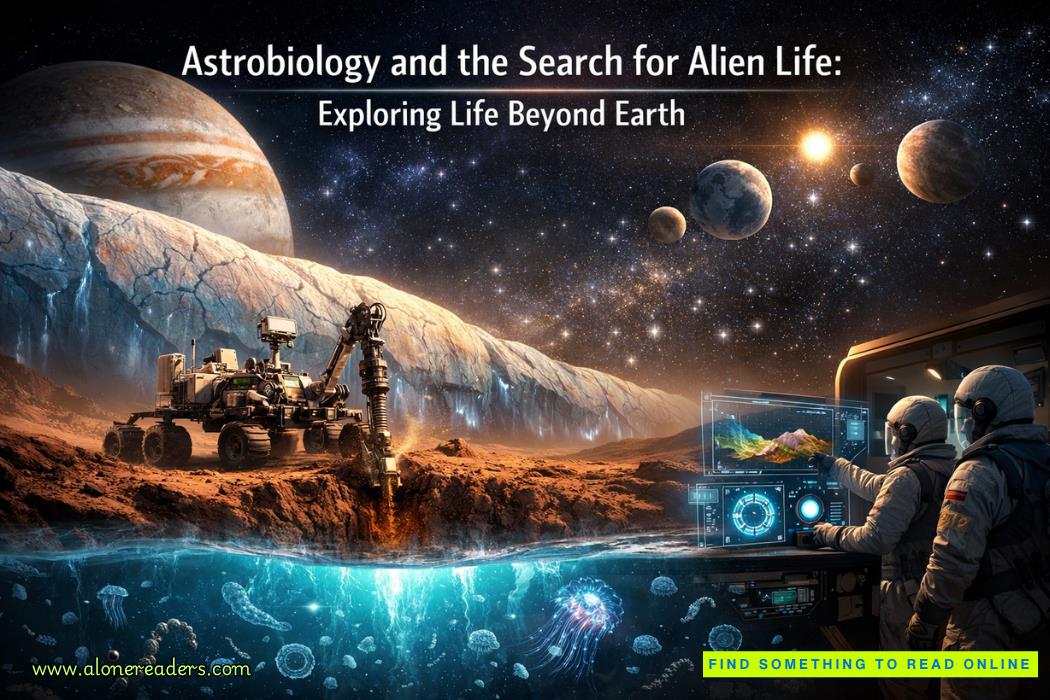
Astrobiology is one of the most intellectually ambitious scientific fields of the modern era. At its core lies one of humanity’s most profound questions: Are we alone in the universe? For centuries this question belonged primarily to philosophy, theology, and speculative fiction. Today, however, it has become a serious scientific inquiry supported by cutting-edge space missions, advanced telescopes, molecular biology, and planetary geology. Astrobiology is the interdisciplinary science dedicated to investigating the origin, evolution, distribution, and potential future of life in the universe. By combining astronomy, chemistry, geology, planetary science, and biology, researchers attempt to determine whether life could exist beyond Earth—and if so, where it might be found.
The search for extraterrestrial life begins with understanding how life emerged on Earth. Scientists believe that life developed roughly 3.5 to 4 billion years ago when simple organic molecules assembled into increasingly complex structures capable of metabolism and replication. Early Earth was a volatile environment filled with volcanic activity, lightning, and a chemically rich atmosphere. These conditions likely enabled the formation of amino acids, nucleotides, and other organic molecules that eventually led to the first primitive cells. Astrobiologists analyze these early processes because if life arose naturally under certain environmental conditions on Earth, similar processes could potentially occur elsewhere in the universe.
One of the most important elements in the search for life is liquid water. Water acts as a universal solvent, allowing chemical reactions necessary for life to occur efficiently. Because of this, astrobiologists often describe their strategy as “follow the water.” When scientists discover environments where liquid water may exist or may have existed in the past, those locations immediately become prime targets in the search for extraterrestrial biology. Across the solar system, several planetary bodies show evidence suggesting that water once flowed or still exists beneath their surfaces.
Mars has been the primary focus of astrobiological exploration for decades. Geological observations from orbiting spacecraft reveal ancient river valleys, dried lake beds, and mineral deposits that form only in the presence of water. Billions of years ago, Mars may have possessed a thicker atmosphere and a warmer climate capable of sustaining rivers and possibly shallow seas. Today, robotic explorers such as advanced rovers analyze Martian rocks and soil in search of chemical signatures that might indicate ancient microbial activity. These missions are particularly interested in identifying organic molecules, sedimentary layers formed in water, and minerals that preserve traces of biological processes. If microbial life ever existed on Mars, traces of its chemical fingerprints may still be preserved in ancient rock formations.
Beyond Mars, some of the most promising environments for extraterrestrial life may lie beneath thick layers of ice. Several moons in the outer solar system appear to harbor vast subsurface oceans. Jupiter’s moon Europa is one of the most compelling examples. Its surface is covered by a cracked icy crust that scientists believe floats above a deep global ocean of liquid water. Tidal forces generated by Jupiter’s immense gravity create internal heat within Europa, preventing the ocean from freezing completely. This combination of water, heat, and potentially mineral-rich seafloor environments resembles conditions found near hydrothermal vents in Earth’s oceans—locations where thriving ecosystems exist without sunlight.
Saturn’s moon Enceladus presents another extraordinary case. Observations from spacecraft have detected towering plumes of water vapor and ice particles erupting from fractures near its south pole. These plumes contain organic molecules and salts, indicating that a chemically active ocean lies beneath the moon’s frozen surface. Astrobiologists consider such environments extremely promising because they combine liquid water, chemical nutrients, and energy sources—three essential ingredients for life as we understand it.
While planetary exploration focuses on our solar system, another branch of astrobiology searches far beyond it. Over the past few decades astronomers have discovered thousands of exoplanets, planets orbiting stars outside our solar system. Some of these worlds lie within what scientists call the habitable zone, the region around a star where temperatures may allow liquid water to exist on a planet’s surface. Using sophisticated telescopes and spectroscopic techniques, researchers analyze the atmospheres of these distant planets. Certain gases—such as oxygen, methane, or combinations of chemicals that normally react with one another—could potentially indicate biological processes.
The concept of biosignatures is central to this research. A biosignature is any measurable substance, structure, or pattern that could indicate the presence of life. On Earth, biological activity leaves many distinctive chemical and geological traces. For example, oxygen in Earth’s atmosphere is largely produced by photosynthetic organisms. If astronomers detect similar atmospheric patterns on distant planets, it might suggest the presence of life. However, interpreting these signals is extremely challenging because many chemical processes can mimic biological effects. Astrobiologists must carefully distinguish between biological and purely geological or atmospheric explanations.
Interestingly, the search for extraterrestrial life has also led scientists to study life in some of the most extreme environments on Earth. These organisms, known as extremophiles, thrive under conditions once thought to be incompatible with life. Some microbes survive in boiling hydrothermal vents on the ocean floor where temperatures exceed 100 degrees Celsius. Others live deep beneath Antarctic ice, in highly acidic lakes, or in extremely salty environments. Certain microorganisms can even survive intense radiation or long periods of desiccation. These discoveries have dramatically expanded scientists’ understanding of where life can exist.
Deep-sea hydrothermal vents are particularly important analog environments for astrobiology. In these locations, seawater interacts with hot magma beneath the ocean floor, producing mineral-rich fluids that support unique ecosystems. Microorganisms use chemical energy rather than sunlight to fuel their metabolism through processes known as chemosynthesis. Entire communities of organisms—including giant tube worms, shrimp, and clams—depend on these microbial energy cycles. If similar hydrothermal systems exist on ocean worlds like Europa or Enceladus, they could potentially sustain comparable microbial ecosystems.
Another major component of astrobiology involves the study of organic chemistry in space. Complex organic molecules have been detected in interstellar clouds, meteorites, and cometary material. Some meteorites that have fallen to Earth contain amino acids and other molecular building blocks of life. These discoveries suggest that the fundamental ingredients for biology may be widespread throughout the universe. Rather than being rare anomalies, the chemical precursors to life might form naturally in many cosmic environments.
Modern astrobiology is closely tied to advanced space missions and international scientific collaboration. Robotic spacecraft are designed with increasingly sophisticated instruments capable of analyzing planetary surfaces, drilling into subsurface materials, and detecting trace chemical compounds. Some missions aim to collect samples from other planetary bodies and return them to Earth for detailed laboratory analysis. These samples could reveal microscopic structures, organic molecules, or isotopic patterns that indicate biological activity.
Another intriguing avenue of research involves listening for signals from technologically advanced civilizations. Radio telescopes scan the cosmos for unusual patterns that might represent intentional communication from extraterrestrial intelligence. While no confirmed signals have been detected, the search continues with ever-improving detection technologies. The discovery of even a simple microbial ecosystem beyond Earth would be revolutionary, but evidence of intelligent extraterrestrial life would fundamentally transform humanity’s understanding of its place in the universe.
The philosophical implications of astrobiology are profound. If life exists elsewhere, it would suggest that biological processes are a common outcome of cosmic evolution rather than a unique accident limited to Earth. This realization would reshape perspectives across science, philosophy, and even cultural worldviews. Humanity would no longer see itself as the sole living presence in an otherwise lifeless cosmos but as part of a much larger biological tapestry spread across countless worlds.
Future discoveries in astrobiology may arrive sooner than many expect. New generations of space telescopes will soon have the ability to analyze exoplanet atmospheres with unprecedented precision. Planned missions to icy moons aim to probe subsurface oceans and analyze plume material for organic chemistry. Advances in artificial intelligence and data analysis are helping scientists interpret vast datasets collected by spacecraft and observatories. Each technological breakthrough brings humanity closer to answering the question that inspired the field in the first place.
Ultimately, astrobiology represents more than a scientific discipline—it embodies humanity’s curiosity about its origins and its cosmic context. By studying distant planets, hidden oceans, and microscopic life in extreme environments, scientists are gradually building a clearer picture of how life emerges and adapts across the universe. Whether the first confirmed extraterrestrial life is discovered on Mars, beneath Europa’s icy crust, or on a distant exoplanet orbiting another star, the impact will be extraordinary. Such a discovery would not only expand scientific knowledge but also redefine humanity’s understanding of life itself.
In that sense, astrobiology is both a scientific investigation and a form of cosmic self-exploration. As humanity peers deeper into space, it is also searching for reflections of its own biological story—evidence that the processes that created life on Earth may be unfolding on countless other worlds scattered throughout the universe.



 Château de Vincennes: France’s Forgotten Royal Fortress and Medieval Stronghold
 Château de Carcassonne: Europe’s Greatest Medieval Citadel and Fortress
 Château de Chenonceau: The Castle Built by Remarkable Women
 Château de Chambord: France’s Magnificent Renaissance Castle and Architectural Wonder
 Tehri Dam: India's Tallest Dam and the Debate Behind It
 Bhakra Nangal Dam: India's Temple of Modern Development