Who reached distant islands before the invention of recognizable boats?
That question sits at the center of one of the most fascinating puzzles in human prehistory. Long before written records, long before sails crossed oceans, and long before civilizations mapped coastlines, ancient humans somehow appeared on islands separated by stretches of open water. Their presence challenges traditional assumptions about technological development and raises a profound possibility: perhaps seafaring began far earlier than once believed.
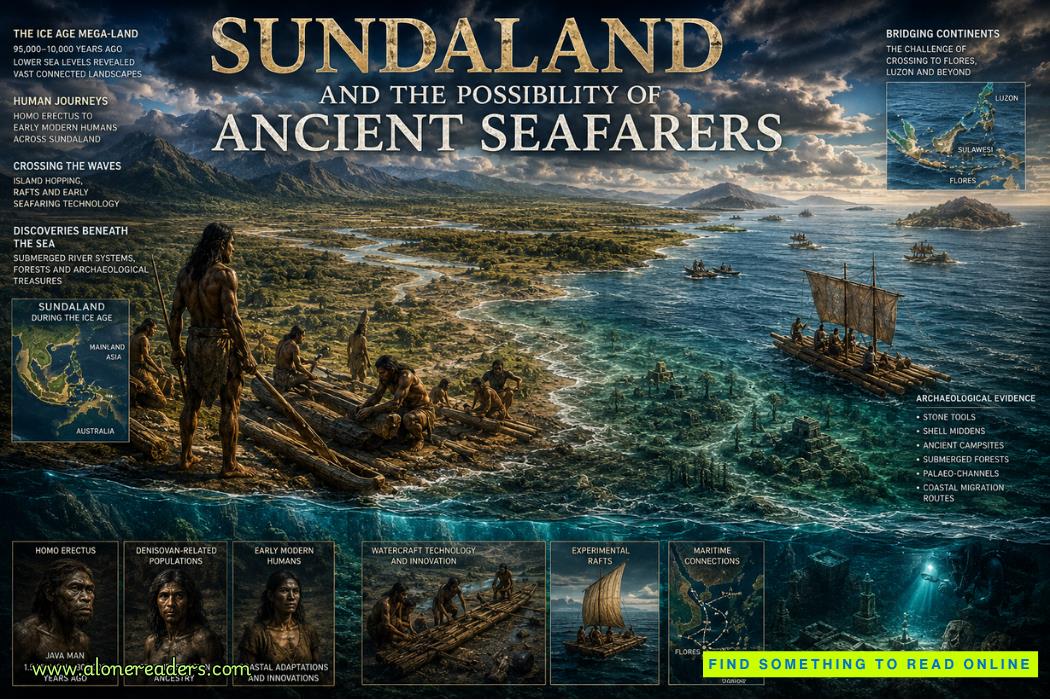
The mystery becomes even more compelling when viewed through the lens of the Sundaland sunken world, a lost landscape that once connected much of Southeast Asia into a vast habitable continent. Today, much of this territory lies beneath shallow seas, concealing evidence of human activity that may fundamentally reshape our understanding of migration, adaptation, and exploration.
As archaeologists, geologists, and paleoanthropologists continue to investigate drowned landscapes and remote islands, a picture is emerging that is both scientifically grounded and deeply intriguing. It suggests that ancient seafarers may have been navigating challenging environments tens or even hundreds of thousands of years before modern maritime technology appeared.
Key Takeaways
To appreciate the mystery of ancient seafarers, it is necessary to understand what Southeast Asia looked like during the Ice Age.
Over the past two million years, Earth experienced repeated glacial periods. During these cold phases, enormous amounts of water became trapped in continental ice sheets. As a result, global sea levels sometimes fell by more than 100 meters.
When sea levels dropped, a vast region known as Sundaland emerged.
Modern-day islands such as Sumatra, Java, and Borneo became connected to mainland Southeast Asia through extensive plains, forests, wetlands, and river systems. Areas that are now submerged beneath the South China Sea, Java Sea, and surrounding waters were once thriving landscapes supporting diverse ecosystems.
Rather than a collection of islands, much of the region resembled a massive continent.
A Landscape Rich in Resources
Sundaland was not an empty wilderness.
Ancient river systems rivaled some of today's largest rivers. Extensive forests supported large mammals, while fertile valleys provided abundant resources for human populations. Such environments would have attracted successive waves of hominins, including Homo erectus and later modern humans.
The region likely contained migration routes, hunting grounds, seasonal camps, and perhaps long-term settlements that are now underwater.
This creates a major challenge for archaeology.
Many of the places where ancient people actually lived are currently hidden beneath the sea.
If Sundaland connected so much territory, why is seafaring even necessary?
The answer lies beyond Sundaland itself.
Even during periods of extremely low sea levels, certain islands remained isolated by deep-water channels. These islands belonged to a different biogeographical region often referred to as Wallacea.
Places such as Flores, Sulawesi, and parts of the Philippines were never fully connected to the mainland.
To reach them, ancient humans had to cross water.
This is where the mystery becomes particularly interesting.
The Flores Enigma
One of the most famous examples comes from Flores.
The island became globally known after the discovery of the diminutive hominin species popularly nicknamed "the Hobbit." However, even before these discoveries, archaeologists had found evidence suggesting that ancient human ancestors reached Flores hundreds of thousands of years ago.
The ancestors involved may have been related to Homo erectus.
Yet reaching Flores required crossing marine barriers.
Even during periods of low sea levels, the island was separated from neighboring landmasses by water.
This means that either accidental drifting occurred repeatedly or some form of deliberate water crossing took place.
Neither explanation is trivial.
The repeated arrival of populations over long periods suggests a level of adaptability that challenges outdated assumptions about early humans.
For much of the twentieth century, Homo erectus was often portrayed as technologically limited compared to later humans.
Recent discoveries paint a more nuanced picture.
Homo erectus survived for over a million years across diverse environments. They adapted to changing climates, developed increasingly sophisticated stone tools, and expanded across enormous geographical distances.
The possibility of Homo erectus island travel adds another dimension to their achievements.
Accidental Versus Intentional Voyages
Scientists continue to debate whether early crossings were accidental or intentional.
Storms, tsunamis, and flooding events can transport vegetation rafts carrying animals and even humans. Such events undoubtedly occurred throughout prehistory.
However, some researchers argue that repeated colonization patterns may indicate more than chance.
Constructing even a simple raft from logs, bamboo, or other natural materials does not require advanced shipbuilding. It requires observation, experimentation, and social learning.
Those abilities existed long before civilization.
The challenge is finding direct evidence, because organic materials used in primitive watercraft rarely survive for hundreds of thousands of years.
Another fascinating question concerns the possibility of Denisovan seafarers.
Denisovans remain one of the most mysterious human groups ever discovered. Known largely from genetic evidence and limited fossil remains, they appear to have occupied vast areas of Asia.
Modern populations in parts of Southeast Asia and Oceania carry significant Denisovan genetic ancestry.
This raises intriguing questions.
How did Denisovan populations spread across such complex island environments?
Were they capable of water crossings similar to those proposed for other ancient human groups?
Direct evidence remains limited, but the geographic distribution of Denisovan ancestry suggests that movement through island-rich landscapes was more extensive than once imagined.
Scientists remain cautious, yet the possibility continues to attract serious investigation.
One reason the puzzle remains unresolved is that much of the evidence may literally be underwater.
The coastlines inhabited during Ice Age periods no longer exist above sea level.
When sea levels rose after the last glacial maximum, vast areas of Sundaland disappeared beneath the ocean.
The Missing Archaeological Record
Human populations often concentrate near rivers, estuaries, and coastlines.
These environments provide food, transportation routes, and ecological diversity.
If ancient communities behaved similarly, many of their most important sites would now lie beneath shallow seas.
Researchers have already identified submerged river channels, ancient lake systems, and drowned landscapes throughout Southeast Asia.
Advanced mapping technologies are beginning to reveal the shape of these lost environments.
Each new survey increases the possibility that future underwater excavations could uncover stone tools, campsites, or even human remains.
Such discoveries would dramatically improve our understanding of ancient migration routes.
The story of Sundaland has attracted considerable public attention, but not all interpretations are equally credible.
Misconception 1: Sundaland Was an Advanced Lost Civilization
A popular claim suggests that Sundaland hosted a highly advanced civilization destroyed by rising seas.
Current archaeological evidence does not support this conclusion.
While Ice Age populations certainly lived throughout the region, evidence for advanced urban societies, monumental architecture, or technologically sophisticated civilizations remains absent.
Misconception 2: Every Underwater Structure Is Human-Made
Natural geological formations frequently resemble walls, terraces, roads, or buildings.
Determining whether a structure is artificial requires careful excavation, dating, and contextual analysis.
Visual resemblance alone is not evidence.
Misconception 3: Scientists Ignore Alternative Theories
In reality, scientists actively investigate surprising possibilities.
The key difference is that conclusions must be supported by verifiable evidence.
Extraordinary claims require extraordinary proof.
The most exciting discoveries often emerge from rigorous investigation rather than speculation.
When people imagine seafaring, they often envision sophisticated boats.
Ancient crossings may have required much less.
Knowledge Rather Than Technology
Successful water crossings depend on several factors:
Even simple floating platforms can become effective transportation when combined with environmental knowledge.
Many traditional societies developed remarkable maritime skills using technologies that appear simple by modern standards.
This suggests that ancient seafarers may have relied more on accumulated ecological knowledge than on complex engineering.
The greatest discoveries may still lie ahead.
Technological advances are transforming the exploration of submerged prehistoric landscapes.
High-resolution sonar, autonomous underwater vehicles, sediment analysis, and digital mapping are allowing researchers to investigate areas that were previously inaccessible.
The drowned plains of Southeast Asia represent one of the largest unexplored archaeological frontiers on Earth.
Entire river valleys remain hidden beneath relatively shallow waters.
Ancient camps, tool-making sites, migration corridors, and coastal settlements could still be preserved beneath layers of sediment.
The implications extend far beyond regional history.
Understanding how humans adapted to changing coastlines, rising seas, and fragmented landscapes offers valuable insights into the broader story of human resilience and innovation.
Future discoveries may reveal that maritime behavior emerged gradually over hundreds of thousands of years rather than appearing suddenly with modern civilizations.
The mystery of the Sundaland sunken world is not merely a story about lost land. It is a story about human adaptability, curiosity, and movement across challenging environments.
Evidence from island archaeology, fossil discoveries, and submerged landscapes suggests that ancient humans were far more capable than earlier generations of researchers imagined. The possibility that ancient seafarers, including populations linked to Homo erectus island travel and perhaps even Denisovan seafarers, crossed stretches of open water long before recognizable boats existed remains one of the most compelling questions in paleoanthropology.
At the same time, the strongest explanations emerge from careful scientific investigation rather than sensational claims about vanished civilizations. The true story is already extraordinary. Ancient humans expanded across some of the world's most complex landscapes, adapting to changing coastlines and exploring territories that challenged their survival.
Beneath the seas of Southeast Asia, the drowned landscapes of Sundaland still hold countless secrets. As underwater archaeology advances, those hidden plains may reveal new chapters in the story of humanity's earliest explorers—people who looked across the water, saw unknown horizons, and somehow found a way to reach them.
1. What was Sundaland?
Sundaland was a vast Ice Age landmass in Southeast Asia that connected many of today's islands when sea levels were much lower than they are now.
2. Why is Sundaland important to human history?
It may have served as a major migration corridor for ancient humans moving through Southeast Asia and toward island regions.
3. Did Homo erectus cross the sea?
Evidence suggests that Homo erectus or related populations may have reached islands separated by water, implying some form of water crossing.
4. Were Denisovans skilled seafarers?
There is no direct proof of Denisovan boats, but their presence in regions that required movement across island landscapes raises important questions about their mobility.
5. Could underwater archaeology change our understanding of prehistory?
Yes. Many ancient coastlines are now submerged, and future underwater discoveries may reveal settlements, tools, and migration routes currently hidden beneath the sea.



 Château de Vincennes: France’s Forgotten Royal Fortress and Medieval Stronghold
 Château de Carcassonne: Europe’s Greatest Medieval Citadel and Fortress
 Château de Chenonceau: The Castle Built by Remarkable Women
 Château de Chambord: France’s Magnificent Renaissance Castle and Architectural Wonder
 Tehri Dam: India's Tallest Dam and the Debate Behind It
 Bhakra Nangal Dam: India's Temple of Modern Development