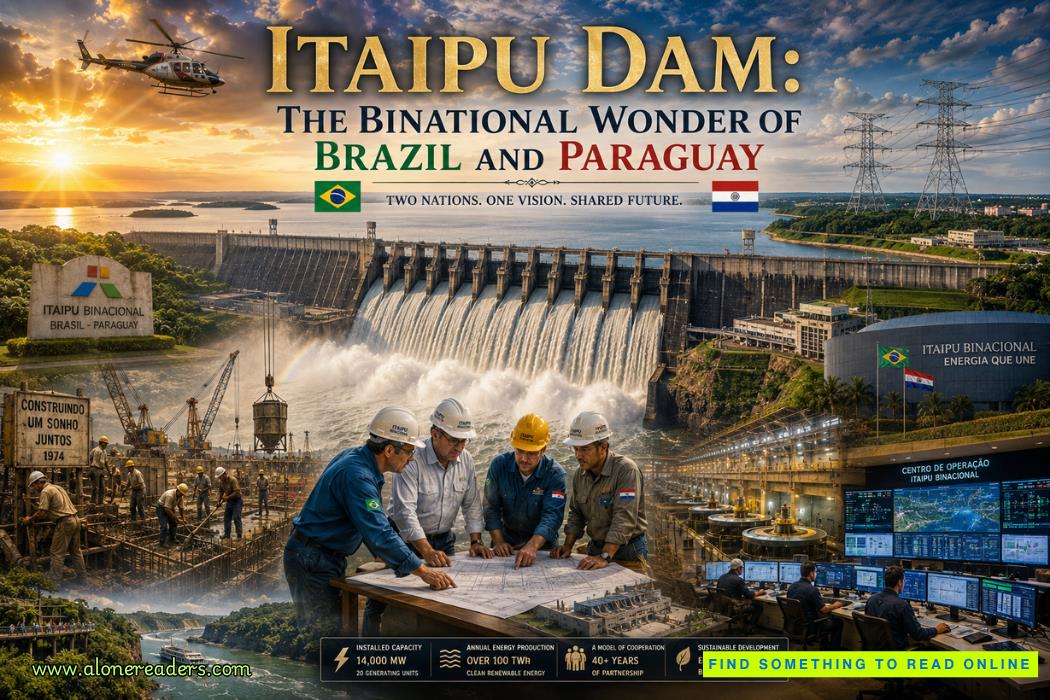
Flowing through the heart of South America, the Paraná River has long served as one of the continent's most important waterways. Stretching nearly 4,900 kilometers from Brazil to the Río de la Plata, the river carries enormous volumes of water through fertile plains, dense forests, and rapidly developing industrial regions. For centuries, its tremendous energy flowed untapped toward the Atlantic Ocean. During the twentieth century, however, two neighboring nations envisioned an engineering project unlike anything the world had seen before. That vision became Itaipu Dam, a colossal hydroelectric complex jointly built and operated by Brazil and Paraguay. Today, Itaipu is recognized not only as one of the world's largest hydroelectric power stations but also as one of history's greatest examples of international engineering cooperation.
Unlike many major dams that are entirely owned and managed by a single nation, Itaipu represents a remarkable partnership between two sovereign countries. The Paraná River forms part of the international boundary separating Brazil and Paraguay, meaning that any major development required cooperation rather than competition. Instead of disputing ownership of the river's immense hydroelectric potential, the two governments negotiated agreements that ultimately transformed the Paraná into a shared source of prosperity. Few engineering projects demonstrate the power of diplomacy and cooperation as successfully as Itaipu Dam.
The idea of harnessing the Paraná River emerged during the mid-twentieth century as both countries sought new sources of electricity to support economic development. Brazil's rapidly expanding industries demanded increasing amounts of reliable power, while Paraguay saw an opportunity to utilize a natural resource far beyond its domestic energy requirements. Engineers quickly recognized that the narrow gorge near the former Guaíra Falls provided an ideal location for constructing an enormous hydroelectric facility capable of generating unprecedented quantities of electricity.
Planning such a project required years of negotiations, scientific investigations, and engineering studies. The governments of Brazil and Paraguay signed the Itaipu Treaty in 1973, establishing the legal and financial framework for the project. This historic agreement created Itaipu Binacional, a jointly owned company responsible for designing, constructing, operating, and maintaining the dam. Every major decision—from financing and engineering standards to electricity distribution—would be managed through equal cooperation between the two countries. The treaty became one of the most successful examples of international collaboration in modern infrastructure development.
Construction officially began in 1975, marking the start of one of the largest civil engineering projects ever undertaken. The scale of the operation was almost unimaginable. Entire construction towns were established to accommodate tens of thousands of workers, engineers, surveyors, geologists, electricians, welders, heavy equipment operators, and technicians. At its peak, more than 40,000 workers participated in building the massive complex. The construction site became a city of its own, complete with housing, medical facilities, schools, transportation systems, workshops, laboratories, and supply networks operating around the clock.
One of the earliest and most difficult engineering challenges involved diverting the mighty Paraná River away from the future construction site. Engineers excavated an enormous diversion channel measuring approximately 2 kilometers in length, making it one of the largest river diversion projects ever attempted. Millions of cubic meters of earth and rock were removed using powerful excavators, bulldozers, blasting operations, and heavy trucks. Once completed, the river was redirected through the artificial channel, allowing construction crews to begin work on the dam's foundation. Successfully diverting one of South America's largest rivers demonstrated the extraordinary precision and planning behind the project.
Before concrete placement could begin, engineers carefully prepared the foundation. Extensive geological investigations confirmed that the underlying basalt rock provided exceptional stability for supporting the enormous weight of the structure. Weak rock formations were removed, fractures were sealed using pressure grouting, and drainage systems were installed beneath the foundation to reduce uplift pressure. Every stage of preparation was carefully inspected because the long-term safety of the dam depended entirely upon the quality of its foundation.
Unlike a single continuous wall, Itaipu Dam is actually a complex system consisting of several interconnected structures, including concrete gravity sections, hollow gravity sections, earth-fill embankments, rock-fill dams, spillways, and powerhouses. Together, these components extend for nearly 8 kilometers, making Itaipu one of the longest hydroelectric dam systems in the world. The central concrete sections provide structural stability, while the surrounding embankments close the remaining gaps across the broad Paraná Valley. This integrated design optimized construction efficiency while adapting to the natural topography of the site.
The amount of concrete required for the project was staggering. Approximately 12 million cubic meters of concrete were used throughout the complex, enough to construct hundreds of skyscrapers or thousands of large buildings. Massive batching plants operated continuously to produce carefully controlled concrete mixtures meeting strict engineering standards. Engineers monitored temperature, strength, curing conditions, and chemical composition throughout placement. Cooling systems prevented excessive heat buildup inside the enormous concrete blocks, ensuring the finished structure would remain durable for generations. Every cubic meter of concrete represented a carefully engineered balance between strength, durability, and long-term performance.
Perhaps Itaipu's greatest achievement lies within its hydroelectric powerhouse. The dam contains 20 giant turbine-generator units, each weighing hundreds of tons and designed to convert the Paraná River's immense energy into electricity with remarkable efficiency. Water enters through enormous intake structures before flowing down giant penstocks that direct it toward the turbines. As the water spins the turbine blades, mechanical energy is transformed into electrical power by massive generators capable of supplying electricity across vast transmission networks. For many years, Itaipu held the world record for annual hydroelectric electricity production, demonstrating exceptional operational efficiency.
The electricity generated by Itaipu has transformed both participating nations. Brazil receives a substantial portion of its renewable electricity from the facility, supporting major industrial centers, commercial development, transportation systems, and millions of households. Paraguay, with a much smaller population, generates far more electricity than it consumes domestically. Under the terms of the binational agreement, surplus Paraguayan electricity is sold to Brazil, creating an important source of national revenue. This unique energy-sharing arrangement has become one of the defining characteristics of Itaipu's international success.
The enormous Itaipu Reservoir formed behind the dam extends for approximately 170 kilometers, storing vast quantities of water necessary for continuous hydroelectric generation. The reservoir stabilizes river flow, allowing turbines to operate efficiently throughout the year despite seasonal variations in rainfall. In addition to electricity production, the reservoir has created opportunities for recreation, tourism, fishing, and scientific research while influencing regional climate and water management.
One of the dam's most visually spectacular features is its massive spillway system. During periods of exceptionally high rainfall, surplus water is safely discharged through enormous gated spillways capable of releasing astonishing volumes of water every second. When fully opened, the spillway creates a breathtaking cascade resembling one of the world's largest artificial waterfalls. The tremendous roar of rushing water and towering clouds of mist have made spillway operations a major attraction for visitors from around the world.
Construction of Itaipu Dam also required significant social and environmental changes. Thousands of families were relocated as the reservoir gradually filled behind the completed structure. Agricultural lands, forests, and settlements disappeared beneath rising waters, while the famous Guaíra Falls, once among the most powerful waterfalls on Earth by volume, were permanently submerged. The loss of these spectacular falls remains one of the project's most significant environmental and cultural consequences. Itaipu illustrates how major infrastructure projects often require difficult trade-offs between development and preservation.
Recognizing these challenges, Itaipu Binacional has invested heavily in environmental conservation. Extensive reforestation programs have restored large areas surrounding the reservoir, creating protected forests that support biodiversity and reduce soil erosion. Wildlife rescue operations accompanied reservoir filling, relocating thousands of animals to safer habitats before flooding occurred. Environmental monitoring continues to evaluate water quality, fish populations, vegetation, and ecosystem health throughout the region. Today, the protected forests surrounding the reservoir have become important ecological corridors supporting numerous species of birds, mammals, reptiles, and amphibians.
The dam has also become a global leader in sustainability initiatives beyond electricity generation. Itaipu Binacional supports educational programs, renewable energy research, watershed protection, sustainable agriculture, waste management, and community development projects throughout both Brazil and Paraguay. Its mission has evolved far beyond power production to include long-term environmental stewardship and regional sustainability.
Technological modernization has allowed Itaipu to remain one of the world's most advanced hydroelectric facilities. Sophisticated digital control centers continuously monitor turbine performance, generator temperatures, water flows, structural movement, electrical demand, and transmission systems. Thousands of sensors embedded throughout the structure provide real-time data that engineers use to optimize operations while ensuring long-term safety. Predictive maintenance systems identify potential equipment issues before failures occur, maximizing reliability and minimizing downtime.
Routine maintenance at Itaipu is itself an extraordinary engineering operation. Individual turbine-generator units can be taken offline while others continue producing electricity, allowing inspections, component replacement, and modernization without interrupting overall power supply. Engineers regularly upgrade control systems, electrical equipment, and mechanical components to improve efficiency and extend operational life. These continuous improvements ensure that Itaipu remains one of the most productive hydroelectric facilities ever constructed despite operating for decades.
Tourism has become another important aspect of the dam's legacy. Millions of visitors travel annually to witness its enormous dimensions, tour the powerhouse, observe the giant turbines, and experience panoramic views of the spillway and reservoir. Educational exhibits explain the engineering, environmental programs, and international cooperation that made the project possible. For many visitors, Itaipu represents not merely a hydroelectric facility but a symbol of what neighboring nations can accomplish through shared vision and mutual trust.
The engineering achievements of Itaipu have influenced hydroelectric projects around the world. Civil engineers study its structural design, river diversion methods, turbine technology, international management model, and long-term operational strategies. Lessons learned during its construction have contributed to advances in large-scale concrete engineering, reservoir management, environmental mitigation, and multinational infrastructure planning.
Today, nearly half a century after construction began, Itaipu Dam continues fulfilling the ambitious goals envisioned by its creators. It supplies enormous quantities of renewable electricity, strengthens the economies of both Brazil and Paraguay, supports sustainable development initiatives, promotes scientific research, and demonstrates the lasting value of peaceful international cooperation. Its success proves that engineering excellence is not measured solely by concrete, steel, or generating capacity, but also by the ability to unite nations in pursuit of a common purpose.
Among the world's greatest dams, Itaipu occupies a truly unique place. It is not merely one of the largest hydroelectric facilities ever built—it is a living example of diplomacy transformed into engineering, shared natural resources transformed into shared prosperity, and technological innovation serving two nations simultaneously. Its enduring legacy stands as a powerful reminder that humanity's greatest engineering achievements are often built not only with machinery and mathematics, but also with cooperation, trust, and a vision that extends beyond national borders.




 Château de Vincennes: France’s Forgotten Royal Fortress and Medieval Stronghold
 Château de Carcassonne: Europe’s Greatest Medieval Citadel and Fortress
 Château de Chenonceau: The Castle Built by Remarkable Women
 Château de Chambord: France’s Magnificent Renaissance Castle and Architectural Wonder
 Tehri Dam: India's Tallest Dam and the Debate Behind It
 Bhakra Nangal Dam: India's Temple of Modern Development










