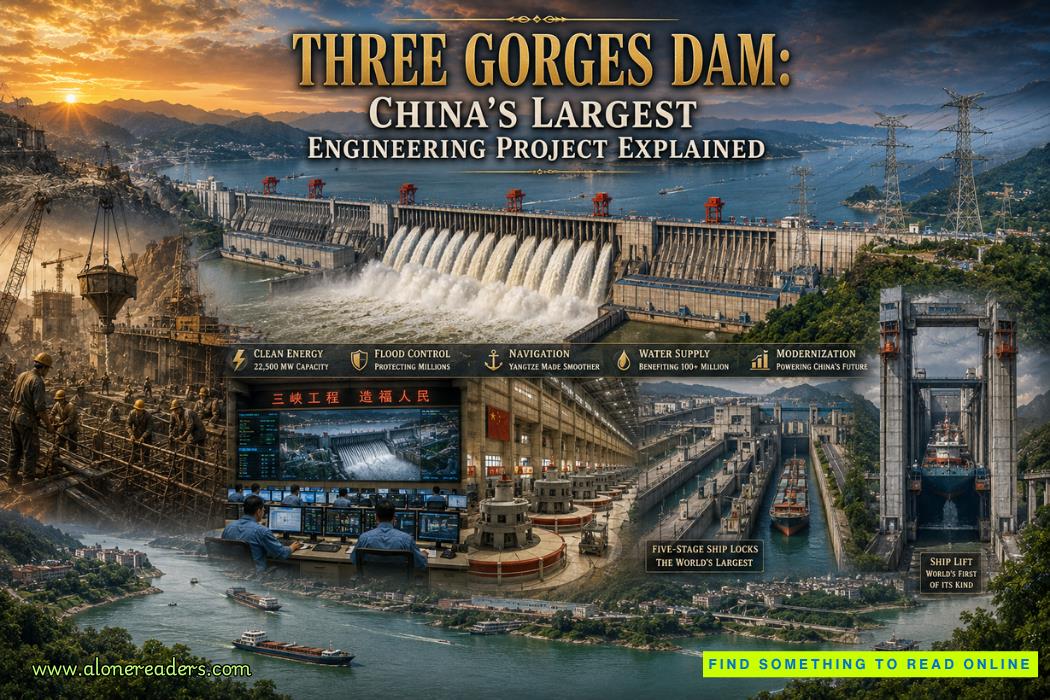
Stretching across the mighty Yangtze River in central China, the Three Gorges Dam is one of the most ambitious engineering projects ever undertaken by humanity. Rising above the river in Hubei Province, this monumental structure represents decades of planning, technological innovation, and national determination. It is not only the world's largest hydroelectric power station by installed generating capacity, but also one of the most complex infrastructure projects in history, designed to control flooding, improve navigation, generate vast amounts of renewable electricity, and support China's rapidly growing economy. At the same time, it has become one of the world's most debated engineering achievements because of its enormous environmental and social impacts. The story of the Three Gorges Dam is therefore one of extraordinary engineering success intertwined with equally significant challenges.
The Yangtze River has shaped Chinese civilization for thousands of years. Extending more than 6,300 kilometers, it is the longest river in Asia and the third-longest in the world. Flowing from the Tibetan Plateau to the East China Sea, the Yangtze has supported agriculture, transportation, commerce, and cultural development for millennia. Yet the river has also been responsible for some of history's most destructive floods. Seasonal rainfall and snowmelt frequently caused the river to overflow its banks, devastating towns, farmland, and entire provinces. Throughout Chinese history, catastrophic flooding along the Yangtze claimed countless lives and caused immense economic losses. Controlling this powerful river became one of China's greatest engineering ambitions.
The idea of constructing a massive dam across the Yangtze dates back to the early twentieth century. Visionaries believed that a large reservoir could simultaneously reduce flood risks, improve inland navigation, and generate electricity for industrial development. However, the technical and financial challenges were far beyond the capabilities of the time. For decades, the proposal remained largely theoretical while engineers continued studying the river's geology, hydrology, and environmental conditions. As China's economy expanded during the late twentieth century, advances in engineering, heavy construction equipment, and hydroelectric technology finally made the project feasible.
Formal approval for the Three Gorges Dam was granted during the 1990s after years of planning, technical evaluations, and national debate. Construction officially began in 1994, marking the start of one of the largest civil engineering projects ever attempted. Thousands of engineers, geologists, architects, environmental specialists, surveyors, and construction workers participated in the undertaking. At its peak, the project employed tens of thousands of people, supported by massive concrete plants, heavy machinery, specialized transportation systems, and extensive quality control laboratories. Few construction projects in history have required such an enormous concentration of engineering expertise and logistical coordination.
Selecting the dam site demanded extensive geological investigations. Engineers carefully analyzed rock formations beneath the Yangtze River to ensure the foundation could safely support a structure weighing millions of tons. The chosen location near Sandouping offered exceptionally strong granite bedrock, reducing the risk of settlement or structural instability. Detailed seismic studies were also conducted because western China experiences varying levels of tectonic activity. Every aspect of the foundation had to withstand not only immense water pressure but also potential earthquakes over the dam's projected lifespan.
The completed Three Gorges Dam is an astonishing example of concrete gravity dam engineering. Measuring approximately 2,335 meters in length and standing about 185 meters high, the structure stretches across the entire width of the Yangtze River. Rather than relying on curved geometry like an arch dam, it depends primarily upon its enormous weight to resist the tremendous hydraulic pressure exerted by the vast reservoir behind it. Millions of cubic meters of high-strength concrete were placed in carefully controlled sections, ensuring long-term durability while minimizing thermal cracking during construction.
Concrete production became one of the project's greatest engineering challenges. Massive batching plants operated continuously to supply carefully designed concrete mixtures meeting strict performance standards. Engineers monitored aggregate quality, cement composition, temperature, and curing conditions throughout the construction process. Cooling systems controlled heat generated during concrete hydration, preventing excessive internal stress. The precision required in placing and curing such enormous quantities of concrete represented one of the largest concrete engineering operations ever undertaken.
Perhaps the dam's most remarkable feature is its hydroelectric generating system. The Three Gorges Dam contains 34 massive turbine-generator units, making it the largest hydroelectric power station on Earth by installed capacity. Water released through giant penstocks spins turbines connected to generators capable of producing tens of billions of kilowatt-hours of electricity annually. This renewable energy supplies major industrial centers and densely populated cities across China, reducing dependence on coal-fired power stations and contributing significantly to national energy security. No other hydroelectric facility in the world matches the Three Gorges Dam's installed generating capacity.
The scale of electricity production has had profound economic implications. Reliable electrical power supports manufacturing, transportation, technology industries, commercial development, and residential communities throughout eastern and central China. The dam contributes to stabilizing the national power grid by supplying large quantities of renewable energy capable of responding rapidly to changing demand. Unlike many other renewable energy sources, hydroelectric generation can often be adjusted within minutes, making it especially valuable for balancing fluctuations in electricity consumption.
Flood control remains one of the dam's primary purposes. Before its construction, severe flooding along the Yangtze repeatedly caused widespread destruction. The enormous Three Gorges Reservoir, extending more than 600 kilometers upstream, stores vast quantities of floodwater during periods of intense rainfall. By regulating downstream releases, operators can substantially reduce peak flood flows that might otherwise threaten major cities and agricultural regions. Protecting millions of people from catastrophic flooding has been one of the project's most significant long-term achievements.
Another remarkable aspect of the Three Gorges Dam is its contribution to inland navigation. Before construction, dangerous rapids and seasonal variations limited commercial shipping through the Three Gorges region. The dam transformed this section of the Yangtze into a navigable waterway capable of accommodating much larger cargo vessels. Engineers constructed a sophisticated five-stage ship lock system, allowing ships to move safely between different water levels. In addition, an innovative vertical ship lift enables smaller vessels to bypass the locks in a fraction of the time. These navigation improvements significantly increased cargo transportation along the Yangtze, strengthening trade between inland provinces and China's coastal regions.
The reservoir created behind the dam dramatically altered the surrounding landscape. Stretching through spectacular mountain gorges, it became one of the largest artificial lakes in the world. While the reservoir improved navigation and flood storage, its creation also required the relocation of an extraordinary number of people. More than one million residents were resettled as towns, villages, farmland, and infrastructure were submerged beneath rising water levels. Entire communities moved to newly constructed urban areas, making this one of the largest population relocation efforts ever associated with an engineering project. The social consequences of the reservoir remain among the dam's most widely discussed aspects.
The project also affected China's rich cultural heritage. Numerous archaeological sites, ancient temples, historical settlements, and cultural landmarks lay within areas designated for flooding. Before reservoir filling began, archaeologists conducted extensive rescue excavations to document and preserve important artifacts wherever possible. Some historical structures were relocated to higher ground, while others could only be recorded before disappearing beneath the reservoir. These preservation efforts highlighted the complex relationship between modern infrastructure development and historical conservation.
Environmental considerations surrounding the Three Gorges Dam have generated international attention. Reservoir creation altered river ecosystems, sediment transport, water quality, and wildlife habitats. Fish migration patterns changed significantly, while reduced sediment reaching downstream regions influenced wetlands, riverbanks, and coastal environments. Scientists continue studying these ecological changes to better understand their long-term consequences. In response, environmental monitoring programs, habitat protection initiatives, and conservation measures have been implemented to reduce some of the project's impacts. The Three Gorges Dam demonstrates both the immense capabilities of modern engineering and the importance of carefully balancing development with environmental stewardship.
Sediment management represents another ongoing engineering challenge. The Yangtze River naturally carries enormous quantities of silt from upstream regions. Without careful reservoir operation, sediment accumulation could gradually reduce storage capacity and affect hydroelectric performance. Engineers employ sophisticated water release strategies, hydrological modeling, and continuous monitoring to manage sediment transport while preserving reservoir efficiency. These operational techniques continue evolving as additional scientific data becomes available.
Modern technology plays a central role in the dam's daily operation. Thousands of sensors continuously monitor structural movement, water pressure, seepage, vibration, concrete temperatures, and mechanical equipment. Advanced digital control systems analyze real-time information, allowing operators to optimize electricity generation, reservoir levels, flood management, and navigation. Artificial intelligence and predictive maintenance software increasingly assist engineers in identifying potential equipment issues before failures occur. The Three Gorges Dam functions not merely as a massive concrete structure but as one of the world's most sophisticated intelligent infrastructure systems.
Climate variability has introduced additional operational challenges. Changes in rainfall patterns, prolonged droughts, and extreme weather events require continual adjustments to reservoir management strategies. Engineers balance multiple objectives simultaneously, including flood protection, hydropower generation, water supply, ecological considerations, and navigation. Sophisticated forecasting models now integrate weather predictions, upstream river flows, and electricity demand to support complex operational decisions throughout the year.
Despite ongoing debate, the Three Gorges Dam has undeniably transformed China's infrastructure. It has significantly expanded renewable electricity production, improved flood protection for millions of people, enhanced inland navigation, stimulated regional economic development, and demonstrated China's ability to execute engineering projects of unprecedented scale. The knowledge gained during its design and construction has influenced dam engineering, concrete technology, hydroelectric development, and large-scale project management worldwide.
Internationally, the Three Gorges Dam has become a benchmark for discussing the opportunities and challenges associated with megaprojects. Engineers study its structural design, turbine technology, reservoir management, navigation systems, and monitoring techniques, while environmental scientists analyze its ecological impacts and long-term sustainability. Governments considering similar projects often examine the Three Gorges experience when evaluating future hydroelectric developments. Few engineering projects have generated such extensive technical, environmental, economic, and political discussion across the global engineering community.
Today, the Three Gorges Dam remains a defining symbol of twenty-first-century infrastructure. Its immense concrete walls, giant turbines, advanced ship locks, and vast reservoir illustrate the extraordinary capabilities of modern engineering. At the same time, its environmental and social legacy reminds the world that projects of such scale require careful planning, responsible management, and continuous adaptation. The true significance of the Three Gorges Dam lies not only in its record-breaking dimensions, but in its lasting influence on engineering, energy production, water management, and the global conversation about balancing technological progress with environmental and human responsibility.




 Château de Vincennes: France’s Forgotten Royal Fortress and Medieval Stronghold
 Château de Carcassonne: Europe’s Greatest Medieval Citadel and Fortress
 Château de Chenonceau: The Castle Built by Remarkable Women
 Château de Chambord: France’s Magnificent Renaissance Castle and Architectural Wonder
 Tehri Dam: India's Tallest Dam and the Debate Behind It
 Bhakra Nangal Dam: India's Temple of Modern Development










