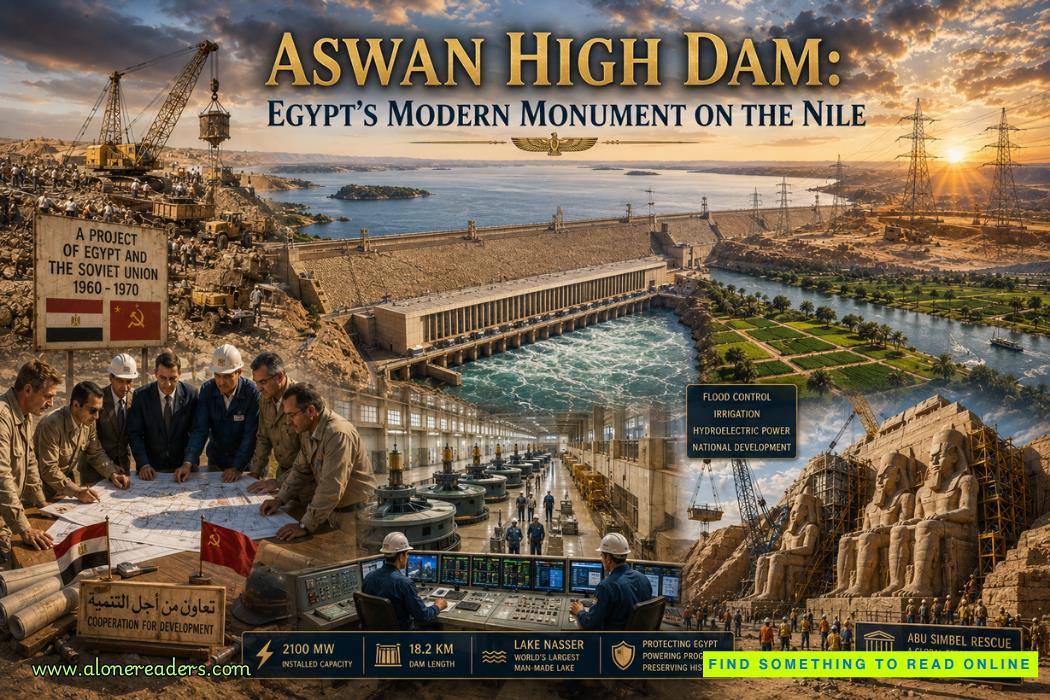
For more than five thousand years, the Nile River has been the lifeblood of Egypt. Flowing northward through deserts before emptying into the Mediterranean Sea, the Nile transformed an otherwise arid landscape into one of the world's earliest and greatest civilizations. Ancient Egyptians depended on the river's annual floods to enrich their farmland with fertile silt, making agriculture possible in a region where rainfall was scarce. Yet while the floods brought prosperity, they also carried uncertainty. Some years the waters rose too high, destroying villages and crops, while in other years insufficient flooding caused drought and famine. For centuries, controlling the Nile remained one of Egypt's greatest ambitions. That ambition ultimately became reality with the construction of the Aswan High Dam, one of the twentieth century's most significant engineering achievements and a project that permanently transformed Egypt's economy, agriculture, and society.
Long before the modern dam existed, engineers recognized the strategic importance of the Aswan region. During the late nineteenth century, Egypt was already seeking ways to regulate the Nile's seasonal flow. The original Aswan Low Dam, completed in 1902 under British supervision, represented an important milestone in hydraulic engineering. Although the structure improved irrigation and water storage, it soon became clear that it could not meet the demands of a rapidly growing population. The reservoir's capacity proved insufficient during prolonged droughts, while increasing agricultural expansion required much larger and more reliable water supplies. Egypt needed a far larger solution capable of controlling the entire river rather than simply moderating seasonal fluctuations.
Following the Egyptian Revolution of 1952, national development became a central priority. President Gamal Abdel Nasser viewed the construction of a massive new dam as essential for transforming Egypt into a modern industrial nation. The proposed project promised to eliminate destructive flooding, provide year-round irrigation, generate large quantities of renewable electricity, and reduce dependence on unpredictable natural river cycles. Beyond its practical benefits, the dam also became a symbol of national independence and technological progress.
Financing such an enormous undertaking, however, proved politically complex. Initial discussions involved international financial institutions and Western governments, but geopolitical tensions during the Cold War altered the project's direction. Eventually, the Soviet Union agreed to provide substantial financial assistance, engineering expertise, heavy equipment, and technical training. Construction officially began in 1960, marking the beginning of one of the largest earth-fill dam projects ever attempted. Thousands of Egyptian workers collaborated with Soviet engineers, creating an international partnership that would fundamentally reshape the Nile River.
Selecting the site near the city of Aswan offered several engineering advantages. The river flowed through strong granite bedrock capable of supporting an enormous structure, while the surrounding terrain allowed the creation of an exceptionally large reservoir. Extensive geological investigations examined rock stability, groundwater conditions, seismic activity, and foundation strength before construction commenced. Engineers understood that the long-term success of the project depended upon an exceptionally stable foundation capable of supporting billions of tons of water for generations.
Unlike many famous dams built primarily from concrete, the Aswan High Dam is a rockfill embankment dam. Measuring approximately 3,830 meters in length, standing around 111 meters high, and extending nearly one kilometer wide at its base, the structure contains an astonishing quantity of rock, sand, clay, and other compacted materials. Millions of tons of fill were carefully transported, layered, and compacted using heavy construction equipment to create a stable barrier capable of resisting immense hydraulic pressure. This design was particularly well suited to local geological conditions and available construction materials.
Building the dam required extraordinary logistical coordination. Massive earthmoving machines operated continuously to excavate, transport, and compact enormous quantities of material. Temporary roads, workshops, housing facilities, supply depots, and maintenance centers supported thousands of workers throughout construction. Every layer of the embankment underwent rigorous quality inspections to ensure proper density, moisture content, and structural stability. The precision with which millions of cubic meters of material were placed reflected the remarkable level of engineering discipline achieved during the project.
One of the first major challenges involved diverting the Nile River around the construction site. Temporary channels and cofferdams redirected water while engineers prepared the foundation and constructed the main embankment. Maintaining river flow throughout construction was essential because millions of people downstream depended upon the Nile for drinking water, agriculture, and transportation. Careful scheduling ensured that construction activities never interrupted Egypt's vital water supply.
Upon completion in 1970, the Aswan High Dam created one of the world's largest artificial reservoirs: Lake Nasser. Stretching approximately 500 kilometers through southern Egypt and northern Sudan, the reservoir stores enormous quantities of freshwater capable of sustaining Egypt through prolonged droughts. Its immense storage capacity fundamentally changed the country's relationship with the Nile. Instead of relying entirely upon annual flood cycles, Egypt could now regulate water releases throughout the year according to agricultural, industrial, and domestic requirements. The creation of Lake Nasser transformed water from a seasonal resource into a carefully managed national asset.
Perhaps the dam's most immediate achievement was flood control. Throughout history, devastating floods periodically destroyed crops, settlements, and infrastructure along the Nile Valley. The reservoir now captures excess floodwaters during years of unusually heavy rainfall, releasing them gradually when downstream conditions permit. This capability has significantly reduced flood damage while simultaneously protecting valuable agricultural land and urban centers. Equally important, stored water provides security during drought years when river flows decline dramatically.
The Aswan High Dam also revolutionized Egyptian agriculture. Before its construction, farming largely depended upon the annual inundation of the Nile. The new reservoir enabled year-round irrigation, allowing farmers to cultivate multiple crops each year rather than relying on a single growing season. Vast irrigation canals distribute stored water across fertile agricultural regions, increasing food production and supporting a rapidly expanding population. Cotton, wheat, rice, sugarcane, maize, vegetables, and fruit crops now benefit from dependable irrigation schedules regardless of seasonal river conditions. The transformation of Egyptian agriculture remains one of the dam's most enduring economic contributions.
Hydroelectric generation became another cornerstone of the project. The dam houses 12 large hydroelectric turbines that convert the Nile's flowing water into renewable electricity. During its early decades of operation, the power station supplied a substantial proportion of Egypt's national electricity demand, enabling widespread electrification of homes, factories, hospitals, schools, and transportation systems. Reliable electricity accelerated industrialization while improving living standards throughout the country. Although Egypt's electricity demand has since expanded beyond the dam's original contribution, the Aswan High Dam remains one of the nation's most important renewable energy facilities.
Construction of the reservoir, however, also created one of history's greatest archaeological preservation challenges. Rising waters threatened hundreds of ancient temples, monuments, and archaeological sites that had survived for thousands of years along the Nile Valley. Among the most significant were the magnificent Abu Simbel Temples, carved into solid rock during the reign of Pharaoh Ramses II. Faced with the prospect of losing these priceless monuments beneath the waters of Lake Nasser, the international community launched an unprecedented rescue operation coordinated by UNESCO.
Engineers, archaeologists, architects, and conservation specialists from numerous countries collaborated to dismantle the Abu Simbel temples into thousands of carefully numbered stone blocks. Each block was transported to higher ground and reassembled with extraordinary precision, preserving both the monuments and their original orientation toward the rising sun. Similar rescue efforts relocated several other important temples, including Philae and Kalabsha. This remarkable international campaign demonstrated that engineering progress and cultural preservation could successfully coexist when supported by global cooperation.
Despite its many achievements, the Aswan High Dam also introduced significant environmental challenges. Historically, annual Nile floods carried nutrient-rich silt that naturally fertilized farmland throughout the Nile Valley and Delta. With sediment now trapped behind the dam, farmers increasingly rely on artificial fertilizers to maintain crop productivity. Reduced sediment reaching the Mediterranean coast has also contributed to coastal erosion in parts of the Nile Delta, altering long-established natural processes.
The reservoir has influenced river ecosystems in additional ways. Changes in water flow, sediment transport, and aquatic habitats have affected fish populations and biodiversity throughout sections of the Nile. Engineers and environmental scientists continue studying these impacts while developing strategies to balance water management with ecological sustainability. The Aswan High Dam illustrates the complex relationship between large-scale engineering and natural environmental systems.
Lake Nasser itself has become an important economic resource beyond water storage. The enormous reservoir supports commercial fishing, tourism, recreational boating, and scientific research. It also serves as a valuable freshwater reserve during years of exceptionally low rainfall throughout the Nile Basin. Continuous monitoring ensures that reservoir operations balance flood protection, irrigation demands, electricity generation, and long-term water conservation.
Modern technology has significantly enhanced dam operations since its completion. Advanced monitoring systems continuously measure water levels, structural movement, seepage, turbine performance, and electrical generation. Digital control centers optimize water releases according to seasonal demand while ensuring structural safety under varying operating conditions. Regular maintenance programs, combined with periodic equipment upgrades, have enabled the dam to continue operating efficiently for more than five decades. The combination of robust original engineering and continuous modernization has ensured the dam's long-term reliability.
The Aswan High Dam has also become a symbol of modern Egypt. Beyond its practical functions, it represents national ambition, technological achievement, and the successful modernization of one of the world's oldest civilizations. Millions of visitors travel annually to witness the immense structure, explore nearby monuments, and appreciate the remarkable transformation of the Nile River. For engineers, the dam remains an important case study in large-scale earth-fill construction, hydraulic engineering, and integrated water resource management.
Climate change has increased the importance of the reservoir in recent decades. Variations in rainfall across the Nile Basin, combined with rising water demand and regional development, require increasingly sophisticated reservoir management strategies. Engineers use hydrological forecasting, satellite observations, and computer modeling to optimize water allocation while maintaining flood protection and electricity production. These technologies help ensure that the Aswan High Dam continues adapting to twenty-first-century challenges while fulfilling its original mission.
Few infrastructure projects have influenced a nation as profoundly as the Aswan High Dam has influenced Egypt. It has protected communities from devastating floods, secured reliable irrigation for millions of hectares of farmland, generated clean electricity, supported industrial growth, and provided strategic water security for one of the world's driest countries. At the same time, it has highlighted the environmental and cultural responsibilities that accompany engineering on such a monumental scale.
Among the world's greatest dams, the Aswan High Dam stands as far more than an immense embankment across the Nile. It is a modern monument to engineering, a catalyst for national development, and a testament to humanity's ability to harness one of history's most iconic rivers. Its enduring legacy lies not only in the water it stores or the electricity it generates, but in the way it reshaped Egypt's future while preserving a vital connection between an ancient civilization and the modern world.





 Château de Vincennes: France’s Forgotten Royal Fortress and Medieval Stronghold
 Château de Carcassonne: Europe’s Greatest Medieval Citadel and Fortress
 Château de Chenonceau: The Castle Built by Remarkable Women
 Château de Chambord: France’s Magnificent Renaissance Castle and Architectural Wonder
 Tehri Dam: India's Tallest Dam and the Debate Behind It
 Bhakra Nangal Dam: India's Temple of Modern Development