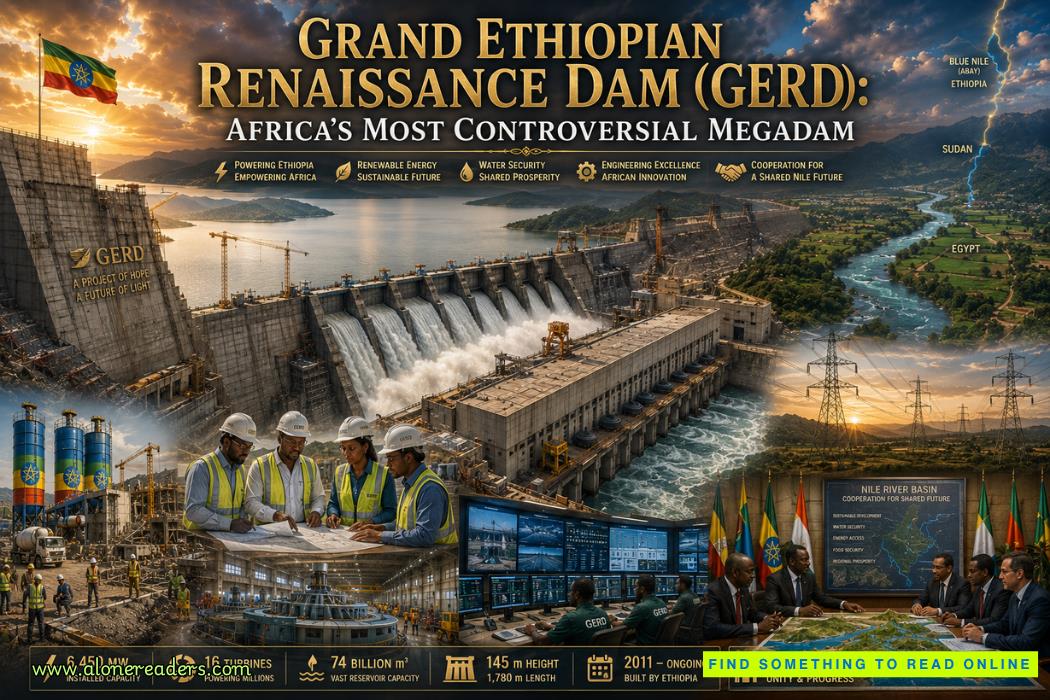
Rising across the Blue Nile River in the rugged highlands of northwestern Ethiopia, the Grand Ethiopian Renaissance Dam (GERD) represents one of the most ambitious engineering projects ever undertaken on the African continent. Designed to become Africa's largest hydroelectric power station, the project symbolizes Ethiopia's determination to transform its economy through renewable energy and infrastructure development. At the same time, because the Blue Nile is the primary source of water flowing into Sudan and Egypt, the dam has become one of the world's most closely watched international water projects. GERD is therefore both an extraordinary engineering achievement and one of the most significant transboundary river developments of the twenty-first century.
The Nile River has supported civilizations for thousands of years. Stretching approximately 6,650 kilometers, it is generally regarded as the longest river in the world or one of the longest, depending on the measurement method. Two major tributaries form the Nile: the White Nile and the Blue Nile. Although the White Nile contributes steady flows throughout the year, the Blue Nile provides the majority of the river's annual water volume during the rainy season, originating in the Ethiopian Highlands before flowing into Sudan and eventually joining the White Nile at Khartoum. Because of this hydrological importance, developments on the Blue Nile have long attracted regional attention.
For much of modern history, Ethiopia utilized only a small fraction of the enormous hydroelectric potential of its rivers despite possessing abundant water resources and significant elevation differences ideal for electricity generation. Large areas of the country lacked reliable access to electricity, limiting industrial growth, healthcare, education, and economic development. Successive governments studied possibilities for constructing a major hydroelectric project on the Blue Nile, but financial limitations, technical challenges, and political circumstances delayed implementation for decades. The concept of a massive dam remained a national aspiration until the early twenty-first century.
Construction of the Grand Ethiopian Renaissance Dam officially began in 2011, marking the start of one of Africa's largest infrastructure projects. Located in Ethiopia's Benishangul-Gumuz Region, near the border with Sudan, the site was selected after extensive geological and hydrological investigations. Engineers determined that the surrounding rock formations could provide a stable foundation while the narrow valley allowed the construction of a massive reservoir with substantial storage capacity. The project's location also offered favorable topographical conditions for efficient hydroelectric generation.
Unlike many earlier large dams, GERD makes extensive use of roller-compacted concrete (RCC), a construction technique that has become increasingly popular for modern megadams. Instead of placing conventional wet concrete in relatively small forms, roller-compacted concrete is delivered in drier mixtures that can be spread using heavy earthmoving equipment and compacted with large rollers, much like constructing a roadway. This method significantly accelerates construction while maintaining excellent structural strength and durability. GERD represents one of the world's largest applications of roller-compacted concrete technology.
The completed dam consists primarily of a massive roller-compacted concrete gravity structure extending approximately 1,780 meters in length and rising about 145 meters above the riverbed. A large saddle dam complements the main structure, increasing the reservoir's storage capacity by closing lower sections of the surrounding terrain. Together, these structures create an enormous artificial lake capable of storing tens of billions of cubic meters of water. The scale of the project places it among the largest dam systems ever constructed in Africa.
Preparing the construction site required extensive excavation, foundation treatment, and river diversion works. Engineers carefully removed weathered rock until reaching competent bedrock capable of supporting the immense weight of the dam. Foundation fractures were sealed through pressure grouting to minimize seepage, while drainage galleries were incorporated to control uplift pressure beneath the structure. Every stage of foundation preparation underwent rigorous geological inspection because the long-term safety of a gravity dam depends fundamentally upon the quality and stability of its foundation.
River diversion represented another critical engineering milestone. Temporary cofferdams redirected the Blue Nile through specially constructed channels while crews built the permanent structure across the original river course. Timing these operations required detailed hydrological analysis to minimize risks during seasonal floods. Sophisticated monitoring systems tracked water levels continuously throughout construction, ensuring that diversion works remained safe under varying river conditions.
Perhaps GERD's greatest engineering significance lies in its hydroelectric generating capacity. The powerhouse is designed to accommodate multiple large Francis turbines, capable of producing more than 5,000 megawatts of electricity when fully operational. Once operating at full capacity, the facility is expected to become Africa's largest hydroelectric power station, generating enough renewable electricity to transform Ethiopia's national energy system while creating opportunities for electricity exports to neighboring countries. The project's primary purpose is electricity generation rather than irrigation or flood control, distinguishing it from many other major dams built throughout history.
Reliable electricity has enormous implications for Ethiopia's economic future. Expanded power generation supports industrial manufacturing, mining, transportation, telecommunications, healthcare, education, and urban development. Rural electrification programs can connect previously underserved communities to modern energy networks, improving quality of life while encouraging new investment. In addition, electricity exports to neighboring countries may generate significant foreign exchange revenue, strengthening regional economic integration across East Africa.
The reservoir behind GERD represents another remarkable engineering feature. During the filling process, engineers carefully regulate water storage according to seasonal river flows, weather conditions, downstream requirements, and operational objectives. Filling such a large reservoir requires detailed hydrological planning because water retained upstream temporarily reduces river flows downstream. Managing reservoir filling has therefore become one of the project's most technically and diplomatically important aspects.
Unlike many large dam projects, GERD's greatest challenges have extended beyond engineering into the realm of international water management. The Blue Nile supplies a substantial portion of the water flowing through Sudan and Egypt, countries that have historically depended heavily upon the Nile for agriculture, drinking water, industry, and economic development. As a result, discussions surrounding GERD have focused on how reservoir filling and long-term operation should be managed to balance Ethiopia's electricity generation goals with downstream water security. These discussions concern operational coordination and water management rather than the engineering capability of the structure itself.
Hydrologists emphasize that the Blue Nile's flow naturally varies from year to year according to rainfall across the Ethiopian Highlands. Consequently, reservoir management strategies must account for wet years, average years, and prolonged droughts. Modern computer models assist engineers in forecasting river flows, optimizing electricity generation, and evaluating alternative operating scenarios. These scientific tools help decision-makers understand how different reservoir management approaches may influence water availability throughout the Nile Basin under varying climatic conditions.
From an engineering perspective, GERD incorporates numerous advanced safety features. The dam includes carefully designed spillways capable of safely passing extreme floodwaters, drainage systems controlling internal seepage, monitoring instruments measuring structural behavior, and comprehensive inspection programs. Thousands of sensors continuously record concrete temperatures, structural movement, reservoir levels, water pressures, and environmental conditions. Real-time monitoring enables engineers to evaluate the dam's performance continuously while supporting long-term operational safety.
Construction logistics represented another extraordinary accomplishment. The remote project location required the development of roads, bridges, worker accommodations, material processing facilities, concrete batching plants, electrical infrastructure, and transportation networks capable of supporting one of Africa's largest construction operations. Heavy machinery operated around the clock while engineers coordinated thousands of workers representing numerous technical disciplines. Managing material supplies, equipment maintenance, and quality control across such a large project demanded exceptional organizational capability.
The project has also become a symbol of national pride within Ethiopia. A significant portion of the financing came from domestic sources, including government funding and public bond purchases. This financing approach reflected the project's importance as a national development initiative rather than simply an infrastructure investment. For many Ethiopians, GERD represents self-reliance, modernization, and the country's long-term economic aspirations.
Environmental considerations remain an important aspect of the project. Reservoir creation inevitably alters local ecosystems, affects vegetation, changes river flow patterns, and influences sediment transport. Engineers and environmental scientists continue monitoring water quality, biodiversity, fisheries, shoreline stability, and surrounding habitats. Because hydropower generates electricity without burning fossil fuels, GERD also contributes to reducing greenhouse gas emissions compared with conventional thermal power stations, supporting broader climate and renewable energy objectives.
Climate variability further increases the importance of sophisticated reservoir management. Changing rainfall patterns, prolonged droughts, and extreme weather events require flexible operating strategies capable of balancing electricity production with water conservation. Advanced hydrological forecasting systems, satellite observations, and climate models increasingly support operational decisions, allowing engineers to adjust reservoir releases according to evolving environmental conditions.
Modern digital technology plays a central role in daily operations. Automated control systems regulate turbine performance, electricity generation, spillway operation, and reservoir management. Digital sensors transmit continuous information to centralized control rooms where engineers analyze structural health, mechanical performance, and hydrological conditions. Predictive maintenance software identifies potential equipment issues before failures occur, improving reliability while reducing operational costs. GERD exemplifies the evolution of modern dams from passive concrete structures into intelligent infrastructure managed through advanced digital technologies.
The project has also attracted worldwide attention from civil engineers, hydrologists, environmental scientists, and policymakers. Researchers study its roller-compacted concrete construction techniques, turbine systems, reservoir management strategies, transboundary water governance, and large-scale project management. Lessons learned from GERD are likely to influence future hydroelectric developments across Africa and other regions where international rivers cross national boundaries.
Despite differing national perspectives regarding aspects of the project, there is broad recognition that cooperative management of shared river systems is essential for long-term regional stability and sustainable development. Scientific collaboration, transparent hydrological data sharing, and coordinated reservoir operations can help optimize benefits while reducing risks for all countries sharing the Nile Basin. Many experts view these approaches as important components of effective transboundary water management.
Today, the Grand Ethiopian Renaissance Dam stands as Africa's largest hydroelectric development project and one of the continent's most significant engineering accomplishments. Its enormous concrete structure, advanced generating systems, sophisticated monitoring technologies, and vast reservoir demonstrate the remarkable capabilities of modern civil engineering. At the same time, its location on one of the world's most important international rivers highlights the growing importance of balancing engineering innovation with cooperative resource management.
Among the world's greatest dams, GERD occupies a unique position. It is not defined solely by its impressive dimensions or generating capacity but also by its role in shaping Africa's energy future and encouraging dialogue about the shared use of transboundary water resources. Its lasting legacy will ultimately be measured not only by the electricity it produces, but by its contribution to sustainable development, regional cooperation, and the responsible management of one of humanity's most vital river systems.




 Château de Vincennes: France’s Forgotten Royal Fortress and Medieval Stronghold
 Château de Carcassonne: Europe’s Greatest Medieval Citadel and Fortress
 Château de Chenonceau: The Castle Built by Remarkable Women
 Château de Chambord: France’s Magnificent Renaissance Castle and Architectural Wonder
 Tehri Dam: India's Tallest Dam and the Debate Behind It
 Bhakra Nangal Dam: India's Temple of Modern Development










