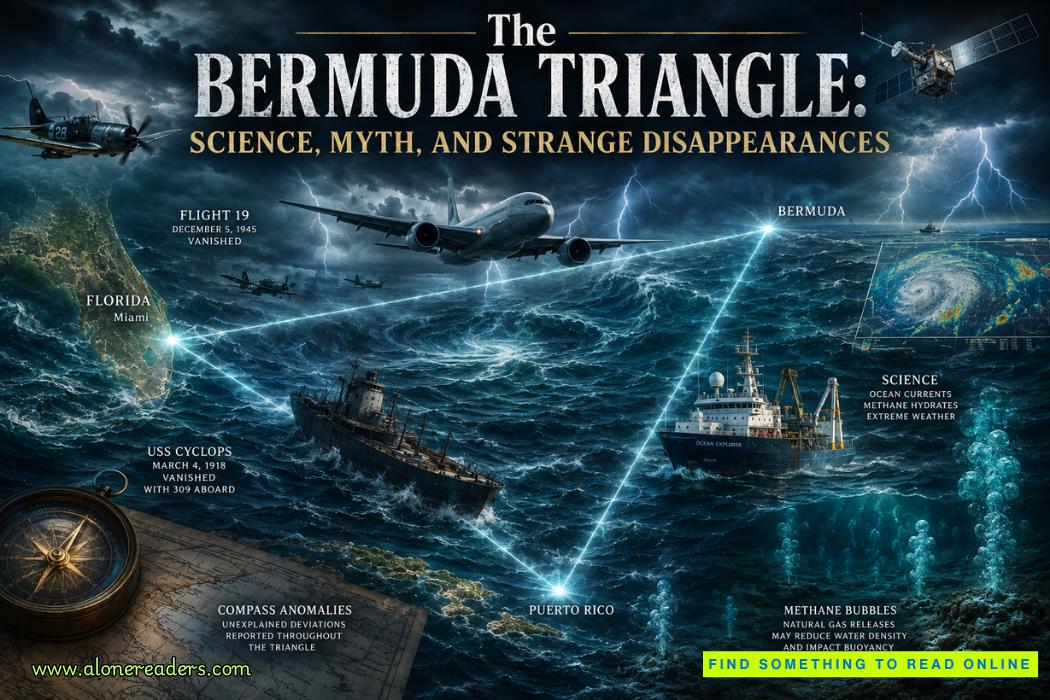
The Bermuda Triangle is one of the most famous mysteries in modern history. For decades, stories of vanished ships, missing aircraft, strange compass readings, and unexplained disappearances have fascinated the public and inspired countless books, documentaries, movies, and conspiracy theories. Stretching across a large section of the western Atlantic Ocean, the Bermuda Triangle has become synonymous with danger and mystery.
Yet behind the sensational stories lies a more complex reality. Scientists, historians, oceanographers, meteorologists, and aviation experts have spent decades studying the region. Their findings reveal a fascinating mixture of natural hazards, human error, media exaggeration, and genuine historical mysteries that continue to spark debate.
The Bermuda Triangle remains a unique case where science and folklore intersect. It is a place where real disappearances occurred, but where myths often grew larger than the facts themselves.
Defining the Bermuda Triangle
The Bermuda Triangle is generally defined as the area bounded by Miami in Florida, Bermuda in the North Atlantic, and San Juan in Puerto Rico. The resulting triangular region covers approximately 500,000 square miles of ocean, although exact boundaries vary depending on the source.
This vast area contains some of the busiest shipping lanes and air routes in the world. Commercial vessels, military ships, fishing boats, private yachts, and thousands of aircraft travel through the region every year.
The waters within the triangle are deep, complex, and influenced by powerful ocean currents. Weather conditions can change rapidly, and tropical storms frequently pass through the region. These characteristics make it a naturally challenging environment for navigation.
The Origins of the Legend
Although disappearances in the region occurred throughout history, the modern Bermuda Triangle legend emerged primarily during the twentieth century.
Reports of mysterious events gained public attention during the 1950s and 1960s when journalists began collecting stories of unexplained losses at sea and in the air. These articles often emphasized mystery while overlooking ordinary explanations.
The term "Bermuda Triangle" became widely known after writers published books suggesting that unknown forces were responsible for disappearances. These works connected separate incidents into a larger narrative, transforming a geographical region into a global mystery.
As media coverage increased, the Bermuda Triangle evolved from a collection of maritime accidents into one of the world's most enduring legends.
Flight 19: The Incident That Defined the Mystery
No event contributed more to the Bermuda Triangle legend than the disappearance of Flight 19.
On December 5, 1945, five United States Navy torpedo bombers departed from Florida on a routine training mission. The weather was initially favorable, and the pilots were experienced.
During the flight, radio transmissions suggested that the flight leader had become confused about his position. He believed his compasses were malfunctioning and appeared uncertain about which direction would lead back to base.
As fuel levels declined, communication became increasingly fragmented. Eventually, all contact was lost.
To make matters even more mysterious, a rescue aircraft dispatched to search for Flight 19 also disappeared shortly after takeoff.
Despite extensive search efforts, no definitive wreckage was recovered. The loss of six aircraft and twenty-seven men became one of the most famous aviation mysteries in history.
Modern investigations suggest navigational confusion, worsening weather, strong winds, and fuel exhaustion likely played major roles. However, the absence of conclusive evidence has allowed speculation to persist.
Famous Maritime Disappearances
Several ship disappearances have also contributed significantly to the Bermuda Triangle's reputation.
One of the most frequently cited cases is the merchant vessel USS Cyclops, which vanished in March 1918 while carrying over 300 crew members and passengers. The massive ship disappeared without sending a distress signal.
The loss remains one of the largest non-combat naval disappearances in American history.
Other vessels often associated with the Bermuda Triangle include:
Each case possesses unique circumstances. Some disappeared during storms, while others encountered mechanical problems or communication difficulties before vanishing.
Although many incidents have plausible explanations, several remain unresolved due to insufficient evidence.
Why the Region Is Naturally Dangerous
One reason the Bermuda Triangle gained its reputation is that the region contains numerous natural hazards.
Rapidly Changing Weather
The western Atlantic is highly dynamic. Weather systems can develop quickly, producing dangerous conditions with little warning.
Thunderstorms, waterspouts, hurricanes, and tropical storms frequently affect the region. Small aircraft and vessels can encounter severe conditions unexpectedly.
The Gulf Stream
The powerful Gulf Stream flows through part of the Bermuda Triangle.
This warm ocean current moves rapidly and can quickly disperse debris. If an aircraft or ship is lost, wreckage may be carried far from the accident site, making recovery difficult.
The Gulf Stream also contributes to complex weather patterns and rough sea conditions.
Deep Ocean Trenches
Some areas within the triangle contain extremely deep water.
The nearby Puerto Rico Trench reaches depths exceeding 8,000 meters. If a vessel sinks in such locations, locating wreckage becomes extraordinarily difficult.
The lack of recovered evidence can create the appearance of a mysterious disappearance when, in reality, the remains simply lie beyond practical recovery limits.
Compass Anomalies and Navigation Mysteries
One of the most persistent Bermuda Triangle claims involves unusual compass behavior.
Many stories describe compasses spinning wildly or providing incorrect readings. These accounts fueled theories involving magnetic anomalies and unknown forces.
In reality, Earth possesses natural variations in its magnetic field. Certain locations experience differences between true north and magnetic north, requiring navigational corrections.
Historically, navigators who failed to account for these variations could become disoriented.
While localized magnetic irregularities exist throughout the world, scientific studies have not identified any extraordinary magnetic phenomenon unique to the Bermuda Triangle.
Most experts conclude that reported compass problems can generally be explained through ordinary navigational challenges rather than mysterious forces.
The Methane Gas Hypothesis
One scientific theory that attracted significant attention involves methane gas.
According to this hypothesis, methane trapped beneath the ocean floor could occasionally be released in massive quantities.
Large methane eruptions might reduce water density, potentially causing ships to lose buoyancy and sink rapidly. Rising gas could also affect aircraft engines if enough methane reached the atmosphere.
The idea is scientifically plausible in principle because methane hydrates exist beneath some ocean floors.
However, researchers have found little evidence that methane releases occur frequently enough in the Bermuda Triangle to explain most reported disappearances.
While methane remains an interesting possibility for isolated events, it is not considered a comprehensive explanation.
Human Error and Mechanical Failure
Investigations into aviation and maritime accidents consistently identify human error as a major contributing factor.
Pilots and ship captains operating in challenging conditions can make navigational mistakes, misinterpret weather data, or become disoriented.
Mechanical failures can also occur unexpectedly.
When accidents happen over vast stretches of ocean, evidence may never be recovered, making definitive conclusions impossible.
Many incidents once considered mysterious were later shown to involve ordinary operational problems.
This does not diminish the tragedy of the events but demonstrates that complex accidents often have understandable causes.
The Role of Media Sensationalism
The growth of the Bermuda Triangle legend cannot be understood without considering the role of media coverage.
Numerous books, magazines, television programs, and films amplified mysterious elements while minimizing contradictory evidence.
Some authors repeated inaccurate information or combined unrelated incidents into a single narrative.
In certain cases, disappearances were reported as mysterious even though investigations had already identified likely causes.
This selective presentation helped transform the Bermuda Triangle into a cultural phenomenon.
The public naturally gravitates toward mysteries, and stories involving vanished ships and aircraft captured imaginations worldwide.
Supernatural Theories
The absence of definitive answers in some cases encouraged the development of supernatural explanations.
Popular theories include:
These theories remain popular in entertainment and popular culture.
However, no credible scientific evidence supports their existence.
Despite this lack of evidence, supernatural explanations continue to attract interest because they provide dramatic answers to unresolved mysteries.
Modern Scientific Investigations
Advances in technology have greatly improved understanding of the Bermuda Triangle.
Satellite monitoring, GPS navigation, sophisticated weather forecasting, sonar mapping, and deep-sea exploration have reduced many historical uncertainties.
Researchers now possess far more accurate information regarding ocean currents, storm development, seafloor geography, and navigational conditions.
Modern studies generally conclude that the Bermuda Triangle does not experience a higher rate of disappearances than other heavily traveled ocean regions.
The area is dangerous primarily because of natural environmental conditions combined with high traffic volume.
In other words, many incidents occurred not because the region is uniquely cursed or mysterious, but because many ships and aircraft pass through it.
Why the Mystery Endures
Despite scientific explanations, the Bermuda Triangle continues to fascinate people around the world.
Part of its appeal lies in the combination of real historical events and unanswered questions. Some disappearances genuinely remain unsolved due to missing evidence.
Human beings are naturally drawn to mysteries, particularly those involving unexplored oceans and vanished travelers.
The Atlantic Ocean still contains vast areas that remain poorly understood compared to land environments. The idea that secrets may still lie hidden beneath thousands of meters of water captures the imagination.
The Bermuda Triangle also represents a broader theme in human culture: the tension between scientific understanding and the unknown.
Conclusion
The Bermuda Triangle stands at the crossroads of fact and folklore. Its reputation was built upon genuine disappearances, tragic accidents, and unanswered questions, but it was amplified by decades of sensational reporting and imaginative speculation.
Scientific research suggests that no extraordinary force operates within the triangle. Powerful storms, strong ocean currents, navigational challenges, mechanical failures, and human error provide reasonable explanations for many incidents. Yet not every case has been solved, and some mysteries remain open.
That combination of explanation and uncertainty is precisely what keeps the legend alive. The Bermuda Triangle reminds us that even in an age of satellites, advanced navigation, and deep-sea exploration, the ocean still possesses the power to surprise us. It remains one of the world's most enduring mysteries—not because science has failed, but because the boundary between what is known and what is unknown continues to inspire curiosity.



 Château de Vincennes: France’s Forgotten Royal Fortress and Medieval Stronghold
 Château de Carcassonne: Europe’s Greatest Medieval Citadel and Fortress
 Château de Chenonceau: The Castle Built by Remarkable Women
 Château de Chambord: France’s Magnificent Renaissance Castle and Architectural Wonder
 Tehri Dam: India's Tallest Dam and the Debate Behind It
 Bhakra Nangal Dam: India's Temple of Modern Development