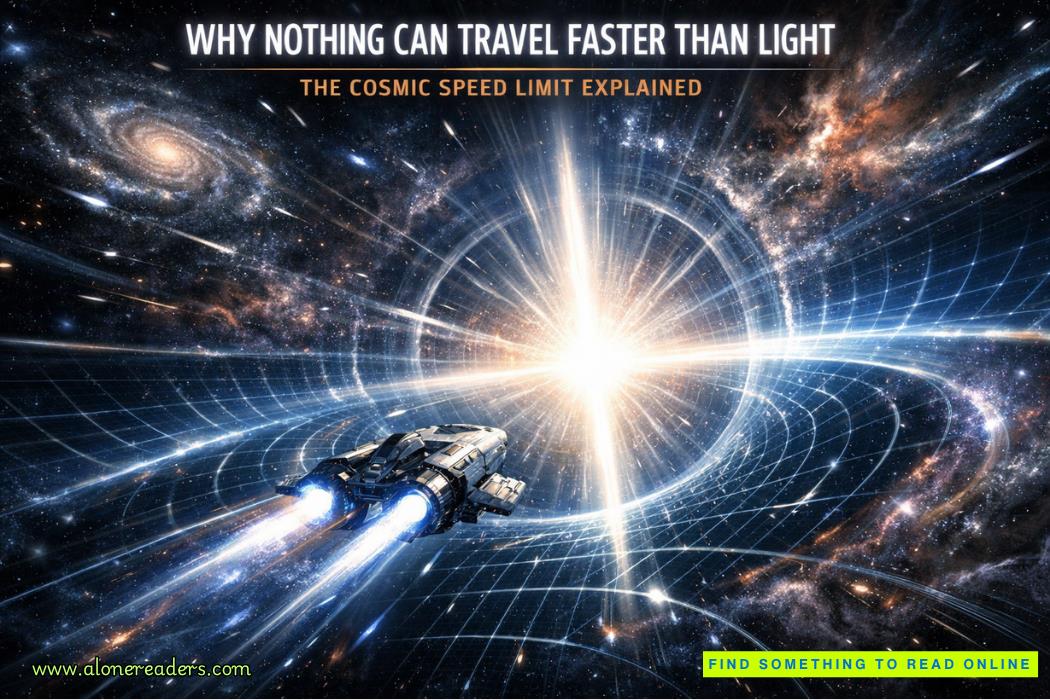
The idea of speed is deeply embedded in how humans perceive motion and change in the universe. From a car accelerating on a highway to planets orbiting stars, motion describes how objects move through space over time. Yet among all known motions in nature, one speed stands above all others—the speed of light. In the vacuum of space, light travels at approximately 299,792 kilometers per second. This value, commonly denoted by the symbol c, is not merely a measurement of how fast light moves; it represents one of the most profound physical constants in the universe. According to modern physics, nothing that carries mass or information can travel faster than this speed. This limit, known as the cosmic speed limit, fundamentally shapes the structure of space, time, energy, and causality itself.
The origin of this concept lies in the revolutionary work of Albert Einstein, whose Special Theory of Relativity, introduced in 1905, reshaped the understanding of motion and time. Before Einstein, classical physics—particularly Newtonian mechanics—treated space and time as absolute and independent. Under that framework, speeds could theoretically increase indefinitely if enough force were applied. Einstein’s insight changed this perspective completely. He proposed that the speed of light in a vacuum is the same for all observers, regardless of how fast they themselves are moving. This single assumption leads to a cascade of extraordinary consequences that redefine the nature of motion.
One of the most significant outcomes of special relativity is the phenomenon known as relativistic mass increase. When an object moves faster and faster, approaching the speed of light, its effective inertia—the resistance to further acceleration—begins to grow dramatically. In practical terms, this means that pushing the object to higher speeds requires increasingly larger amounts of energy. The relationship between energy, mass, and velocity becomes highly nonlinear as speeds approach light speed. The closer an object gets to c, the more energy is required to accelerate it even slightly further. Eventually, the energy requirement approaches infinity.
This leads to a crucial conclusion: reaching the speed of light would require an infinite amount of energy, something physically impossible within our universe. Since energy is always finite, any object with mass can only approach—but never reach—the speed of light. Light itself, however, is composed of particles known as photons, which have no rest mass. Because photons do not possess mass, they can travel exactly at the cosmic speed limit without requiring infinite energy. This distinction explains why light naturally moves at this extraordinary speed while matter cannot.
Another remarkable effect emerges when objects move close to light speed—time dilation. In everyday experience, time appears to pass uniformly for everyone. However, according to relativity, time is not absolute. Instead, it is intertwined with space in a four-dimensional structure known as spacetime. When an object moves very quickly relative to an observer, the flow of time for that object slows down from the observer’s perspective. The faster the object travels, the more pronounced this effect becomes.
Imagine a spacecraft capable of traveling at velocities extremely close to the speed of light. For astronauts inside the spacecraft, time would feel perfectly normal. Their clocks would tick at their usual rate, and daily activities would proceed as expected. However, observers on Earth would measure time on the spacecraft as moving much more slowly. A journey that lasts only a few months for the astronauts might correspond to many years passing on Earth. The faster the spacecraft travels, the slower time appears to move for those onboard relative to the outside universe.
This phenomenon has been experimentally verified using highly precise atomic clocks. When clocks are placed on fast-moving aircraft or satellites, they tick slightly slower than identical clocks on Earth. Although the effect is extremely small at everyday speeds, it becomes dramatically significant at relativistic velocities. Technologies such as GPS satellites must account for these relativistic time adjustments to maintain accurate positioning.
Speed also affects the measurement of distance. As an object approaches the speed of light, the length of objects in the direction of motion appears to contract when measured by an external observer. This effect is called length contraction. While it does not change how objects appear to observers moving with them, it demonstrates that space and time are flexible quantities that depend on relative motion. In other words, space and time are not rigid frameworks but dynamic components of a unified spacetime fabric.
Beyond affecting matter and clocks, the speed-of-light limit also governs the transmission of information. Signals, messages, and physical interactions cannot propagate faster than light. This restriction ensures that cause always precedes effect in a consistent order throughout the universe. If faster-than-light communication were possible, it would lead to paradoxes in which an effect could occur before its cause. For instance, a message might theoretically be received before it was sent, creating contradictions in the sequence of events.
This connection between the speed of light and causality is one of the deepest reasons why the limit exists. The universal speed limit preserves the logical structure of reality, ensuring that time flows in a consistent direction and that physical events occur in an orderly sequence. Without this limit, the universe could become chaotic, with the possibility of time loops or violations of fundamental physical laws.
Scientists have long explored whether exotic phenomena might circumvent this barrier. Hypothetical concepts such as tachyons, particles that always move faster than light, have been proposed in theoretical physics. However, no experimental evidence has ever confirmed their existence. Other speculative ideas involve manipulating spacetime itself rather than moving through it. Concepts like the warp drive, inspired by science fiction, suggest compressing space in front of a spacecraft and expanding it behind, allowing the craft to effectively travel faster than light relative to distant observers without locally exceeding the speed limit. While intriguing, such ideas remain purely theoretical and would require forms of energy or matter that have never been observed.
Similarly, wormholes—hypothetical tunnels connecting distant points in spacetime—have been suggested as shortcuts across cosmic distances. In theory, they could allow travelers to reach distant regions of the universe more quickly than light traveling through normal space. Yet wormholes would require extremely exotic conditions to exist and remain stable, making them speculative at best with current scientific understanding.
Despite these fascinating possibilities, all experimentally verified physics supports the principle that the speed of light is an absolute boundary for motion and information transfer. Particle accelerators on Earth provide strong evidence of this limit. In facilities such as the Large Hadron Collider, particles are accelerated to velocities extremely close to the speed of light. As scientists push these particles to higher energies, they observe the predicted relativistic effects—mass increase, time dilation, and diminishing returns in acceleration. No matter how much energy is added, the particles never exceed the speed of light.
This universal limit also has profound implications for astronomy and cosmology. Because light takes time to travel, observing distant galaxies means looking back into the past. A galaxy located one billion light-years away appears to us as it existed one billion years ago. The finite speed of light therefore acts as a natural time machine, allowing astronomers to study earlier stages of the universe’s evolution simply by observing farther into space.
In essence, the speed of light acts as both a messenger and a boundary. It carries information across the cosmos while simultaneously defining the maximum rate at which that information can travel. It links space and time into a single structure and determines how energy and matter behave under extreme conditions. Without this limit, the coherent structure of the universe would likely collapse into paradox and unpredictability.
For humanity, the concept of a cosmic speed limit is both humbling and inspiring. It reminds us that even with the most advanced technology imaginable, certain boundaries remain embedded in the laws of nature. Yet these limits also deepen our understanding of the universe and reveal the remarkable elegance of physical reality. The speed of light is not simply the velocity of a beam traveling through space—it is a fundamental constant that defines the architecture of the cosmos itself.
As scientific exploration continues, future discoveries may uncover deeper layers of understanding about spacetime, energy, and the universe’s structure. New theories of quantum gravity or undiscovered aspects of physics might reshape our interpretation of these limits. But for now, the evidence remains clear: the speed of light stands as an unbreakable frontier, a boundary written into the very fabric of reality. It is the ultimate reminder that while the universe invites exploration, it also establishes rules that govern how far and how fast we can go.



 Château de Vincennes: France’s Forgotten Royal Fortress and Medieval Stronghold
 Château de Carcassonne: Europe’s Greatest Medieval Citadel and Fortress
 Château de Chenonceau: The Castle Built by Remarkable Women
 Château de Chambord: France’s Magnificent Renaissance Castle and Architectural Wonder
 Tehri Dam: India's Tallest Dam and the Debate Behind It
 Bhakra Nangal Dam: India's Temple of Modern Development