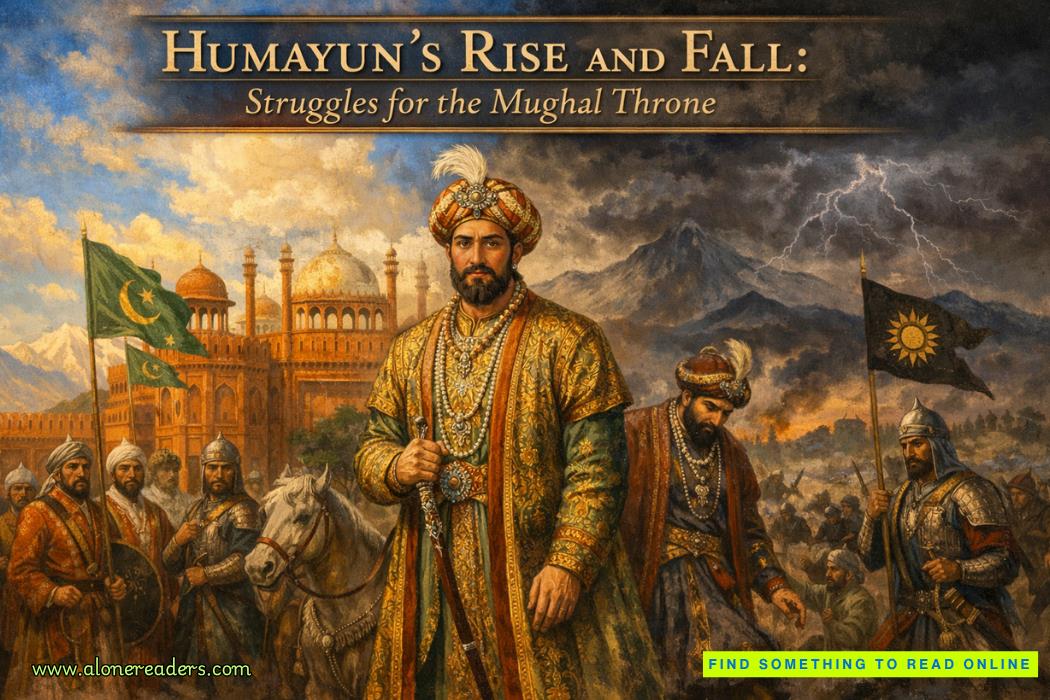
The story of Nasir-ud-Din Muhammad Humayun, the second emperor of the Mughal Empire, is a tapestry woven from threads of ambition, misfortune, resilience, and destiny. His life was not simply one of imperial grandeur; it was a tale of a man repeatedly tested by fate, driven into exile, and forced to rebuild from ashes the empire his father, Babur, had so triumphantly founded. Between his rise in 1530 and his fall into tragedy in 1556, Humayun’s journey marked the Mughal dynasty’s most fragile yet formative phase—a prelude to the later brilliance of Akbar the Great.
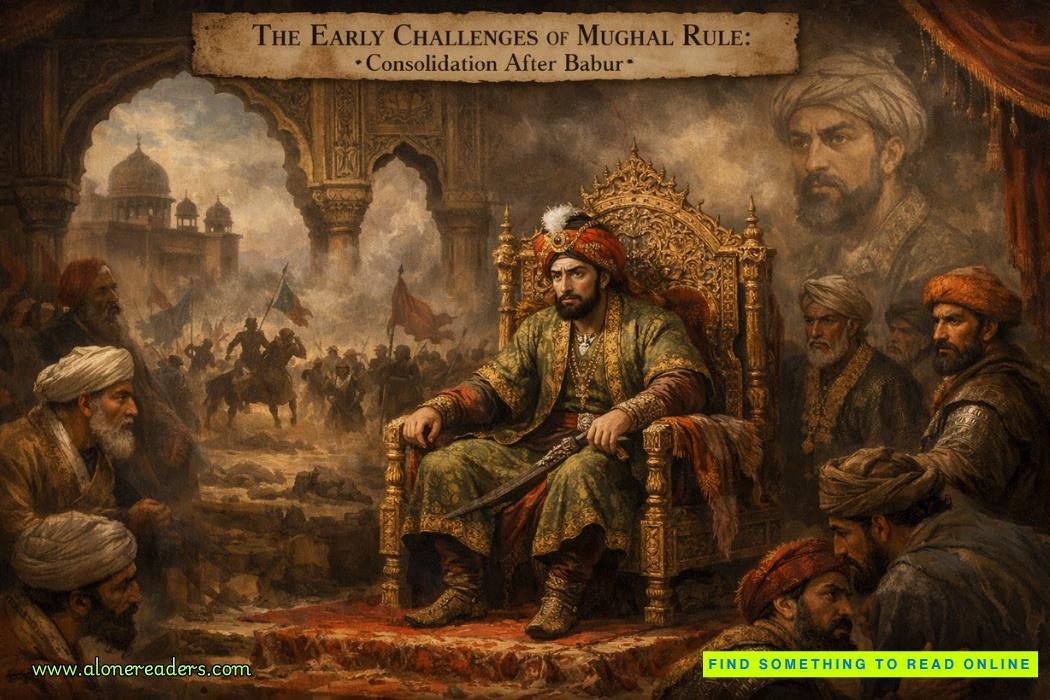
When Babur died in 1530, the empire he left behind was still a house without solid foundations. Although his victories at Panipat (1526) and Khanwa (1527) secured northern India for the Mughals, the structure of governance was unstable. Regional chiefs, Afghan warlords, and Rajput princes remained defiantly independent, united only in their animosity toward foreign rulers from Central Asia. Into this unsteady inheritance stepped Humayun—just twenty-two, charming, scholarly, and generous, yet often indecisive and overly trusting of those around him.
Unlike his father’s disciplined military temperament, Humayun was a dreamer fascinated by astrology, mysticism, and opium-induced visions. He divided his empire among his brothers not as an act of strategy but of misguided affection. Kamran was given Kabul and Lahore; Askari received Sambhal; and Hindal was offered Alwar. This gesture, though noble in intention, fractured the unity crucial for the survival of a newly born empire. From this moment, Humayun’s greatest battles would not only be against external foes but against the rival ambitions within his own bloodline.
Early in his reign, Humayun faced his first serious challenge from the Afghan chieftains in the east, particularly Sher Khan Sur, later known as Sher Shah Suri—a man of remarkable intelligence, administrative skill, and tenacity. Originally a minor Afghan noble in Bihar, Sher Khan observed and learned from Humayun’s missteps, gathering resources and building alliances quietly. In contrast, Humayun, distracted by ceremonies and astrological rituals, failed to consolidate authority in Bengal and Bihar, regions notorious for instability and rebellion.
In 1532, Humayun encountered Sher Khan near Chunar Fort, a stronghold of immense importance. Though Humayun managed to subdue it, the victory was short-lived. Sher Khan retreated, grew stronger, and bided his time. Meanwhile, the emperor diverted his attention towards conquering Gujarat—a campaign that brought him temporary glory but ultimately weakened his grip on the eastern territories. His decision to chase distant ambitions while his core lands simmered with unrest marked the beginning of the storm that would soon uproot him from Hindustan.
By 1539, Sher Khan had transformed from a defiant noble into a formidable sovereign, commanding disciplined Afghan forces and securing local loyalty through just governance and firm law. When Humayun finally engaged him at Chausa, near the Ganges, his forces were divided, uncoordinated, and numerically inferior. The result was disastrous. At the Battle of Chausa (1539), Humayun’s army crumbled, and the emperor narrowly escaped by swimming across the river with the help of an inflated water-skin. His escape became legend, symbolizing both humiliation and providence—an emperor saved by chance to fight another day.
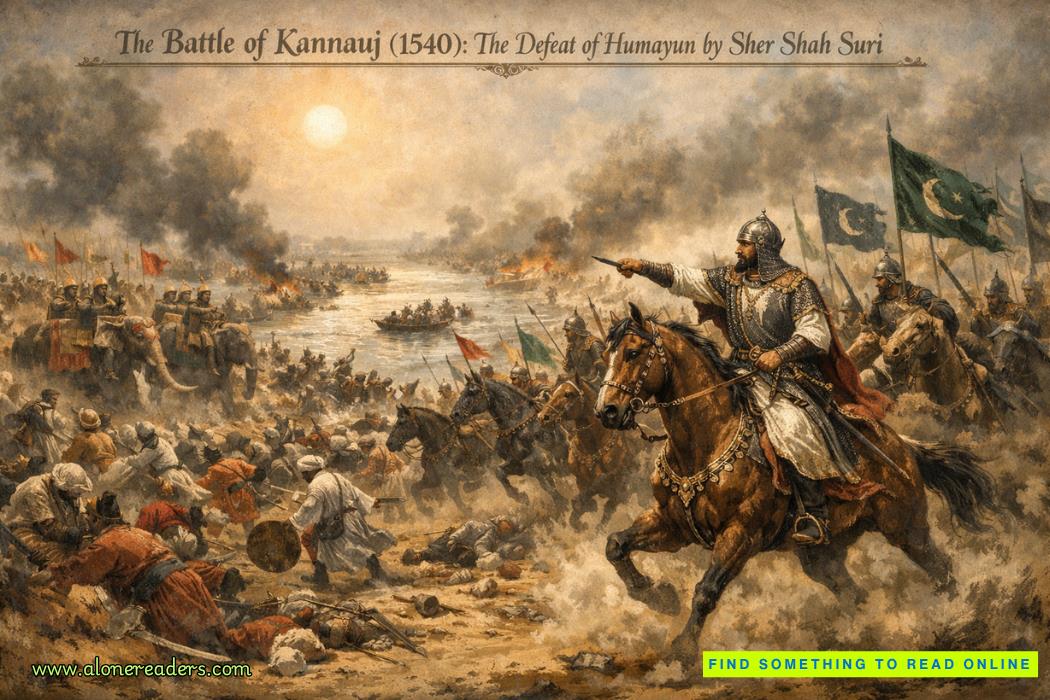
However, fate offered no respite. In 1540, the two armies clashed again at Kannauj, where Humayun’s defeat was absolute. The Mughal flag was torn down from Delhi, and Sher Shah Suri ascended the throne, establishing the Sur Empire—ushering in one of the most competent, though brief, non-Mughal regimes in Indian history. The once-proud emperor was now a fugitive, not only dispossessed of his empire but also betrayed by his brothers. Kamran seized Lahore and refused him refuge. Hindal plotted for kingship. Alone, weary, and desolate, Humayun embarked on one of history’s most dramatic exiles.
His flight took him across the Thar Desert, where the emperor and his small retinue nearly perished of thirst. Anecdotes from this perilous journey reveal a man humbled by suffering, carrying water skins on his shoulders and sharing morsels with loyal companions. In Sindh and Thatta, he sought alliances, but political favor eluded him. Finally, he turned to Persia, seeking help from Shah Tahmasp, the Safavid ruler. It was a desperate but ultimately transformative decision.
The court of Shah Tahmasp in Isfahan dazzled the exiled emperor with elegance and culture. Here, Humayun was treated with royal hospitality, but at a price. In exchange for Persian military support, he had to accept Shia religious symbolism and cede Kandahar, a jewel of strategic significance, to Persia. Though such concessions stirred debate about his political acumen, this alliance would later prove instrumental in his restoration. The exiled emperor, rejuvenated by Persian patronage, raised a new army and began his long campaign of reclamation.
By 1545, Humayun, with Persian aid, captured Kandahar and later Kabul, wresting them from his rebellious brother Kamran. What followed was not merely a military campaign but a brother’s trial of mercy. Despite Kamran’s repeated betrayals—allying with Afghan insurgents, attempting assassinations, and undermining state affairs—Humayun did not execute him outright. Instead, he ordered his brother’s eyes be blinded and sent him to Mecca. This act, though harsh by modern standards, reflected a conflicted conscience—an emperor torn between mercy and necessity.
During the next decade, Humayun rebuilt his strength patiently. While Sher Shah Suri and his successors governed India with efficiency, they also faced internal fissures after Sher Shah’s sudden death in 1545. The Sur Empire, strong in administration but weak in succession, began to crumble. By 1554, opportunity knocked once more. Sensing the tide turning, Humayun marched from Kabul toward the plains of Punjab, reclaiming territories abandoned by fractious Afghan governors.
In 1555, the Mughal banner once again fluttered over Delhi. After fifteen years of exile, Humayun entered his capital as a conqueror transformed by adversity. The rejoicing in his camp was immense, but his restored empire was fragile—a house rebuilt upon the old ruins. The Afghan threat still lingered, and the emperor’s administrative framework was far from stable. Though he regained the throne, the real fruits of resurgence would ripen under his son, the young Akbar, who learned from his father’s suffering.
Tragically, Humayun’s return to power was short-lived. In January 1556, barely six months after his victory, destiny struck a cruel blow. One evening, as he descended the steps of his library in the capital, arms filled with manuscripts, he stumbled and fell, hitting his head fatally. The cause of his death appeared almost symbolic—a scholar-king undone not by war but by the weight of his intellectual pursuits. His body was laid to rest in a grand mausoleum in Delhi, later immortalized as Humayun’s Tomb, the prototype that inspired the architectural majesty of the Taj Mahal.
Humayun’s reign, viewed through the lens of history, often stands overshadowed by the towering figures of Babur and Akbar. Yet, his story carries its own unique resonance within the rhythm of Mughal destiny. He was not the empire’s builder nor its greatest conqueror, but he was its bridge between turmoil and greatness. His defeats taught his lineage the value of unity; his exile sowed seeds of cross-cultural exchange between Persia and India; his humility birthed the renaissance that defined Akbar’s rule.
In the heart of his narrative lies the timeless paradox of power—the fragility of fortune and the endurance of vision. Humayun rose as a prince of promise, fell as a fugitive king, and returned as a wiser emperor. His journey epitomizes the truth that empires, like men, are shaped not only by triumphs but by trials. Had Sher Shah Suri not toppled him, had Kamran not betrayed him, perhaps the Mughal story would have lacked the lessons that later refined its greatness.
In the corridors of Indian history, Humayun stands as a melancholic yet inspiring figure, a monarch who faced destiny’s cruelty with remarkable grace. His life was a testament to the cyclical nature of imperial fortune—rise, fall, exile, return. His end, sudden yet serene, drew the curtain on an age of uncertainty and opened the stage for an era of remarkable consolidation.
When one gazes today at Humayun’s Tomb, with its red sandstone walls and Persian-style arches, one does not merely see a monument to a fallen emperor; one sees the architectural prelude to Mughal glory. Beneath its dome rests a man who, despite his failures, reignited the vision of an empire destined to rule India for centuries. His story is not one of defeat—it is of resilience reborn through suffering, a chapter that embodies both the vulnerability and the vitality of the Mughal dynasty.
Thus ends the chronicle of Humayun’s rise and fall, but within that rise and fall lies the foundation of continuity—a reminder that in every empire’s moment of darkness, the seeds of renewal are quietly sown.



 The Hundred Days Offensive: How the Allies Defeated Germany in World War I
 The Second Battle of the Marne: The Turning Point of World War I in 1918
 The Spring Offensive of 1918: Germany's Final Gamble to Win World War I
 The Treaty of Brest-Litovsk: How Russia Left World War I
 The Russian Revolution and World War I: How War Brought Down the Tsar
 The Zimmermann Telegram Explained: Germany's Secret Offer to Mexico in World War I










