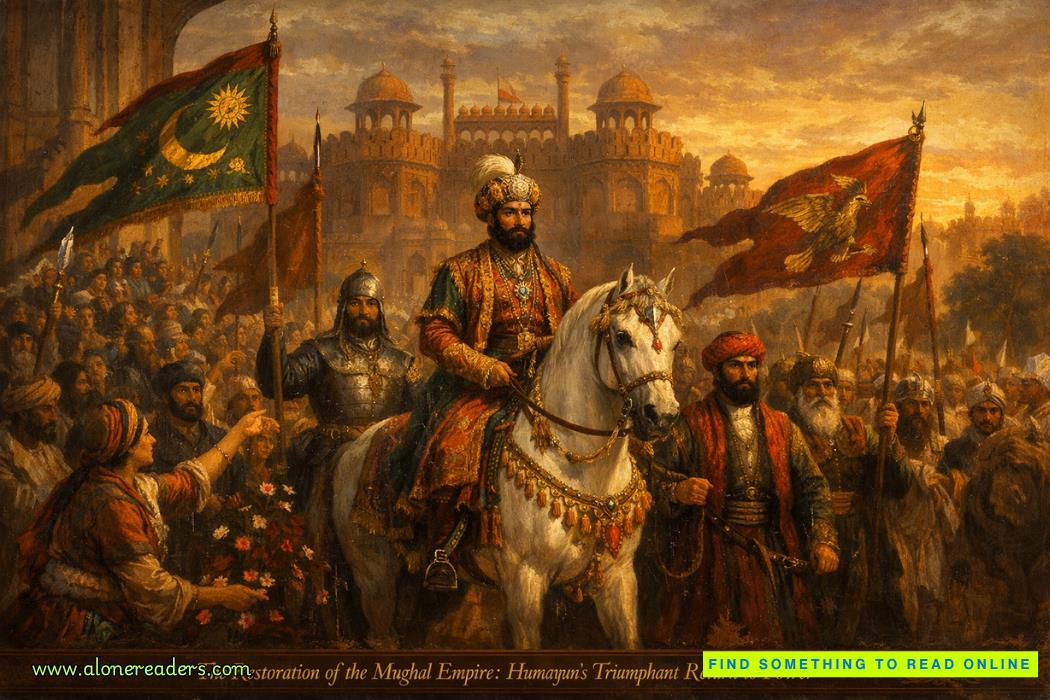
The Mughal Empire, one of the most powerful dynasties in medieval India, experienced both dramatic collapse and remarkable revival within a single generation. The story of Humayun’s return to power stands not merely as a tale of personal fortune but as a crucial turning point in South Asian history—a moment when political ambition, exile, cultural transformation, and dynastic destiny intertwined to restore the Mughal throne. When Humayun regained Delhi in 1555 after nearly fifteen years of humiliation and wandering, it was more than the restoration of a ruler; it was the rebirth of an empire that would soon reach unparalleled heights under Akbar.
The fall and rise of Emperor Humayun began almost immediately after his father, Babur, founded the Mughal state in India in 1526. Babur’s victory at Panipat brought the dynasty to Delhi, but the fragile foundation of the empire became apparent once he passed away in 1530. Humayun inherited a kingdom less cohesive than it appeared—fragmented by local rivalries, exhausted revenues, and surrounded by hostile Afghan chiefs who had not accepted Mughal authority. Though well-educated and chivalrous, Humayun lacked his father’s harsh decisiveness. His early reign was marked by idealistic naivety, which would soon draw him into the most perilous phase of his life.
Among his greatest adversaries stood Sher Khan Sur, later renowned as Sher Shah Suri—a brilliant Afghan commander who embodied the military realism Humayun never fully mastered. The contests between the two would soon decide the fate of northern India. In a series of fatal misjudgments, Humayun allowed Sher Khan to consolidate power in Bengal while he indulged in celebrations and astrology-driven policies at his capital. The fateful encounters at Chausa in 1539 and Kannauj in 1540 crushed Mughal authority. Humayun barely escaped with his life, beginning what would become an exile of extraordinary endurance.
For nearly fifteen years, Humayun was an emperor without a throne, wandering across deserts and foreign courts, clinging to fragile hope. His journey from the plains of Punjab to the Persian deserts was not one of conquest but of introspection and learning. Accompanied by a shrinking band of loyalists, his brother Mirza Askari’s betrayals, and the presence of his wife Hamida Banu Begum, Humayun’s exile transformed him profoundly. It stripped away his youthful complacency and introduced him to Persian grandeur, administrative discipline, and the subtleties of diplomacy that would eventually remake him into a wiser statesman.
One of the legendary episodes of his exile centers around his flight across the Thar Desert, with his newborn son Akbar being carried from fort to fort under constant danger. At one point, driven by desperation, Humayun sought shelter among the Rajputs and other regional rulers, only to be refused or betrayed by many. Yet his tenacity never waned. The image of Humayun crossing the desert, exhausted but unbroken, has since become a symbol of the inexhaustible will to reclaim destiny.
By 1543, Humayun reached the Safavid court of Shah Tahmasp I in Persia, marking a critical turning point in his fortunes. The Safavid ruler, a devout Shia monarch, received the Sunni Mughal emperor with grandeur, but not without conditions. In exchange for military assistance, Humayun agreed to adopt Shia symbols temporarily—an act that demonstrated his political pragmatism. His time in Persia became a period of cultural renaissance, where he absorbed Persian art, administrative discipline, and court etiquette deep into Mughal political culture. The friendship between Humayun and Shah Tahmasp was not merely superficial diplomacy; it reshaped the aesthetics of the Mughal court forever.
With Persian artillery, manpower, and funds, Humayun launched one of the most remarkable campaigns of restoration in Indian history. In 1545, he set out to reconquer Kandahar, an essential Mughal outpost linking India to Central Asia. The campaign succeeded through calculated coordination and the use of Persian-trained soldiers. Humayun’s leadership, once indecisive, now reflected strategic precision. By 1547, he captured Kabul and reestablished it as a base of operations. Once again, his flag flew over the rugged fortresses his father had once held. The contrast between the desperate fugitive of 1540 and the commanding monarch of 1547 illustrated the profound evolution of Humayun’s character and the essential fusion of Central Asian heritage and Persian sophistication that would define Mughal governance.
However, his ambition reached beyond Afghanistan; his aim was nothing less than the full recovery of India. The death of Sher Shah Suri in 1545 and the subsequent disarray within the Sur dynasty created a fleeting yet critical opportunity. The Afghan polity began to fracture under weak successors, presenting Humayun the moment he had long awaited. By 1553, he began his march toward the heartland of Hindustan, commanding not only Persian-trained troops but also reinvigorated Mughal forces long dormant in exile.
The 1555 campaign unfolded like a destiny fulfilled. Humayun’s general, Bairam Khan, played an instrumental role, rallying loyal officers and uniting scattered territories. The Mughal army advanced through Punjab methodically, defeating Afghan outposts at every stage. The decisive engagements at Sirhind and Machhiwara in 1555 marked the end of Afghan authority in northern India. Delhi and Agra were recaptured almost without resistance, as local chieftains shifted allegiance to the returning emperor. When Humayun finally entered Delhi that July, the same city from which he had fled fifteen years earlier, he did so not as the exuberant dreamer of youth but as a measured and mature monarch reborn from exile.
His restoration symbolized the second founding of the Mughal Empire. Yet, fate allowed him only a brief period on the throne. In less than a year, a tragic accident within the imperial library at Delhi took his life in 1556. Contemporary chroniclers described him slipping while descending the library steps after hearing the call to prayer, never to rise again. His restored empire passed to his thirteen-year-old son Jalal-ud-din Akbar, under the guardianship of the capable Bairam Khan. What Humayun rebuilt was thus not only an empire reclaimed but a legacy secured—for under Akbar, the Mughal state would expand, consolidate, and transform into one of the greatest empires of early modern history.
Humayun’s legacy lies not in daring conquests or monumental architecture but in resilience, diplomacy, and cultural synthesis. The years of exile had taught him endurance; his alliance with Persia instilled administrative sophistication; and his restoration demonstrated the power of strategic vision grounded in patience. When later Mughal chroniclers celebrated his son Akbar’s glory, they often overlooked the crucial groundwork Humayun had laid. Without his restoration, the Mughal Empire might have vanished like so many short-lived dynasties before it.
Perhaps the most enduring symbol of Humayun’s rebirth is his own tomb in Delhi—commissioned by the grieving Hamida Banu Begum and designed by Persian architects. This magnificent structure, the first garden-tomb on the Indian subcontinent, became the architectural prototype for the Taj Mahal a century later. In that sense, Humayun’s return did not merely revive an empire but also ignited a cultural renaissance that continued to define Mughal identity across generations. The blending of Persian refinement, Central Asian lineage, and Indian artistry that began with his restoration formed the creative bedrock of Mughal civilization.
Looking back, the restoration of the Mughal Empire under Humayun illustrates the dynamic rhythm of history—its relentless cycles of fall, exile, and renewal. It shows how the fate of empires often depends not on uninterrupted glory but on the capacity to recover from defeat. Humayun’s life, marked by weakness, wisdom, and eventual triumph, embodies the timeless principle that empires, like individuals, are forged not in comfort but through suffering and perseverance. His story remains one of the most remarkable testimonies to personal and political redemption in the history of South Asia.



 The Hundred Days Offensive: How the Allies Defeated Germany in World War I
 The Second Battle of the Marne: The Turning Point of World War I in 1918
 The Spring Offensive of 1918: Germany's Final Gamble to Win World War I
 The Treaty of Brest-Litovsk: How Russia Left World War I
 The Russian Revolution and World War I: How War Brought Down the Tsar
 The Zimmermann Telegram Explained: Germany's Secret Offer to Mexico in World War I