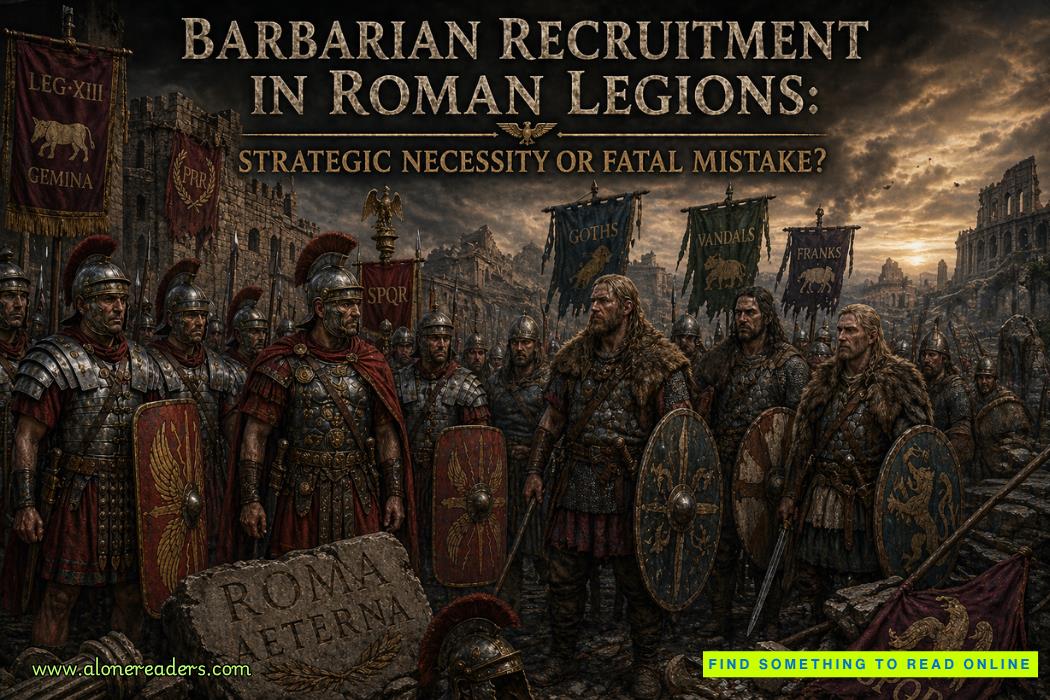
The recruitment of barbarian soldiers into the Roman legions stands as one of the most debated military and political strategies in the history of the Western Roman Empire. What began as a pragmatic adaptation to changing realities gradually evolved into a structural dependency that altered the very identity of Rome’s military power. By the late fourth and fifth centuries, the once disciplined and homogenous Roman army had transformed into a diverse and often fragmented force composed heavily of non-Roman recruits. The critical question remains: was this policy a strategic necessity born of survival, or a fatal miscalculation that accelerated Rome’s collapse?
To understand this shift, it is essential to recognize the pressures facing the empire. By the third century, Rome was already struggling with declining population levels, economic instability, and increasing threats along its vast frontiers. Traditional recruitment from Roman citizens became insufficient, especially as fewer citizens were willing to serve in the military due to harsh conditions and diminishing rewards. At the same time, external pressures intensified as Germanic tribes, Huns, and other groups pushed against Rome’s borders, often driven by their own migrations and conflicts.
In this context, the incorporation of barbarians—referred to by Romans as foederati—was not initially a sign of weakness but rather a calculated strategy. These groups were allowed to settle within Roman territory in exchange for military service. This arrangement provided immediate manpower and leveraged the martial skills of these warriors, who were often highly effective in combat. For a time, this system appeared to strengthen the empire. Barbarian soldiers brought fresh energy and adaptability, and their leaders, when loyal, served as valuable allies in defending Roman frontiers.
However, this policy also introduced a fundamental shift in the nature of Roman military organization. The traditional Roman army was built on discipline, uniform training, and a strong sense of Roman identity. Soldiers were not just fighters but representatives of the empire’s authority and culture. With the increasing presence of barbarian troops, this cohesion began to erode. Many recruits maintained their own customs, languages, and loyalties, which sometimes conflicted with Roman interests.
One of the most significant turning points came with the settlement of the Visigoths in 376 AD. Fleeing the advancing Huns, they were allowed to cross the Danube and settle within Roman territory. Mismanagement and exploitation by Roman officials led to rebellion, culminating in the Battle of Adrianople in 378 AD, where the Eastern Roman army suffered a devastating defeat and Emperor Valens was killed. This event exposed the risks of relying on poorly integrated barbarian forces and marked a moment when Rome’s control over such groups visibly weakened.
Despite such setbacks, the empire continued—and even expanded—its reliance on barbarian soldiers. By the fifth century, many of the highest-ranking military positions in the Western Roman Empire were held by individuals of barbarian origin. Figures such as Stilicho, a Vandal general, and Ricimer, of Suebi and Visigothic descent, wielded immense power. In many cases, these leaders acted as kingmakers, controlling emperors and directing imperial policy. While some served loyally, their prominence highlighted a deeper issue: the erosion of centralized Roman authority.
Another consequence of this reliance was the gradual privatization of military power. Barbarian leaders often commanded troops that were personally loyal to them rather than to the Roman state. This undermined the traditional chain of command and made coordinated defense increasingly difficult. When conflicts arose between rival generals, the empire’s military strength was turned inward, further weakening its ability to respond to external threats.
Economically, the system also had profound implications. Instead of paying soldiers through traditional means, Rome often granted land to barbarian groups in exchange for their service. While this reduced immediate financial strain, it effectively created semi-autonomous enclaves within the empire. Over time, these regions became less integrated into the Roman administrative system and more aligned with their own leaders. This process contributed to the fragmentation of the Western Empire, as local authorities gained power at the expense of central governance.
Culturally, the integration of barbarian soldiers challenged the concept of what it meant to be Roman. The army had long been a vehicle for Romanization, spreading language, customs, and loyalty throughout the empire. With the influx of non-Roman recruits, this process reversed in some areas, leading to a blending—and at times dilution—of Roman identity. While cultural exchange is not inherently negative, in this context it coincided with political instability and institutional decline.
Yet, it would be overly simplistic to label barbarian recruitment as the sole or even primary cause of the Western Roman Empire’s fall. The empire was already facing a complex web of challenges, including economic decline, administrative corruption, and repeated invasions. In many ways, the use of barbarian troops was a symptom of deeper structural issues rather than the root cause. Without these recruits, Rome may have lacked the manpower to defend itself even in the short term.
Indeed, there were moments when barbarian forces played a crucial role in sustaining the empire. The general Stilicho, for example, successfully defended Italy against multiple invasions in the early fifth century. His leadership demonstrated that barbarian origin did not preclude loyalty or competence. Similarly, many foederati units fought bravely in defense of Roman territories, suggesting that the system could function effectively under the right conditions.
The problem, therefore, was not merely the presence of barbarian soldiers but the failure to integrate them fully into the Roman system. Instead of creating a unified military structure, the empire allowed parallel systems of power to develop. This lack of integration fostered divisions and made it difficult to maintain consistent loyalty. In times of crisis, these divisions often proved disastrous.
The sack of Rome in 410 AD by the Visigoths under Alaric is often cited as a symbolic moment in the empire’s decline. Alaric himself had served in the Roman military and sought recognition and status within the imperial system. When these ambitions were frustrated, he turned against Rome. This episode illustrates the double-edged nature of barbarian recruitment: individuals who were once allies could become formidable enemies if their relationship with the empire deteriorated.
By the mid-fifth century, the Western Roman Empire had effectively lost control over large portions of its territory. Barbarian kingdoms, such as those established by the Vandals in North Africa and the Ostrogoths in Italy, emerged as dominant powers. These developments were not solely the result of military defeat but also of the gradual transfer of authority from Roman institutions to barbarian leaders. The army, once the backbone of imperial power, had become a vehicle for this transformation.
When the last Western Roman emperor, Romulus Augustulus, was deposed in 476 AD by the Germanic leader Odoacer, it marked the end of an era. Significantly, Odoacer did not destroy the existing structures of governance but rather assumed control within them, reflecting the extent to which barbarian and Roman systems had already merged. The fall of the Western Roman Empire was not a sudden collapse but the culmination of long-term changes, among which barbarian recruitment played a crucial role.
In evaluating whether this policy was a strategic necessity or a fatal mistake, the answer lies in recognizing its dual nature. In the short term, it was undeniably a necessary adaptation to immediate challenges. It provided manpower, strengthened defenses, and allowed the empire to survive crises that might otherwise have led to earlier collapse. However, in the long term, the way this policy was implemented—without sufficient integration or control—contributed to the weakening of central authority and the fragmentation of the empire.
Thus, barbarian recruitment should be seen neither as a simple error nor as a flawless strategy, but as a complex response to an evolving crisis. It reflects the broader challenges faced by the Western Roman Empire, where solutions to immediate problems often created new vulnerabilities. The story of these soldiers—both defenders and eventual successors of Rome—captures the intricate interplay between adaptation and decline that defines the end of one of history’s greatest empires.



 The Hundred Days Offensive: How the Allies Defeated Germany in World War I
 The Second Battle of the Marne: The Turning Point of World War I in 1918
 The Spring Offensive of 1918: Germany's Final Gamble to Win World War I
 The Treaty of Brest-Litovsk: How Russia Left World War I
 The Russian Revolution and World War I: How War Brought Down the Tsar
 The Zimmermann Telegram Explained: Germany's Secret Offer to Mexico in World War I