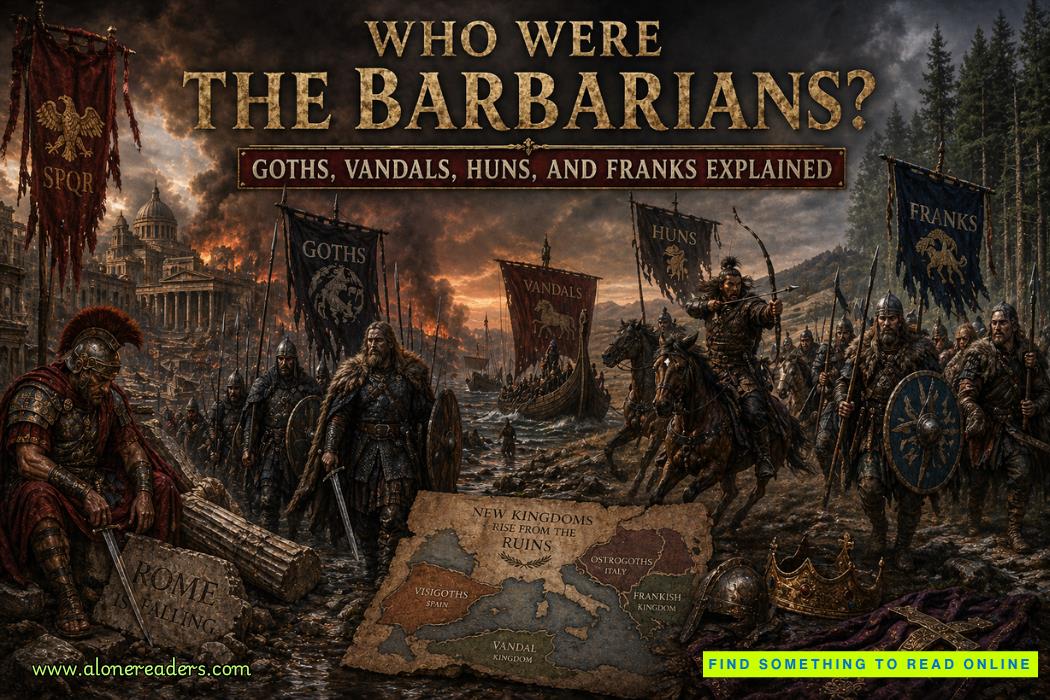
The word barbarian is one of the most loaded labels in ancient history, and it says as much about Rome as it does about the peoples it described. To the Romans, it did not simply mean “wild” or “primitive.” It meant outsider — someone beyond the Latin-speaking, Roman-ruled world, someone who did not belong to the civic order that Rome believed it had built for civilization itself. That distinction mattered enormously, because the collapse of the Western Roman Empire was not caused by a single invading horde. It was shaped by a long, complex movement of peoples who entered Roman territory, fought Roman armies, negotiated with emperors, served as allies, and eventually built kingdoms of their own. Among the most important of these groups were the Goths, Vandals, Huns, and Franks.
The Goths were not one tribe in the simple sense, but a broad Germanic people divided into several branches, most famously the Visigoths and Ostrogoths. They entered Roman history as frontier neighbors, but by the late fourth century they had become central actors in the empire’s fate. Pressure from the Huns pushed many Goths toward Roman territory, and their arrival inside imperial borders exposed a basic Roman weakness: the empire could no longer fully control who entered, who stayed, and who demanded land. The crisis of 376, when Gothic groups crossed the Danube seeking refuge, became catastrophic because Roman officials mismanaged their settlement, exploited them, and turned a potentially useful population into an armed enemy. Their revolt ended in the stunning Roman defeat at Adrianople in 378, where Emperor Valens was killed and Roman military prestige suffered a blow from which it never fully recovered.
The Goths were not merely destroyers, however. They were also political builders. The Visigoths moved through the empire as both refugees and warriors, at times negotiating with Roman rulers and at times fighting them. Under leaders such as Alaric, they marched through Italy and famously sacked Rome in 410, an event that shocked the ancient world even though it did not end the empire overnight. The sack mattered because it proved that the Eternal City was no longer untouchable. Later, the Visigoths established a powerful kingdom in Gaul and Spain, where they adapted Roman law, used Roman administrative habits, and gradually became part of the post-Roman order. The Ostrogoths followed a similar path in Italy under Theodoric the Great, who ruled with Roman-style institutions while preserving Gothic identity at the top of the political system. In this sense, the Goths were not simply enemies of Rome; they were one of the chief peoples through whom Roman power was transformed into medieval kingship.
The Vandals had a very different reputation, and much of it came from the Roman memory of one event: the sack of Rome in 455. Their name became a lasting symbol of destruction, even though the historical reality is more complicated. The Vandals were a Germanic people who moved through Gaul and Spain before crossing into North Africa, where they built a durable kingdom centered on Carthage. That move was far more significant than the famous sack itself. North Africa was one of the richest regions of the Roman world, especially because it supplied grain, taxes, and Mediterranean naval power. By taking Africa, the Vandals struck at the economic heart of the Western Empire. Their control of the sea allowed them to become a major naval force, and Roman emperors increasingly lacked the money and resources to respond effectively.
The image of the Vandals as mindless wreckers is misleading. They were not random looters. They were state builders who used violence, migration, and maritime power to carve out a realm of their own. Their kingdom in North Africa lasted for generations and became one of the most important post-Roman states in the western Mediterranean. They were also Arian Christians, which placed them at odds with the Catholic majority of Roman North Africa and added a religious dimension to later conflicts. Yet even their religious difference should not be exaggerated into a simple civilizational story. Like other so-called barbarian peoples, the Vandals were deeply influenced by Roman institutions, Roman diplomacy, and Roman wealth. Their rise shows that the end of the Western Empire was not just the loss of land, but the transfer of power into new hands that had learned how Roman power worked.
The Huns were different from both Goths and Vandals. They were not Germanic settlers from the Roman frontier, but a confederation of steppe peoples whose origins lay farther east. Their world was mobile, cavalry-based, and oriented around speed, pressure, and force. Roman writers often described them in terrifying language, emphasizing their horsemanship, their archery, and their unfamiliar way of life. The Huns entered European history as an external shock that disrupted the balance between Rome and the frontier peoples. Their westward movement pushed Goths, Alans, and others toward Roman territory, creating a chain reaction of migration and conflict. In that sense, the Huns were not just another barbarian group; they were a catalyst for wider upheaval.
Under Attila, the Huns became the most feared military power in Europe. Attila was not only a raider but also a ruler who built a loose imperial structure through tribute, alliance, intimidation, and war. He extracted wealth from both the Eastern and Western Roman Empires, and his campaigns threatened the stability of the entire Mediterranean world. Roman diplomats dealt with him as both enemy and political actor. That ambiguity is important. The Huns did not settle into Roman provinces in the same way the Goths or Vandals did, but they transformed the political landscape by making Roman frontier defense even more difficult and by forcing Roman leaders to depend on increasingly mixed armies. When Attila’s coalition collapsed after his death, the Hunnic empire disappeared quickly, which reveals how personal and fragile steppe power could be. Still, the damage had already been done: the Hunnic pressure helped set in motion the migrations and wars that weakened Rome from within.
The Franks were in some ways the most successful of all these peoples, though they were often less sensational in Roman eyes than the Goths or Huns. They were a Germanic confederation along the Rhine, and unlike the Huns they were not outsiders in a remote sense. They lived close to Roman territory, traded with Rome, fought for Rome, and sometimes served as Roman allies. This proximity gave them a practical understanding of Roman politics. The Franks did not simply sweep over the empire in a dramatic attack. They expanded gradually, taking advantage of the imperial collapse in Gaul and the vacuum left by weakening Roman authority. Their power grew through settlement, military service, local alliances, and political consolidation.
What made the Franks especially important was their ability to turn migration into state formation. Under leaders such as Clovis, they defeated rival powers, expanded across northern Gaul, and built a kingdom that would outlast most of their contemporaries. They were also crucial because they embraced Catholic Christianity, which gave them a major advantage over Arian rulers such as the Visigoths and Vandals. This religious alignment helped them win support from Roman bishops and local elites in Gaul. The Frankish kingdom became the seed of later France, and in a broader sense it helped shape the political future of western Europe. Of all the so-called barbarian peoples, the Franks are the clearest example of how a frontier group could absorb Roman practices, convert Roman identity into legitimacy, and become the foundation of a new civilization rather than a force of pure destruction.
It is tempting to group Goths, Vandals, Huns, and Franks together as though they were all the same kind of enemy. They were not. The Goths were migratory Germanic peoples who became both military threats and kingdom builders. The Vandals were a mobile Germanic people who seized one of the empire’s richest provinces and turned it into a naval base. The Huns were steppe warriors whose movement destabilized the whole frontier system. The Franks were a Rhine-based confederation that rose from border politics into long-term state power. Each group had its own origins, military style, leadership structure, and relationship with Rome. Roman authors often flattened these differences because the label “barbarian” made outsiders easier to fear and easier to dismiss.
The problem is that the Roman world itself had already become deeply interconnected with these peoples long before the empire officially fell in the West in 476. Many “barbarians” served in Roman armies. Some held Roman titles. Some negotiated treaties with emperors. Some adopted Christianity, Latin administration, and Roman material culture. In other words, the line between Roman and barbarian was never as clean as Roman propaganda suggested. The empire’s last centuries were shaped less by a simple clash between civilization and chaos than by a long process of integration, pressure, and transformation. Rome did not merely fall to outsiders; it was slowly remade by them.
That is why the fall of the Western Roman Empire should be understood as both an ending and a beginning. The Goths, Vandals, Huns, and Franks did not destroy Rome in one moment. They helped expose the empire’s military overreach, fiscal weakness, political instability, and dependence on frontier peoples it could no longer fully control. At the same time, they inherited Roman roads, Roman cities, Roman law, Roman prestige, and Roman administrative habits. The kingdoms they created were not anti-Roman worlds. They were post-Roman worlds, built from Roman materials and Gothic, Vandal, Hun, and Frankish power. That is what makes them so important in history. They were not simply the people who ended an empire. They were the peoples who shaped what came after it.
For readers trying to understand the phrase “the barbarians,” the most accurate answer is this: it was a Roman label for many different peoples who lived beyond Rome’s borders, but it became shorthand for the forces that transformed the empire from within and without. The Goths showed how migration could become conquest and settlement. The Vandals showed how a kingdom could emerge from movement across Roman space. The Huns showed how a mobile empire could trigger wider collapse. The Franks showed how a frontier people could become the nucleus of a new European order. Together, they reveal that the end of the Western Roman Empire was not the triumph of darkness over light, but the difficult birth of a new world from the ruins of the old.
Across the story of the fifth century, one truth stands out: Rome did not disappear because one people defeated it once. It weakened because so many pressures came at once, and because some of those pressures came from peoples who were no longer outside the Roman world, but already inside it. That is the deeper meaning behind the so-called barbarians. They were enemies, allies, refugees, conquerors, and founders all at once. And in that mixture lies the real history of the fall of Rome.



 The Hundred Days Offensive: How the Allies Defeated Germany in World War I
 The Second Battle of the Marne: The Turning Point of World War I in 1918
 The Spring Offensive of 1918: Germany's Final Gamble to Win World War I
 The Treaty of Brest-Litovsk: How Russia Left World War I
 The Russian Revolution and World War I: How War Brought Down the Tsar
 The Zimmermann Telegram Explained: Germany's Secret Offer to Mexico in World War I










