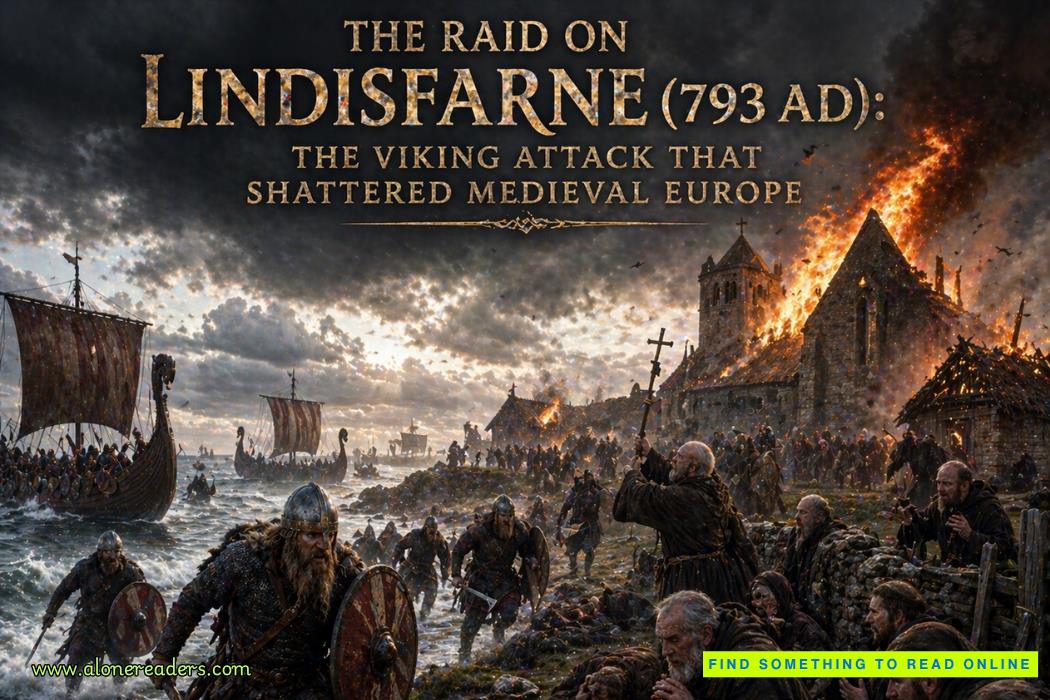
The year 793 AD marked a moment that would echo across centuries, sending shockwaves through the spiritual and political fabric of medieval Europe. On a small, windswept island off the northeast coast of England stood Lindisfarne, a sacred center of Christian devotion. Known as the Holy Island, it was a place of prayer, learning, and quiet reflection. Yet on one fateful day, it became the stage for an event so violent and unexpected that it would come to symbolize the terrifying dawn of a new era—the Viking Age.
Lindisfarne was not chosen at random. It was one of the most revered religious institutions in Anglo-Saxon England, founded in the 7th century and associated with Saint Cuthbert, whose relics drew pilgrims from across the region. The monastery held immense spiritual significance and, crucially, accumulated wealth in the form of precious manuscripts, gold, silver, and offerings from the faithful. To the outside world, particularly to the seafaring Norsemen of Scandinavia, it was both a symbol of power and a vulnerable target.
What made the raid so shocking was not merely its brutality but its unexpected nature. Prior to this event, the British Isles had experienced internal conflicts and occasional invasions, but nothing quite like the sudden, seaborne assault carried out by the Vikings. These were not armies marching across land with banners raised—they were swift, silent predators arriving from the sea, striking with precision and vanishing just as quickly.
The attack itself was swift and merciless. Viking longships, sleek and shallow, allowed the raiders to navigate both open seas and narrow coastal waters with ease. As they landed on Lindisfarne, the monks—unarmed and unprepared—stood no chance. The invaders looted the monastery’s treasures, desecrated sacred spaces, and killed or enslaved many of its inhabitants. Contemporary accounts describe the horror in vivid terms, emphasizing the sacrilege of the act. Churches were not merely buildings; they were seen as houses of God, and their violation was interpreted as a sign of divine wrath or cosmic imbalance.
One of the most striking aspects of the Lindisfarne raid is how it was recorded by those who lived through its aftermath. Anglo-Saxon chroniclers expressed deep anguish and confusion, often framing the event as a punishment from God. Reports spoke of “heathen men” descending like a storm, bringing devastation and terror. Some accounts even mention strange omens preceding the attack—flashes of lightning, fiery dragons in the sky, and violent storms—interpreted as warnings of the catastrophe to come.
The psychological impact of the raid cannot be overstated. For a deeply religious society, the idea that a holy site could be so easily violated was profoundly unsettling. It challenged the belief in divine protection and forced people to reconsider their understanding of the world. If even Lindisfarne could fall, nowhere was truly safe. This sense of vulnerability spread quickly, fueling fear and uncertainty across kingdoms.
From a broader historical perspective, the raid on Lindisfarne is often regarded as the beginning of the Viking Age. While there had likely been earlier encounters between Norse seafarers and European communities, this event was the first to be widely recorded and recognized as a significant turning point. It marked the start of a period characterized by increased Viking activity, including raids, trade, exploration, and eventual settlement across vast regions of Europe.
The motivations behind the raid are complex and multifaceted. Economic factors played a crucial role. Scandinavia in the late 8th century was undergoing social and political changes, with population growth and limited arable land pushing some communities to seek opportunities elsewhere. Monasteries like Lindisfarne, rich in portable wealth and lightly defended, presented ideal targets. Additionally, the Vikings possessed advanced shipbuilding technology, which gave them a significant advantage in mobility and surprise.
There is also a cultural dimension to consider. Viking society placed a high value on honor, reputation, and martial prowess. Raiding was not merely an economic activity; it was a means of gaining prestige and demonstrating strength. Success in such ventures could elevate an individual’s status within their community. The raid on Lindisfarne, therefore, may have been as much about asserting dominance as it was about acquiring wealth.
The aftermath of the attack saw significant changes in how communities responded to external threats. Coastal monasteries and settlements began to implement defensive measures, although these were often limited in effectiveness. Over time, the increasing frequency of Viking raids forced rulers to rethink their strategies, leading to the development of fortified towns and more organized military responses. In England, this would eventually contribute to the rise of leaders capable of resisting Viking incursions more effectively.
Despite its violence, the Viking Age was not solely defined by destruction. The same seafaring skills that enabled raids also facilitated trade and cultural exchange. Vikings established trade networks that connected distant regions, bringing goods, ideas, and technologies into contact with one another. However, in 793 AD, none of this broader context softened the immediate horror of Lindisfarne. To those who experienced it, the raid was an unambiguous catastrophe.
The symbolic power of Lindisfarne endured long after the flames were extinguished. It became a reference point for subsequent generations, a story told and retold as a warning and a reminder. In many ways, it represents the moment when Europe realized it was facing a new and formidable force. The Vikings were no longer distant figures from the fringes of the known world; they were a tangible and immediate threat.
Interestingly, the legacy of the raid also reflects the biases of the sources that recorded it. Most contemporary accounts were written by Christian monks, whose perspectives were shaped by their religious worldview. As a result, Vikings were often portrayed in starkly negative terms, emphasizing their brutality and pagan beliefs. While there is no doubt about the violence of the raid, modern historians approach these accounts with a critical eye, recognizing that they capture only one side of a complex historical interaction.
Archaeological evidence has added further depth to our understanding of the event. Excavations and studies of Viking artifacts reveal a society that was not only capable of violence but also highly skilled in craftsmanship, navigation, and trade. This duality challenges simplistic narratives and invites a more nuanced interpretation of the Viking Age.
What remains undeniable is the transformative impact of the Lindisfarne raid. It set in motion a series of events that would reshape the political and cultural landscape of Europe. Kingdoms would rise and fall, alliances would shift, and new identities would emerge as a result of ongoing interactions with Viking groups. The raid was not an isolated incident but the opening chapter of a much larger story.
In reflecting on Lindisfarne, it is important to consider both its immediate and long-term significance. In the short term, it was a devastating attack that inflicted suffering and loss. In the long term, it marked the beginning of an era defined by movement, conflict, and exchange. It serves as a powerful reminder of how a single event can alter the course of history, leaving a legacy that endures for centuries.
The image of Viking longships appearing on the horizon, their sails cutting through the mist, has become one of the most iconic symbols of the medieval world. It captures a moment of sudden change, when the familiar gave way to the unknown. For the people of Lindisfarne, that moment arrived without warning, forever altering their lives and their understanding of the world around them.
Even today, the story of the raid continues to captivate historians, writers, and audiences alike. It speaks to universal themes of vulnerability, resilience, and the clash of cultures. By examining this event in detail, we gain not only insight into the past but also a deeper appreciation for the forces that have shaped our present.
The raid on Lindisfarne was more than just an attack; it was a turning point—a moment when history shifted direction. Its echoes can still be felt, reminding us of the fragile balance between peace and conflict, and the enduring impact of human actions across time.



 The Hundred Days Offensive: How the Allies Defeated Germany in World War I
 The Second Battle of the Marne: The Turning Point of World War I in 1918
 The Spring Offensive of 1918: Germany's Final Gamble to Win World War I
 The Treaty of Brest-Litovsk: How Russia Left World War I
 The Russian Revolution and World War I: How War Brought Down the Tsar
 The Zimmermann Telegram Explained: Germany's Secret Offer to Mexico in World War I