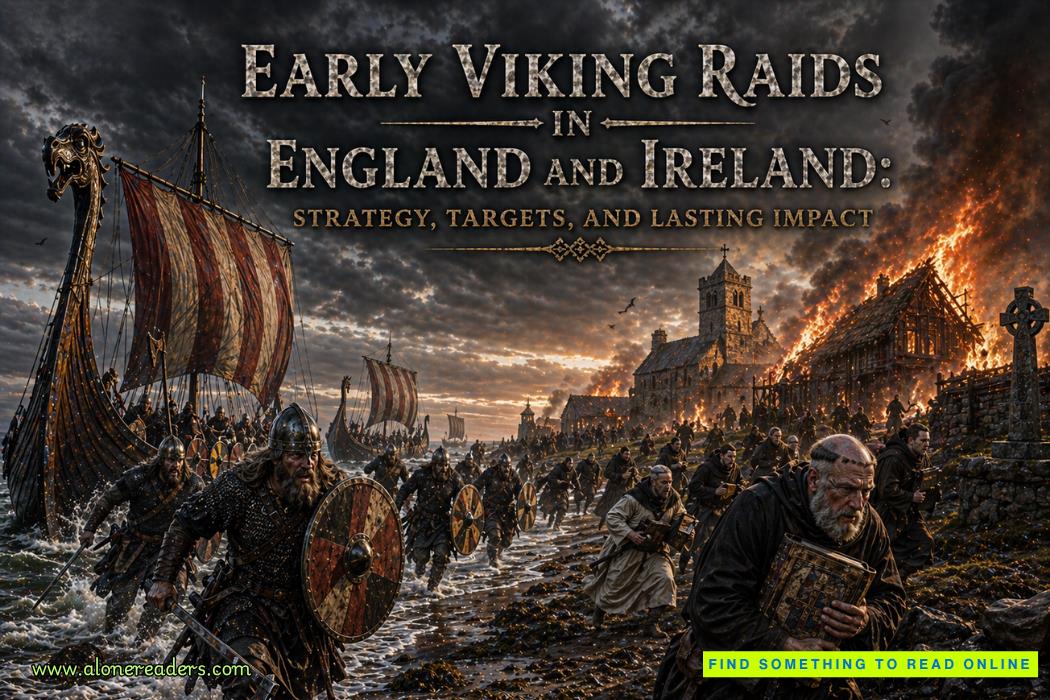
The early Viking raids in England and Ireland were not random acts of chaos, but rather highly calculated operations driven by economic need, social pressures, and strategic brilliance. Emerging from the rugged landscapes of Scandinavia in the late eighth century, Viking raiders reshaped the political and cultural landscape of the British Isles with a speed and intensity that stunned contemporary observers. What began as sporadic coastal attacks soon evolved into organized campaigns that exploited weaknesses in local defenses, targeted wealth-rich religious centers, and laid the groundwork for long-term Norse settlement.
The first recorded Viking raid, the infamous attack on the monastery of Lindisfarne in 793, marked a psychological turning point. This was not simply an act of plunder; it was an assault on one of the most sacred sites in Christian Britain. The choice of Lindisfarne reveals a key element of Viking strategy: the deliberate targeting of isolated, wealthy, and poorly defended locations. Monasteries across England and Ireland were ideal targets because they accumulated wealth in the form of gold, silver, and precious manuscripts, yet they lacked military protection. These religious centers also served as symbolic targets, amplifying the fear and perceived brutality of the attackers.
The Vikings demonstrated a remarkable understanding of geography and mobility. Their longships were central to their success, designed with shallow drafts that allowed them to navigate both open seas and narrow rivers. This technological advantage enabled them to strike deep inland with surprising speed. Rivers such as the Thames, Severn, Shannon, and Liffey became natural highways for Viking incursions, allowing raiders to bypass fortified coastal defenses and attack settlements that considered themselves safe. The element of surprise was often decisive; local populations had little warning before the arrival of these swift, disciplined warriors.
In Ireland, early Viking activity initially mirrored the hit-and-run tactics seen in England. Raids on monasteries such as those at Iona, Armagh, and Clonmacnoise revealed a consistent pattern: swift attacks, seizure of portable wealth, and rapid withdrawal. However, the situation in Ireland evolved more quickly into something more permanent. By the early ninth century, Vikings began establishing fortified encampments known as longphorts, which served as bases for continued operations. These settlements eventually grew into major urban centers, including Dublin, which became a thriving hub of trade and Norse culture.
England, by contrast, experienced a more gradual escalation. Early raids were sporadic, but by the mid-ninth century, they gave way to coordinated invasions by larger Viking forces, such as the Great Heathen Army. This shift reflects an important strategic evolution: from opportunistic raiding to organized conquest. The Vikings began to overwinter in England, establish strongholds, and exert political control over large territories. The establishment of the Danelaw in eastern and northern England illustrates how raiding could transition into governance and settlement.
The choice of targets was never arbitrary. Vikings prioritized locations that maximized reward while minimizing risk. Monasteries remained primary targets due to their wealth and vulnerability, but trading centers and emerging towns also became increasingly attractive. Places like York, which the Vikings captured and renamed Jorvik, offered both economic opportunities and strategic advantages. Control of such centers allowed the Vikings to dominate regional trade networks and integrate themselves into existing economic systems.
Another crucial aspect of Viking strategy was psychological warfare. The sheer brutality of their attacks, often exaggerated in contemporary accounts, created a reputation that preceded them. This fear factor sometimes led to minimal resistance, allowing smaller Viking forces to achieve disproportionate success. The destruction of religious sites also carried symbolic weight, undermining the authority of local rulers who were seen as protectors of the faith. In this way, Viking raids destabilized not only economies but also the ideological foundations of Anglo-Saxon and Irish societies.
The impact of these raids on England and Ireland was profound and multifaceted. Economically, the immediate effect was devastating. Monasteries were looted, trade disrupted, and agricultural communities displaced. However, in the long term, Viking activity contributed to the development of more robust economic systems. The establishment of Viking towns introduced new trade routes connecting the British Isles to Scandinavia, the Baltic, and even the Islamic world. This expansion of trade networks facilitated the exchange of goods, ideas, and cultural practices.
Politically, the Viking threat forced significant changes. In England, the need for coordinated defense led to the consolidation of smaller kingdoms into more unified entities. The reign of Alfred the Great exemplifies this transformation. His efforts to build fortified towns, reorganize military forces, and develop a navy were direct responses to Viking tactics. These reforms not only helped resist further incursions but also laid the foundations for a more centralized English state. In Ireland, the political impact was more fragmented, with Viking settlements coexisting alongside native kingdoms in a complex and often volatile relationship.
Culturally, the interaction between Vikings and local populations led to a process of mutual influence and adaptation. Norse settlers adopted aspects of local language and religion over time, while also introducing their own customs, art styles, and legal practices. Place names across England and Ireland still bear the imprint of this period, with many locations retaining Old Norse origins. Linguistic influences are also evident in the English language, particularly in regions that were part of the Danelaw.
It is important to recognize that the Vikings were not solely destroyers. While their raids were undeniably violent, they were also traders, settlers, and innovators. Their activities accelerated processes of urbanization, economic integration, and cultural exchange. The dual nature of their presence—both destructive and transformative—makes the early Viking raids a complex historical phenomenon that cannot be reduced to simple narratives of invasion.
The environmental and logistical factors behind Viking expansion also deserve attention. Scandinavia’s limited agricultural capacity and growing population created pressures that encouraged outward movement. Raiding offered a means of acquiring wealth and resources, while also providing opportunities for younger sons who might not inherit land at home. The decentralized political structure of Scandinavian societies allowed for flexibility and initiative, enabling groups of warriors to organize expeditions independently. This combination of push and pull factors helps explain the intensity and persistence of Viking activity during this period.
Religion played a subtle but significant role in shaping both Viking actions and local responses. For the Vikings, who practiced Norse paganism, Christian monasteries held no sacred status, making them legitimate targets. For the Christian populations of England and Ireland, however, these attacks were deeply shocking and often interpreted as divine punishment or apocalyptic signs. This religious dimension added another layer of psychological impact, reinforcing the sense of crisis and urgency.
Over time, the nature of Viking activity shifted as raiders became settlers and rulers. In both England and Ireland, Norse leaders began to engage in diplomacy, alliances, and even conversion to Christianity. This transition reflects a broader pattern in which initial violence gave way to integration and coexistence. By the end of the Viking Age, the descendants of these early raiders were no longer outsiders but integral parts of the societies they had once attacked.
The legacy of early Viking raids in England and Ireland is still visible today. Archaeological discoveries continue to reveal the extent of Norse influence, from artifacts and burial sites to urban layouts and trade networks. Historical narratives, shaped by both contemporary accounts and later interpretations, preserve the memory of these dramatic encounters. More importantly, the transformations triggered by Viking activity—political centralization, economic expansion, and cultural exchange—played a crucial role in shaping the medieval history of the British Isles.
In examining these early raids, it becomes clear that they were far more than isolated acts of violence. They were carefully planned operations that took advantage of specific weaknesses, focused on valuable targets, and adjusted over time as conditions changed. The Vikings’ ability to combine speed, knowledge, and psychological pressure allowed them to achieve impressive success despite their relatively small numbers. Their actions set in motion a series of changes that would reshape the course of England and Ireland for centuries.
Ultimately, the story of early Viking raids is one of transformation. What began as sudden and frightening attacks developed into a complex pattern of interaction that reshaped societies on both sides of the North Sea. The Vikings were not only forces of destruction but also agents of connection, linking distant regions through trade, movement of people, and cultural exchange. Understanding their strategy, targets, and impact offers valuable insight into one of the most dynamic and influential periods in European history



 The Hundred Days Offensive: How the Allies Defeated Germany in World War I
 The Second Battle of the Marne: The Turning Point of World War I in 1918
 The Spring Offensive of 1918: Germany's Final Gamble to Win World War I
 The Treaty of Brest-Litovsk: How Russia Left World War I
 The Russian Revolution and World War I: How War Brought Down the Tsar
 The Zimmermann Telegram Explained: Germany's Secret Offer to Mexico in World War I










