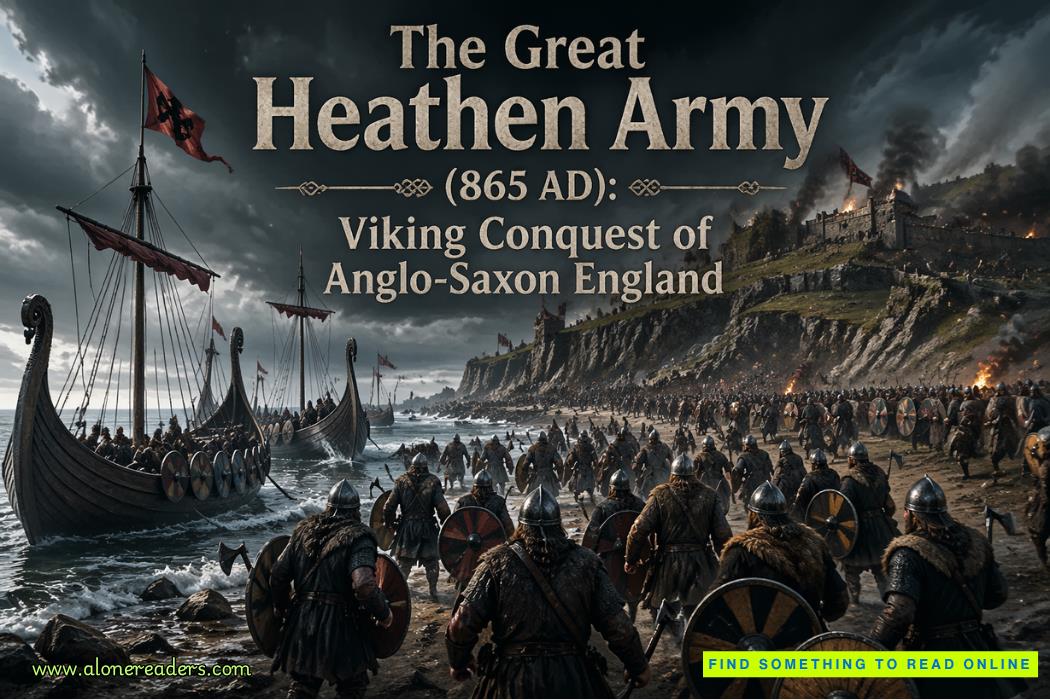
The year 865 AD marks one of the most decisive turning points in early English history, when a formidable Viking force known as the Great Heathen Army descended upon Anglo-Saxon England with a level of coordination, ambition, and brutality previously unseen. Unlike earlier Viking raids, which were typically swift coastal attacks aimed at plunder, this invasion signaled something far more profound: a calculated campaign of conquest, settlement, and domination.
The term “Great Heathen Army” itself reflects the perspective of Anglo-Saxon chroniclers, who viewed these Norse invaders not only as foreign aggressors but as pagan enemies of Christian order. Yet, beneath the dramatic label lay a complex and highly organized coalition of Scandinavian warriors, likely drawn from Denmark, Norway, and possibly Sweden. These were not mere raiders; they were seasoned fighters, strategic thinkers, and opportunists who recognized the political fragmentation of England as an open invitation.
At the time of the invasion, England was not a unified nation but a patchwork of competing kingdoms, including Northumbria, Mercia, East Anglia, and Wessex. This lack of unity proved to be one of the greatest vulnerabilities exploited by the Viking army. Internal rivalries and shifting alliances weakened resistance, allowing the invaders to move with surprising efficiency across territories that might otherwise have mounted a stronger defense.
The army first landed in East Anglia, a kingdom that quickly opted for submission rather than confrontation. In exchange for peace, the East Anglians provided the Vikings with horses, a strategic resource that enabled rapid inland movement. This moment highlights a crucial shift in Viking warfare: mobility and adaptability became central to their success. Rather than relying solely on ships, they transformed into a highly mobile land force capable of striking deep into English territory.
From East Anglia, the Great Heathen Army advanced northward into Northumbria, a kingdom already weakened by internal conflict between rival claimants to the throne. The Vikings exploited this instability with ruthless precision. In 866 AD, they captured the city of York, one of the most important urban centers in England. The fall of York was not merely a tactical victory; it represented a symbolic and strategic breakthrough that gave the Vikings a stronghold in the north.
The battle for York in 867 AD further demonstrated the effectiveness of Viking strategy. When Northumbrian forces attempted to retake the city, they were decisively defeated, and both rival kings were killed. This outcome effectively neutralized Northumbria as a unified power and allowed the Vikings to install a puppet ruler, thereby consolidating their control. The pattern of conquest followed by political manipulation became a hallmark of the Great Heathen Army’s campaign.
Following their success in Northumbria, the Vikings turned their attention to Mercia, another powerful kingdom. Initially, Mercia managed to resist outright conquest, but it was forced into submission and heavy tribute payments. The Vikings established winter camps, or “winter quarters,” which allowed them to maintain a continuous presence rather than retreating seasonally as earlier raiders had done. This shift underscores the long-term intent of the invasion: this was no temporary incursion but a sustained effort to reshape the political landscape.
Perhaps the most famous phase of the campaign came with the invasion of Wessex, the last major Anglo-Saxon kingdom capable of mounting significant resistance. Under the leadership of King Alfred, later known as Alfred the Great, Wessex became the focal point of resistance against Viking expansion. The conflict between Alfred and the Viking forces would ultimately define the legacy of the Great Heathen Army.
The battles between Wessex and the Vikings were intense and often unpredictable. In 871 AD, a series of engagements tested the resilience of Alfred’s forces. Although the Vikings achieved several victories, they were unable to deliver a decisive blow. Alfred’s leadership proved crucial during this period, as he combined military resistance with strategic retreats, preserving his forces for future engagements.
The turning point came in 878 AD, when the Viking leader Guthrum launched a surprise attack on Alfred’s stronghold at Chippenham. Alfred was forced into hiding, retreating into the marshes of Athelney. This moment could have marked the end of Anglo-Saxon resistance, but instead, it became the prelude to one of the most remarkable comebacks in English history.
Emerging from the marshes, Alfred rallied his forces and confronted the Vikings at the Battle of Edington. The victory he achieved there was decisive. Guthrum was defeated and subsequently entered into negotiations that led to the Treaty of Wedmore. As part of the agreement, Guthrum converted to Christianity, and a boundary was established between Viking-controlled territory and Wessex.
This division gave rise to the region known as the Danelaw, an area of England under Norse influence and governance. The establishment of the Danelaw was one of the most enduring consequences of the Great Heathen Army’s campaign. It introduced Scandinavian legal systems, cultural practices, and linguistic elements that would leave a lasting imprint on English society.
The impact of the Great Heathen Army extended far beyond the battlefield. The influx of Scandinavian settlers led to significant demographic changes, particularly in northern and eastern England. Place names, language, and local customs began to reflect Norse influence. Words of Old Norse origin entered the English language, and elements of Viking culture blended with existing Anglo-Saxon traditions.
Economically, the Vikings contributed to the development of trade networks that connected England to the wider Scandinavian world. Towns such as York became thriving centers of commerce under Viking rule. This transformation illustrates a critical aspect of the Viking presence: while initially destructive, it ultimately facilitated new forms of economic and cultural exchange.
Politically, the invasion forced the Anglo-Saxon kingdoms to adapt. The threat posed by the Great Heathen Army highlighted the need for greater unity and more effective military organization. Alfred the Great’s reforms, including the establishment of fortified towns known as burhs and the reorganization of the army, laid the groundwork for the eventual unification of England.
The Great Heathen Army also occupies a prominent place in historical and cultural narratives. Its leaders, often associated with legendary figures such as Ivar the Boneless and Halfdan Ragnarsson, have been immortalized in both historical texts and modern storytelling. While the exact identities and roles of these figures remain subjects of debate, their association with the invasion adds a layer of mythic intrigue to the historical record.
It is important to recognize that the success of the Great Heathen Army was not solely due to its strength but also to the weaknesses of its opponents. The fragmented political landscape of Anglo-Saxon England, combined with inconsistent military coordination, created an environment in which a determined and organized force could achieve extraordinary results. The Vikings capitalized on these conditions with remarkable effectiveness.
Yet, the story of the Great Heathen Army is not one of simple conquest. It is also a story of adaptation, negotiation, and transformation. The Vikings who arrived as invaders eventually became settlers, rulers, and participants in the evolving identity of England. Their legacy is woven into the fabric of English history, not as outsiders but as contributors to a shared past.
By the end of the 9th century, the momentum of the Great Heathen Army had slowed, and the balance of power began to shift. The resilience of Wessex, combined with internal divisions among Viking leaders, limited further expansion. Over time, the descendants of both Anglo-Saxons and Vikings would coexist, shaping a new cultural and political landscape.
The invasion of 865 AD stands as a powerful reminder of how quickly and profoundly history can change when opportunity meets ambition. The Great Heathen Army did not merely conquer land; it reshaped identities, redrew boundaries, and set in motion developments that would influence England for centuries.
In examining this period, one sees more than a series of battles. One sees the collision of worlds, the blending of cultures, and the emergence of a new order from the chaos of invasion. The Great Heathen Army remains a defining chapter in the story of the Viking Age and a crucial moment in the formation of England itself.



 The Hundred Days Offensive: How the Allies Defeated Germany in World War I
 The Second Battle of the Marne: The Turning Point of World War I in 1918
 The Spring Offensive of 1918: Germany's Final Gamble to Win World War I
 The Treaty of Brest-Litovsk: How Russia Left World War I
 The Russian Revolution and World War I: How War Brought Down the Tsar
 The Zimmermann Telegram Explained: Germany's Secret Offer to Mexico in World War I