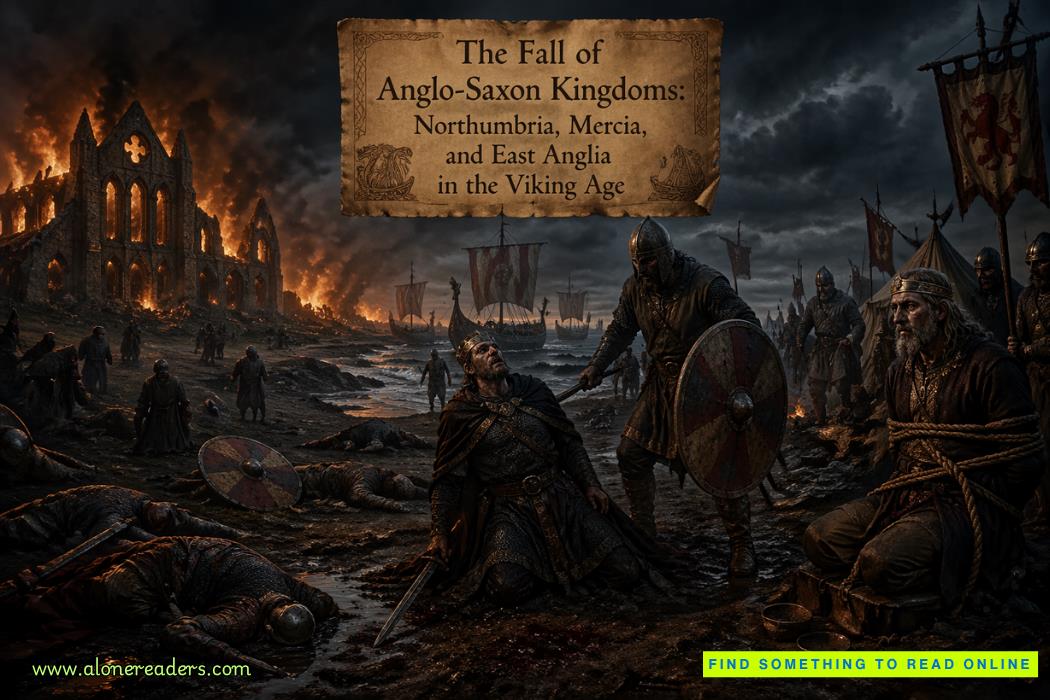
The fall of the Anglo-Saxon kingdoms of Northumbria, Mercia, and East Anglia stands as one of the most transformative episodes in early medieval English history. It was not a sudden collapse but a prolonged and violent unraveling, driven by internal instability, shifting power structures, and the relentless pressure of Viking incursions. By the late eighth century, these kingdoms had already begun to show signs of fragility, but it was the arrival of Scandinavian forces—organized, opportunistic, and increasingly ambitious—that accelerated their downfall and permanently altered the political and cultural landscape of England.
Northumbria, once the intellectual and spiritual heart of Anglo-Saxon England, was the first to fracture under pressure. In its golden age during the seventh and early eighth centuries, Northumbria had been a beacon of learning and religious influence. Monasteries such as Lindisfarne and Wearmouth-Jarrow were centers of scholarship, producing figures like Bede, whose works shaped the understanding of early English history. However, beneath this cultural brilliance lay deep political instability. The kingdom was frequently torn by dynastic disputes, assassinations, and rival claimants to the throne. Kings rarely ruled long enough to establish lasting authority, and loyalty among the nobility was often fluid.
This instability proved disastrous when the Vikings first appeared. The raid on Lindisfarne in 793 is often cited as the symbolic beginning of the Viking Age, and for Northumbria, it marked the start of a long decline. What began as seasonal raids soon evolved into sustained campaigns. Viking forces learned the geography, exploited the rivers, and targeted not only monasteries but also towns and political centers. By the mid-ninth century, the so-called Great Heathen Army had arrived, not merely to plunder but to conquer and settle.
In 866, the Vikings captured York, one of Northumbria’s most important cities. The kingdom, already divided between rival rulers, could not mount a unified defense. The capture of York effectively ended Northumbrian independence as a major power. Although local rulers continued to exist under Viking influence, real authority shifted to Scandinavian leaders who established the Kingdom of Jorvik. The transformation was profound: what had been a Christian Anglo-Saxon kingdom became a hybrid Norse-Anglo society, where new cultural and political norms took root. Northumbria did not simply fall—it was reshaped from within.
Mercia, the dominant power of southern England during much of the eighth century, faced a different but equally devastating trajectory. Under kings like Offa, Mercia had exercised considerable influence, even overshadowing neighboring kingdoms. Offa’s Dyke, a massive earthwork along the Welsh border, symbolized the kingdom’s strength and organizational capability. Yet after Offa’s death in 796, Mercia entered a period of decline. Successive rulers struggled to maintain authority, and the kingdom’s dominance began to erode.
By the time Viking forces turned their attention to Mercia, the kingdom was no longer at its peak. The Great Heathen Army, having secured a foothold in Northumbria, moved southward. Mercia initially attempted to resist, forming alliances with Wessex, but these efforts were often reactive and lacked cohesion. In 874, the Vikings expelled King Burgred of Mercia, forcing him into exile. In his place, they installed a puppet ruler, Ceolwulf II, who governed under Viking oversight.
This moment marked a critical turning point. Mercia was no longer an independent kingdom but a territory divided between Viking-controlled areas and regions increasingly influenced by Wessex. The eastern part of Mercia fell under the Danelaw, where Scandinavian law and customs prevailed, while the western part became aligned with Wessex, setting the stage for the eventual unification of England under West Saxon leadership. The fall of Mercia was not just a military defeat; it was a political absorption that erased its identity as a dominant kingdom.
East Anglia, though smaller and less powerful than Northumbria and Mercia, played a pivotal role in the Viking conquest of England. Its fertile lands and relative wealth made it an attractive target. Unlike Northumbria, East Anglia initially chose accommodation over confrontation. When the Great Heathen Army arrived in 865, the East Anglians provided horses to the Vikings, likely in an attempt to buy peace or delay conflict. This strategy, however, only postponed the inevitable.
In 869, the Vikings returned with greater force and intent. King Edmund of East Anglia chose to resist, and his stand became one of the most legendary episodes of the period. According to later tradition, Edmund refused to renounce his faith or submit to Viking authority. He was captured and executed, reportedly martyred in a brutal fashion. Whether embellished or not, the story reflects the stark reality faced by Anglo-Saxon rulers: submission or destruction.
With Edmund’s death, East Anglia ceased to exist as an independent kingdom. The region was absorbed into the Danelaw, becoming a center of Viking settlement and administration. Scandinavian influence reshaped the landscape, from place names to legal systems. The fall of East Anglia illustrates how quickly a kingdom could be erased when faced with a determined and organized external force.
The broader collapse of these kingdoms cannot be understood solely through the lens of Viking aggression. Internal weaknesses played a crucial role. Political fragmentation, succession disputes, and regional rivalries weakened the ability of Anglo-Saxon kingdoms to present a unified front. Even when alliances were formed, they were often temporary and driven by immediate necessity rather than long-term strategy. The Vikings, by contrast, demonstrated a capacity for coordination and adaptability that gave them a significant advantage.
Another key factor was the transformation of Viking tactics. Early raids were opportunistic and seasonal, but by the mid-ninth century, Viking leaders had shifted toward sustained campaigns of conquest and settlement. They brought families, established winter camps, and integrated themselves into the territories they controlled. This shift from raiding to colonization made resistance far more difficult, as the Vikings were no longer transient threats but permanent occupants.
The impact of these events extended far beyond the immediate political changes. The fall of Northumbria, Mercia, and East Anglia marked the end of the traditional Anglo-Saxon heptarchy—a system of multiple competing kingdoms—and paved the way for the rise of a more centralized English state. Wessex, under leaders like Alfred the Great, emerged as the primary force resisting Viking expansion. By learning from earlier failures, adopting new military strategies, and fortifying key locations, Wessex managed to survive and eventually reclaim lost territories.
Culturally, the integration of Viking settlers led to a blending of traditions. Language, law, and social structures evolved as Anglo-Saxon and Norse elements merged. Place names ending in “-by” and “-thorpe” still reflect this legacy, as do aspects of English vocabulary and legal practice. The fall of these kingdoms was not merely an end but also a beginning—a period of transformation that shaped the identity of England.
The stories of Northumbria, Mercia, and East Anglia reveal a pattern of decline that was both gradual and sudden, predictable yet chaotic. Each kingdom collapsed in its own way, shaped by its unique circumstances, yet all ultimately failed to withstand the combined pressures of internal weakness and external invasion. Their fall was not inevitable, but it became unavoidable as the balance of power shifted decisively in favor of the Vikings.
What remains striking is how these once powerful kingdoms, each with its own legacy of achievement and influence, were reduced within just a few decades to fragments of their former strength. Their fall serves as a reminder of how fragile political systems can be and how quickly power can change hands. At the same time, it highlights the resilience of cultural identity, as elements of Anglo Saxon society endured and adapted even under foreign rule.
When examining the fall of these kingdoms, one sees not only the end of an era but also the foundation of a new one. The Viking Age, often defined by violence and disruption, also acted as a driving force for unification and transformation. The destruction of old systems opened the way for new forms of governance and identity, eventually leading to the rise of a more unified England.
The legacy of Northumbria, Mercia, and East Anglia continues, not only in historical records but also in the cultural and geographic landscape of modern England. Their fall marked a turning point, a moment when the old order gave way to a new reality shaped by conflict, adaptation, and change. Understanding their fall offers valuable insight into the forces that shaped the medieval English state and the lasting impact of the Viking Age on European history.



 The Hundred Days Offensive: How the Allies Defeated Germany in World War I
 The Second Battle of the Marne: The Turning Point of World War I in 1918
 The Spring Offensive of 1918: Germany's Final Gamble to Win World War I
 The Treaty of Brest-Litovsk: How Russia Left World War I
 The Russian Revolution and World War I: How War Brought Down the Tsar
 The Zimmermann Telegram Explained: Germany's Secret Offer to Mexico in World War I










