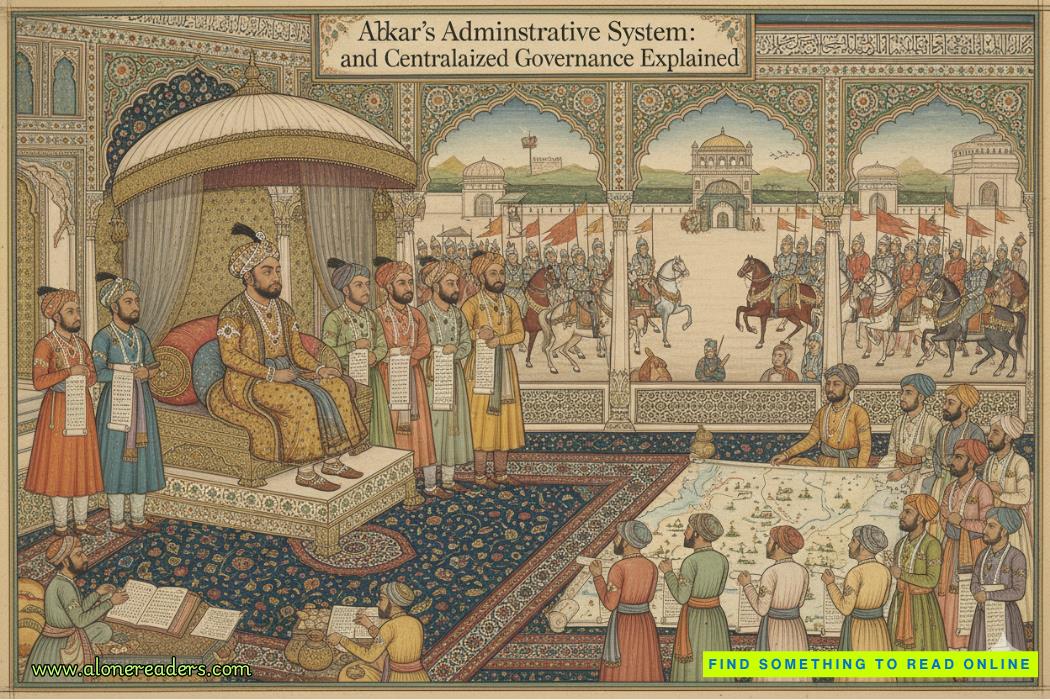
Akbar’s reign stands as one of the most remarkable phases in the history of the Mughal Empire, not merely for territorial expansion but for the creation of a robust and innovative administrative framework that ensured stability, loyalty, and efficiency. At the heart of this system were two defining features: the Mansabdari system and a deeply centralized form of governance that integrated military, civil, and fiscal structures into a cohesive imperial order. These mechanisms transformed a fragile empire into a durable and well-regulated state, capable of managing diversity across vast territories.
The concept of centralized governance under Akbar was not an arbitrary imposition of authority but a carefully crafted structure designed to balance imperial control with administrative practicality. Akbar understood that ruling over a vast and culturally diverse empire required more than military strength; it required a system that ensured accountability, loyalty, and efficient distribution of resources. Thus, he developed a system where authority radiated from the emperor, yet was executed through a network of carefully ranked officials who were directly dependent on imperial favor.
At the core of this administrative machinery was the Mansabdari system, a unique ranking structure that combined both civil and military responsibilities. The term “mansab” literally means rank or position, and every official in Akbar’s service was assigned a mansab, which determined their status, salary, and obligations. This system was revolutionary in that it eliminated hereditary nobility as the sole basis of power, replacing it with a merit-based hierarchy controlled by the emperor.
Each mansabdar was assigned two numerical designations: Zat and Sawar. The Zat rank indicated the personal status of the official, reflecting their position in the imperial hierarchy and determining their salary. The Sawar rank, on the other hand, specified the number of cavalry troops the mansabdar was required to maintain. This dual-ranking system ensured that military readiness and administrative responsibility were intertwined, creating a class of officials who were both bureaucrats and military commanders.
What made this system particularly effective was its emphasis on imperial control and flexibility. Mansabdars did not own the land they administered; instead, they were assigned jagirs, or revenue assignments, from which they collected income. These jagirs were transferable and non-hereditary, preventing the emergence of independent regional powers that could challenge the emperor’s authority. By frequently transferring mansabdars from one region to another, Akbar ensured that local loyalties did not override loyalty to the empire.
The Mansabdari system also introduced a level of standardization and accountability that was unprecedented in earlier Indian polities. Detailed records were maintained regarding the number of troops each mansabdar was supposed to maintain, and periodic inspections ensured compliance. The branding of horses and descriptive rolls of soldiers were introduced to prevent fraud, reinforcing a culture of discipline and administrative precision.
Beyond the Mansabdari system, Akbar’s centralized governance extended into the organization of the imperial administration at multiple levels. At the top stood the emperor, whose authority was absolute but exercised with a sense of responsibility and consultation. Supporting him was a council of key officials, including the Wazir (chief minister), Diwan (finance minister), Mir Bakshi (military head), and Sadr (religious affairs officer). Each of these positions was carefully defined to ensure that power was distributed yet ultimately controlled by the emperor.
The Diwan played a crucial role in managing the empire’s finances, overseeing revenue collection, expenditure, and auditing. Akbar’s revenue system, refined under the guidance of Raja Todar Mal, introduced systematic land measurement and classification, ensuring fair taxation based on productivity. This not only increased state revenue but also reduced arbitrary taxation, thereby fostering economic stability and agrarian growth.
Provincial administration mirrored the central structure, reflecting the principle of uniform governance across the empire. The empire was divided into provinces known as subahs, each governed by a Subahdar who acted as the emperor’s representative. Supporting him were officials responsible for finance, military, and judiciary functions, ensuring that no single authority dominated provincial administration. This system of checks and balances prevented misuse of power and ensured that provincial governance remained aligned with imperial policies.
At the district and local levels, officials such as Amils, Qanungos, and village headmen played vital roles in maintaining order and implementing policies. This multi-tiered administrative structure ensured that imperial directives reached even the smallest units of governance, creating a seamless chain of command from the emperor to the village level.
One of the most striking features of Akbar’s governance was its emphasis on inclusivity and integration. Unlike many rulers who relied solely on a narrow elite, Akbar incorporated individuals from diverse ethnic, religious, and regional backgrounds into his administration. Rajputs, Persians, Central Asians, and Indian Muslims all found representation within the Mansabdari system. This inclusivity not only strengthened the administrative framework but also fostered a sense of shared identity and loyalty to the empire.
The centralized nature of Akbar’s governance did not imply rigidity. On the contrary, it was marked by adaptability and responsiveness. Policies were frequently revised based on practical considerations, and officials were expected to report conditions from their regions, enabling the emperor to make informed decisions. This dynamic approach ensured that the administration remained efficient and relevant in a changing environment.
Another critical aspect of Akbar’s system was the separation of revenue collection from military command, which reduced the likelihood of corruption and abuse. By ensuring that financial and military powers were not concentrated in a single individual, Akbar created a system where mutual oversight acted as a safeguard against inefficiency and exploitation.
The success of the Mansabdari system and centralized governance can be measured by the longevity and stability of the Mughal Empire during and after Akbar’s reign. His administrative innovations laid the foundation for a state that could sustain itself through successive rulers, maintaining order and prosperity across a vast and diverse territory.
However, it is also important to recognize the limitations inherent in such a system. The heavy reliance on the emperor’s authority meant that the system required a capable and vigilant ruler to function effectively. In later periods, when weaker emperors ascended the throne, the same centralized mechanisms sometimes became sources of rigidity and inefficiency. Despite these challenges, the core principles established by Akbar continued to influence governance structures for generations.
In essence, Akbar’s administrative system represents a remarkable synthesis of military organization, bureaucratic efficiency, and centralized authority. The Mansabdari system ensured that officials remained loyal and accountable, while the broader framework of governance provided stability and cohesion. Together, they created a model of administration that was not only effective in its time but also enduring in its impact on the subcontinent’s political and administrative traditions.
The brilliance of Akbar’s approach lay in his ability to transform power into a structured and sustainable system, where authority was not merely imposed but institutionalized. His vision of governance, rooted in discipline, inclusivity, and adaptability, continues to be studied as a defining example of statecraft in pre-modern history.



 The Hundred Days Offensive: How the Allies Defeated Germany in World War I
 The Second Battle of the Marne: The Turning Point of World War I in 1918
 The Spring Offensive of 1918: Germany's Final Gamble to Win World War I
 The Treaty of Brest-Litovsk: How Russia Left World War I
 The Russian Revolution and World War I: How War Brought Down the Tsar
 The Zimmermann Telegram Explained: Germany's Secret Offer to Mexico in World War I










