Akbar, the third emperor of the Mughal Empire, stands out not merely as a conqueror but as a visionary ruler who fundamentally reshaped the relationship between religion and governance in early modern India. His reign, from 1556 to 1605, marked a decisive shift from rigid orthodoxy toward a policy rooted in inclusivity, dialogue, and intellectual curiosity. At a time when much of the world was fractured by religious conflicts, Akbar’s approach to faith and governance demonstrated an extraordinary commitment to coexistence and harmony.
Born into a Muslim royal family, Akbar inherited a political environment shaped by Islamic traditions but also deeply influenced by the diverse religious fabric of the Indian subcontinent. From the outset, he recognized that ruling a vast and culturally varied empire required more than military strength; it demanded sensitivity to the beliefs and traditions of his subjects. This realization became the foundation of his religious policy, which evolved over time into one of the most remarkable experiments in spiritual pluralism.
In the early years of his rule, Akbar followed conventional Islamic practices and relied heavily on orthodox scholars. However, as he matured, he began to question the authority of rigid interpretations of religion. His interactions with scholars of different faiths—Hinduism, Jainism, Christianity, Zoroastrianism, and even atheistic philosophies—broadened his intellectual horizons. These engagements were not superficial; they were driven by a genuine desire to seek truth beyond dogma. This shift marked the beginning of a new phase in Mughal governance, where religion was no longer a tool of division but a means of understanding.
One of Akbar’s most significant steps toward religious tolerance was the abolition of discriminatory taxes such as the jizya, which had traditionally been imposed on non-Muslims. By removing this tax, he sent a powerful message that all subjects, regardless of faith, were equal in the eyes of the state. Similarly, he ended the practice of forcing prisoners of war to convert to Islam, reinforcing his belief that faith should be a matter of personal conviction rather than coercion. These reforms were not merely administrative; they reflected a deeper philosophical commitment to justice and equality.
Akbar also promoted the inclusion of non-Muslims in high administrative positions. Rajput rulers, in particular, were integrated into the Mughal nobility through alliances and marriages. This policy not only strengthened political stability but also fostered a sense of shared identity among diverse communities. By valuing merit over religious affiliation, Akbar created a governance system that was both efficient and inclusive.
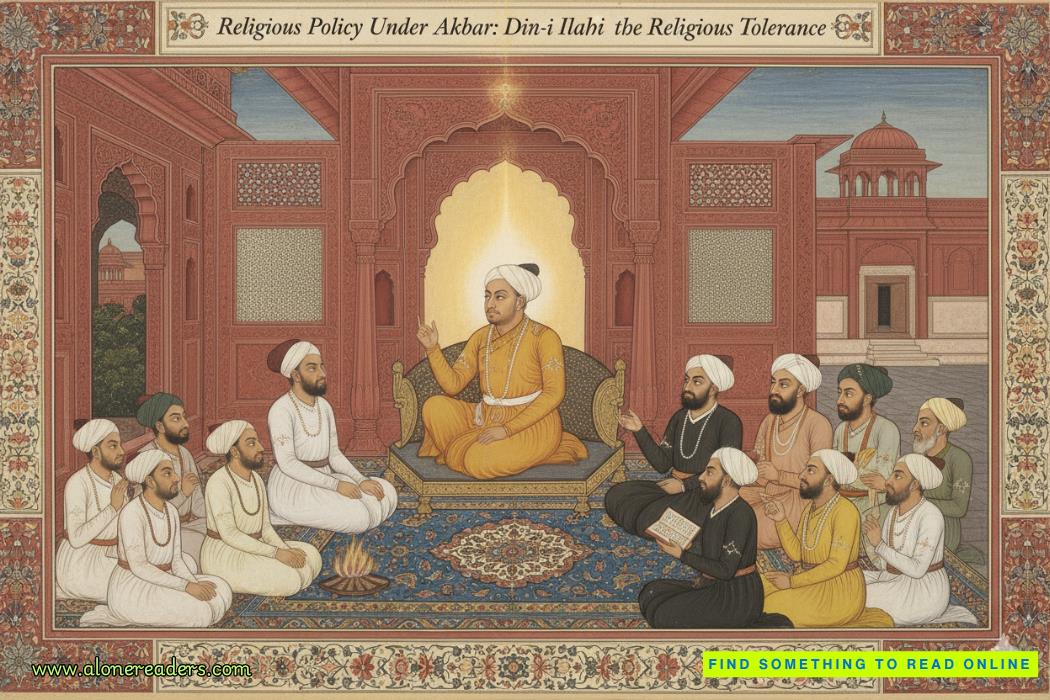
A crucial element of Akbar’s religious policy was the establishment of the Ibadat Khana, or House of Worship, at Fatehpur Sikri. This institution served as a forum for theological debates and discussions among scholars of various religions. Initially intended for Muslim theologians, it soon expanded to include representatives of other faiths. The debates held in the Ibadat Khana were often intense and revealing, exposing the limitations and contradictions within different religious doctrines. For Akbar, these discussions reinforced the idea that no single religion possessed a monopoly on truth.
It was within this context of intellectual exploration that Akbar introduced the concept of Din-i Ilahi, or the “Divine Faith,” around 1582. Contrary to popular belief, Din-i Ilahi was not a formal religion with a structured doctrine or widespread following. Instead, it was a spiritual framework that sought to combine ethical and philosophical elements from various religions into a unified system. Its core principles emphasized loyalty to the emperor, ethical living, self-discipline, and reverence for all forms of life.
Din-i Ilahi drew inspiration from multiple traditions. From Islam, it adopted the idea of monotheism and devotion to a single divine entity. From Hinduism, it incorporated concepts of karma and dharma. Jainism influenced its emphasis on non-violence, while Zoroastrianism contributed elements such as the symbolic use of fire. Even Christian teachings, introduced by Jesuit missionaries at Akbar’s court, played a role in shaping its ethical outlook. This synthesis was not an attempt to dilute religions but rather an effort to identify universal truths that transcended individual doctrines.
Despite its philosophical depth, Din-i Ilahi was never intended to replace existing religions. It remained limited to a small group of close associates and courtiers, including figures like Abul Fazl and Birbal. Akbar did not enforce its adoption, nor did he present it as a compulsory belief system. Instead, it functioned as a personal expression of his spiritual vision, reflecting his belief in unity through diversity. The limited spread of Din-i Ilahi underscores the fact that Akbar’s primary goal was not to create a new religion but to encourage mutual respect among existing ones.
Akbar’s broader policy of Sulh-i Kul, meaning “universal peace,” became the guiding principle of his rule. This concept extended beyond religious tolerance to include social harmony and ethical governance. It required the state to treat all individuals fairly, regardless of their background, and to promote dialogue rather than conflict. Sulh-i Kul was not merely an abstract ideal; it was actively implemented through administrative reforms, legal measures, and cultural initiatives.
The impact of Akbar’s religious policy was profound and far-reaching. It created an environment where different communities could coexist without fear of persecution. Artistic and cultural exchanges flourished, leading to the development of a rich and diverse Mughal culture. Literature, architecture, and music all benefited from this atmosphere of openness, blending influences from various traditions into a unique synthesis.
However, Akbar’s policies were not without criticism. Orthodox Muslim scholars, in particular, viewed his actions as a departure from established religious norms. They questioned his authority to reinterpret religious principles and criticized the perceived dilution of Islamic identity. These tensions highlight the challenges inherent in implementing a policy of tolerance in a deeply traditional society. Yet, Akbar remained steadfast in his beliefs, prioritizing unity and stability over rigid adherence to orthodoxy.
In evaluating Akbar’s religious policy, it is important to recognize its historical context. The sixteenth century was a period marked by religious conflicts across the globe, from the Protestant Reformation in Europe to sectarian divisions in the Islamic world. Against this backdrop, Akbar’s approach appears remarkably progressive. His willingness to engage with different perspectives and to question established norms reflects a rare combination of political skill and intellectual openness.
The legacy of Din-i Ilahi and Akbar’s policy of tolerance continues to resonate in modern discussions about secularism and pluralism. While Din-i Ilahi itself did not survive beyond his reign, the principles underlying it—respect for diversity, ethical governance, and the search for universal truths—remain relevant. Akbar’s rule serves as a reminder that effective leadership requires not only authority but also empathy and vision.
In conclusion, Akbar’s religious policy was a bold and innovative experiment that sought to redefine the relationship between faith and power. Through measures such as the abolition of discriminatory practices, the promotion of interfaith dialogue, and the introduction of Din-i Ilahi, he laid the groundwork for a more inclusive and harmonious society. His emphasis on tolerance, understanding, and unity set him apart as one of the most enlightened rulers of his time. While his ideas were not universally accepted, their impact on the Mughal Empire and beyond cannot be overstated. Akbar’s reign stands as a testament to the possibility of bridging differences through wisdom, curiosity, and a commitment to shared humanity.



 The Hundred Days Offensive: How the Allies Defeated Germany in World War I
 The Second Battle of the Marne: The Turning Point of World War I in 1918
 The Spring Offensive of 1918: Germany's Final Gamble to Win World War I
 The Treaty of Brest-Litovsk: How Russia Left World War I
 The Russian Revolution and World War I: How War Brought Down the Tsar
 The Zimmermann Telegram Explained: Germany's Secret Offer to Mexico in World War I