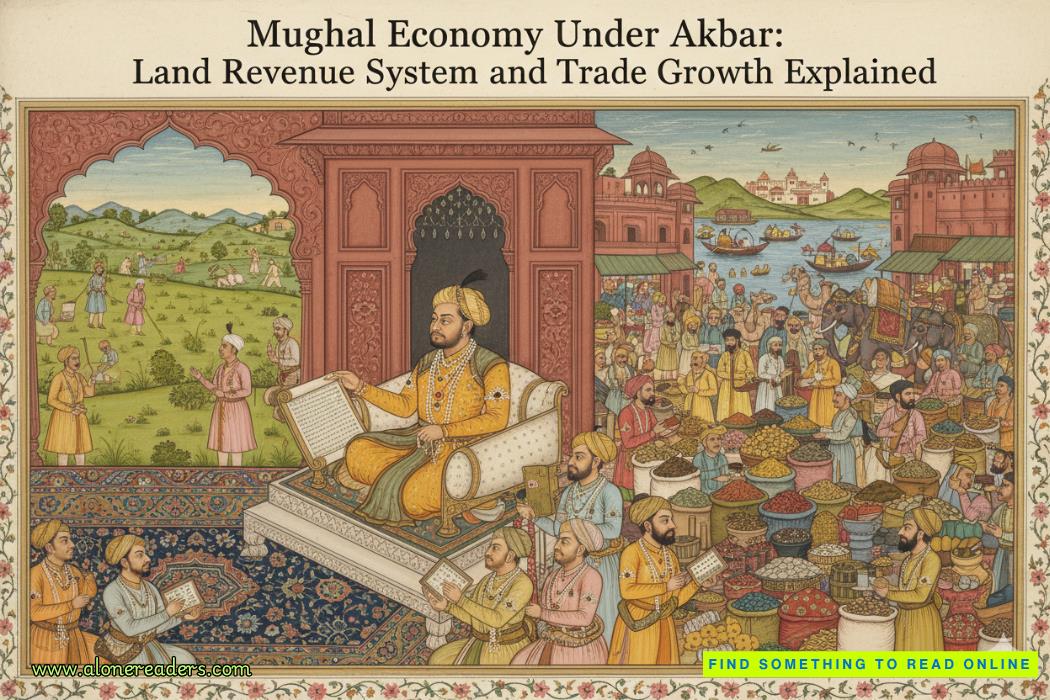
The Mughal Empire reached a remarkable level of economic organization and prosperity during the reign of Emperor Akbar, who ruled from 1556 to 1605. His reign marked a turning point in Indian economic history, as he introduced systematic reforms, administrative discipline, and fiscal innovation that laid the foundation for a stable and flourishing empire. The Mughal economy under Akbar was not merely a result of territorial expansion, but rather the outcome of carefully designed policies that regulated agriculture, taxation, trade, and market practices. Among these, the land revenue system and the expansion of trade networks stand out as the most defining elements of his economic vision.
Agriculture formed the backbone of the Mughal economy, and Akbar understood that a strong agrarian base was essential for political stability and imperial revenue. Before his reforms, revenue collection was often arbitrary and exploitative, with local officials imposing inconsistent demands on peasants. This unpredictability created distress among cultivators and reduced agricultural productivity. Akbar sought to replace this chaos with a rational and uniform system of land revenue assessment, which would ensure fairness for farmers while securing steady income for the state.
One of the most significant contributors to this transformation was Raja Todar Mal, Akbar’s trusted finance minister, who developed the Zabt system of land revenue. This system was based on accurate measurement and classification of land, marking a shift from guesswork to empirical assessment. Land was carefully surveyed using standardized units, and its productivity was evaluated over a period of several years. This allowed the administration to determine the average yield and fix a reasonable share of revenue that the state could claim.
The land under cultivation was divided into different categories based on fertility and usage. For example, Polaj land referred to regularly cultivated fields, while Parauti land was left fallow for a short period to regain fertility. Other classifications included Chachar and Banjar, which represented lands that were fallow for longer durations or uncultivated. This classification system ensured that taxation was not uniform across all lands but adjusted according to productivity, reflecting a more scientific and equitable approach to revenue assessment.
The state demand was generally fixed at one-third of the average produce, though this could vary depending on local conditions. Importantly, the revenue could be paid either in kind or in cash, though Akbar increasingly encouraged cash payments, which facilitated monetization of the economy. To support this transition, the administration maintained detailed records of crop yields, prices, and local conditions, ensuring transparency and accountability in revenue collection.
Akbar also introduced the Dahsala system, which further refined the revenue process. Under this method, the average produce and prices of the previous ten years were calculated to determine a stable rate of taxation. This reduced the impact of annual fluctuations caused by droughts, floods, or market instability. By stabilizing revenue demands, the Dahsala system provided relief to peasants and encouraged long-term agricultural planning.
Another important feature of Akbar’s land revenue system was the role of local officials, such as Amils and Qanungos, who were responsible for collection and record-keeping. While these officials ensured administrative efficiency, Akbar also implemented checks to prevent corruption and exploitation. Farmers were given patta (title deeds) specifying the amount of revenue they owed, while they, in turn, signed qabuliat (agreements) accepting these terms. This mutual documentation created a formal relationship between the state and the cultivator, reducing arbitrary demands.
The impact of these reforms on agriculture was profound. Farmers gained a sense of security, knowing that their obligations were fixed and predictable. This encouraged them to invest in better cultivation practices, expand the area under farming, and adopt new crops. Regions like the Indo-Gangetic plain saw increased productivity, while cash crops such as cotton, indigo, and sugarcane gained prominence due to growing market demand.
Parallel to agricultural reforms, Akbar placed great emphasis on the growth of trade and commerce. The Mughal Empire, under his rule, became a vibrant hub of both internal and external trade, connecting diverse regions through a network of roads, markets, and trade routes. Akbar recognized that economic prosperity depended not only on agricultural output but also on the efficient movement and exchange of goods.
One of the key measures taken to promote trade was the improvement of infrastructure. Roads were constructed and maintained to facilitate transportation, while sarais (rest houses) were built along major routes to provide shelter for travelers and merchants. These sarais also functioned as centers of exchange, where traders could interact, store goods, and gather information about markets. The development of such infrastructure significantly reduced the risks and costs associated with long-distance trade.
Akbar also worked to eliminate unnecessary taxes and barriers that hindered commerce. Internal customs duties were reduced or abolished in many regions, allowing goods to move freely across the empire. This created a unified market where merchants could operate without facing multiple layers of taxation. The standardization of weights and measures further enhanced trade efficiency, ensuring consistency and fairness in transactions.
The Mughal currency system under Akbar played a crucial role in facilitating trade. He introduced a uniform and high-quality coinage system, including the silver rupiya and the copper dam. These coins were widely accepted and trusted, which boosted commercial activity and encouraged the use of money instead of barter. The availability of a stable currency allowed traders to conduct transactions more easily and expanded the scale of economic exchange.
Urban centers emerged as important hubs of trade and industry during Akbar’s reign. Cities such as Agra, Lahore, and Fatehpur Sikri became bustling marketplaces where goods from different regions were bought and sold. Artisans and craftsmen produced a wide range of goods, including textiles, metalwork, ceramics, and jewelry. The Mughal court itself was a major consumer of luxury goods, stimulating demand for high-quality craftsmanship.
Textile production, in particular, became a cornerstone of Mughal trade. Indian cotton and silk fabrics were highly valued both domestically and internationally. Regions like Bengal and Gujarat became famous for their fine textiles, which were exported to Central Asia, the Middle East, and even Europe. The demand for these goods created a thriving export economy, bringing wealth into the empire.
Maritime trade also flourished under Akbar’s rule, with ports such as Surat playing a key role in international commerce. Merchants traded spices, textiles, indigo, and other goods with foreign markets, while importing items like horses, precious metals, and luxury products. The Mughal state generally maintained a policy of non-interference in trade, allowing merchants considerable freedom while ensuring law and order.
The growth of trade was further supported by the presence of merchant communities, including Banias, Marwaris, and Multanis, who played a vital role in financing and organizing commercial activities. These communities developed networks that extended across regions, facilitating the movement of goods and capital. Credit instruments such as hundis (bills of exchange) were widely used, reducing the need to carry large amounts of cash and making trade more secure.
Akbar’s policies also contributed to the integration of rural and urban economies. Agricultural surplus generated in villages was transported to cities, where it supported urban populations and industrial production. In turn, manufactured goods from cities were distributed to rural areas, creating a cycle of economic interdependence. This integration strengthened the overall economic structure of the empire.
Another noteworthy aspect of Akbar’s economic policy was his emphasis on justice and administrative efficiency. He believed that a prosperous economy depended on fair governance and the protection of people’s rights. Measures were taken to prevent exploitation by officials, resolve disputes, and maintain stability. This created an environment of trust, encouraging both farmers and merchants to participate actively in economic activities.
The combination of a well-organized land revenue system and a dynamic trade network resulted in a robust and resilient economy. Revenue from agriculture provided the financial foundation for the state, while trade generated additional wealth and connected the empire to global markets. This dual structure allowed the Mughal Empire to sustain its administrative machinery, military strength, and cultural achievements.
However, it is important to recognize that the system was not without its challenges. Despite efforts to ensure fairness, some regions experienced heavy taxation, and the burden on peasants could still be significant during periods of crop failure. Similarly, while trade flourished, it remained dependent on political stability and infrastructure maintenance. Nevertheless, compared to earlier periods, Akbar’s economic policies represented a significant advancement in governance and economic management.
In essence, the Mughal economy under Akbar was characterized by innovation, organization, and inclusivity. His land revenue reforms transformed agriculture into a stable and productive sector, while his support for trade created opportunities for growth and exchange. By balancing state interests with the welfare of his subjects, Akbar established an economic system that not only sustained his empire but also left a lasting legacy in the history of South Asia.
The success of Akbar’s economic policies can be seen in the prosperity and stability that defined his reign. His ability to integrate diverse regions, communities, and economic activities into a cohesive system remains a remarkable achievement. Even centuries later, his reforms continue to be studied as examples of effective governance and economic planning, highlighting the enduring significance of his contributions to the Mughal Empire.



 The Hundred Days Offensive: How the Allies Defeated Germany in World War I
 The Second Battle of the Marne: The Turning Point of World War I in 1918
 The Spring Offensive of 1918: Germany's Final Gamble to Win World War I
 The Treaty of Brest-Litovsk: How Russia Left World War I
 The Russian Revolution and World War I: How War Brought Down the Tsar
 The Zimmermann Telegram Explained: Germany's Secret Offer to Mexico in World War I