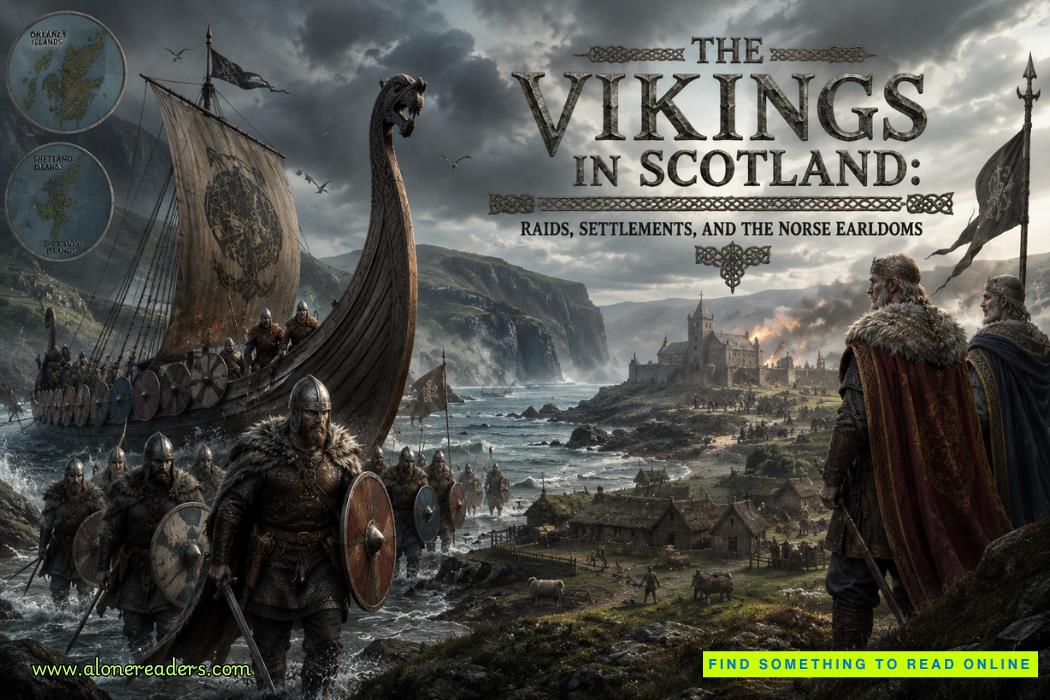
The story of the Vikings in Scotland is not merely one of sudden violence and fleeting raids, but rather a complex transformation of power, culture, and identity that reshaped the northern and western edges of Britain for centuries. From the late eighth century onward, Norse seafarers arrived first as raiders, then as settlers, and eventually as rulers who carved out structured political domains known as the Norse earldoms. These developments were not isolated events; they formed part of a wider Scandinavian expansion that connected Scotland to a vast maritime world stretching from Norway to Ireland and beyond.
The earliest Viking activity in Scotland began with swift and devastating coastal raids, targeting monasteries and undefended settlements. These attacks were driven by both economic motives and opportunistic warfare. Monasteries such as those in Iona became frequent targets due to their wealth and symbolic importance. The monastery at Iona, founded by Saint Columba, was raided repeatedly, culminating in destruction and loss of life that shocked the Christian world. These assaults were not random acts of chaos but calculated strikes designed to exploit weak defenses and maximize plunder.
What made the Viking raids particularly effective was their mastery of maritime mobility. Their longships, with shallow drafts and flexible design, allowed them to navigate both open seas and inland waterways. This meant that no coastal or riverine community was entirely safe. The Vikings could appear suddenly, strike quickly, and disappear before organized resistance could form. In this early phase, Scotland experienced the Vikings primarily as raiders from the sea, unpredictable and terrifying.
However, by the ninth century, the nature of Viking activity began to change. Instead of returning to Scandinavia after each raid, many Norse groups chose to remain. They established permanent settlements, particularly in regions that were geographically suitable for their maritime lifestyle. The Northern Isles—Orkney and Shetland—became central hubs of Norse power. These islands were not just convenient stopping points; they evolved into fully Norse societies, where Scandinavian language, law, and culture dominated.
The settlement process was not always peaceful. In many cases, existing populations were displaced or absorbed. Archaeological evidence suggests that in places like Orkney, the Norse presence became so dominant that earlier cultural traces were significantly reduced. Over time, these islands developed a distinctly Norse identity, separate from mainland Scotland. The Norse language, known as Old Norse, became the primary means of communication, and Norse customs shaped daily life.
Further south and west, Viking settlements spread into the Hebrides and parts of the Scottish mainland. These areas saw a more blended cultural interaction. Norse settlers intermarried with local populations, creating a hybrid culture often referred to as Norse-Gaelic. This fusion produced unique social and linguistic developments, where Scandinavian and Gaelic traditions coexisted and influenced one another. The result was not simply conquest, but cultural synthesis, visible in place names, art, and governance.
The emergence of the Norse earldoms marked a significant evolution from scattered settlements to organized political authority. The most prominent of these was the Earldom of Orkney, which became a powerful Norse-controlled territory. According to tradition, the earldom was established by Harald Fairhair, the king of Norway, who sought to bring order to Viking activities in the region. Whether entirely historical or partly legendary, this narrative reflects the broader trend of centralized Norse governance.
The Earls of Orkney wielded considerable influence, ruling not only the islands but also extending their power into mainland Scotland and the Hebrides. They operated as both local rulers and representatives of Norwegian authority, balancing independence with allegiance. The earldom became a key political entity, involved in alliances, conflicts, and negotiations with neighboring kingdoms, including the Scots and the Irish.
One of the most fascinating aspects of the Norse earldoms is their integration into the wider medieval world. The earls were not isolated warlords; they participated in broader networks of trade, diplomacy, and religion. Christianity gradually took hold among the Norse settlers, leading to the construction of churches and the adoption of Christian practices. This transition did not erase Norse identity but rather transformed it, blending pagan heritage with new religious frameworks.
The political landscape of Scotland during this period was highly fragmented, and the presence of Norse earldoms added another layer of complexity. Scottish kings sought to assert control over territories influenced or ruled by the Norse, leading to ongoing conflict and negotiation. Control over the Hebrides and the Northern Isles was particularly contested, as these regions held strategic and economic importance.
The relationship between the Norse earls and the Scottish crown was not purely antagonistic. At times, alliances were formed through marriage and diplomacy. Norse rulers could act as both rivals and partners, depending on the shifting balance of power. This fluid dynamic highlights the interconnected nature of medieval politics, where identity and loyalty were often flexible.
Over time, the influence of the Norse earldoms began to decline. Internal conflicts, changing political circumstances, and the growing strength of the Scottish kingdom contributed to their gradual weakening. By the thirteenth century, Scotland had begun to assert more direct control over previously Norse-held territories. The Treaty of Perth in 1266 marked a decisive turning point, transferring the Hebrides and the Isle of Man from Norwegian to Scottish rule.
Despite this political shift, the legacy of the Vikings in Scotland remained deeply embedded in the cultural landscape. Place names across the Northern Isles and western Scotland still reflect their Norse origins. Words derived from Old Norse persist in local dialects, and archaeological sites continue to reveal the extent of Viking settlement and influence. The Norse earldoms may have faded as political entities, but their impact endured.
What distinguishes the Viking presence in Scotland from that in other parts of Europe is the balance between destruction and creation. While the early raids brought violence and disruption, the subsequent settlements and governance structures contributed to long-term development. The Norse did not simply pass through Scotland; they became part of its historical fabric.
The story also challenges simplistic narratives of Vikings as mere raiders. In Scotland, they were explorers, settlers, rulers, and cultural intermediaries. Their ability to adapt to new environments and integrate with existing societies allowed them to establish lasting footholds. The Norse earldoms, in particular, demonstrate how Viking groups could transition from loosely organized bands into structured political systems.
Understanding the Vikings in Scotland requires looking beyond the dramatic imagery of burning monasteries and fierce warriors. It involves recognizing the gradual processes of settlement, adaptation, and governance that followed the initial waves of raiding. These processes reshaped not only the regions directly under Norse control but also the broader political and cultural landscape of medieval Scotland.
The interplay between Norse and Scottish identities created a dynamic frontier where cultures met, clashed, and merged. This frontier was not fixed but constantly evolving, influenced by migration, trade, and political ambition. The Norse earldoms stood at the center of this transformation, acting as both agents of change and products of their environment.
In the end, the Viking Age in Scotland was not a brief episode but a prolonged period of interaction and transformation. Its legacy can still be seen in the geography, language, and cultural memory of the region. The Norse earldoms, though long gone, remain a testament to the enduring impact of Viking expansion and the complex history of Scotland’s northern and western frontiers.
This history reveals a deeper truth about the Viking Age: it was not defined solely by conquest, but by connection. Through raids, settlements, and the establishment of earldoms, the Vikings wove Scotland into a wider Scandinavian world, leaving behind a legacy that continues to shape its identity today.



 The Hundred Days Offensive: How the Allies Defeated Germany in World War I
 The Second Battle of the Marne: The Turning Point of World War I in 1918
 The Spring Offensive of 1918: Germany's Final Gamble to Win World War I
 The Treaty of Brest-Litovsk: How Russia Left World War I
 The Russian Revolution and World War I: How War Brought Down the Tsar
 The Zimmermann Telegram Explained: Germany's Secret Offer to Mexico in World War I