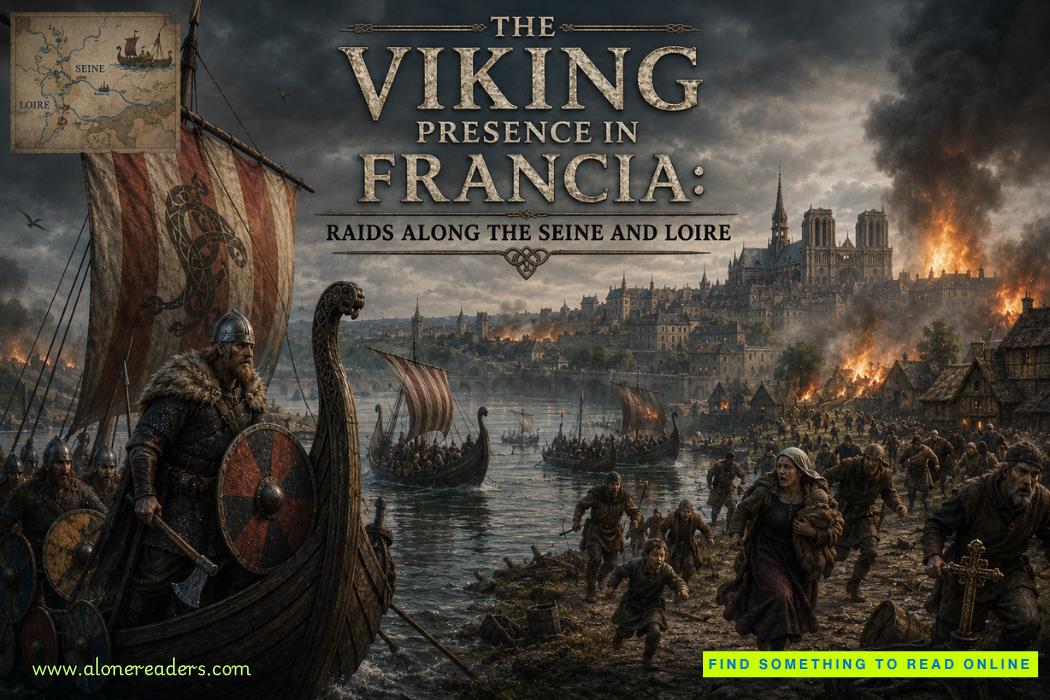
The Viking expansion into Western Europe during the ninth and tenth centuries represents one of the most transformative and violent chapters in early medieval history, and nowhere was this more evident than in the riverine heartlands of Francia. The great rivers of the Seine and the Loire became not just geographical features, but strategic arteries through which Scandinavian warriors projected power deep into the Frankish interior. These incursions were not random acts of piracy; they were calculated campaigns that exposed structural weaknesses in Frankish defenses, reshaped political authority, and ultimately contributed to the formation of one of medieval Europe’s most significant regions: Normandy.
The Vikings, originating from present-day Denmark, Norway, and Sweden, possessed an unmatched advantage in mobility due to their longships. These vessels, with their shallow drafts and flexible design, allowed them to traverse both open seas and narrow rivers with equal ease. This technological superiority transformed rivers like the Seine and Loire into invasion highways, enabling Viking fleets to bypass coastal defenses and strike at the very heart of Frankish civilization. Unlike static armies, Viking raiders could appear suddenly, withdraw quickly, and return repeatedly, creating an atmosphere of constant insecurity.
The Seine River, flowing through northern Francia and passing directly by Paris, became one of the primary routes of Viking penetration. As early as the mid-ninth century, Viking fleets began to exploit this waterway, launching devastating raids on towns, monasteries, and trade centers. Monasteries were particularly attractive targets, as they housed not only religious communities but also immense wealth in the form of manuscripts, precious metals, and relics. The raid on the Abbey of Saint-Denis and similar institutions revealed a pattern: Vikings were not merely seeking plunder, but also deliberately targeting symbols of Frankish religious and political authority.
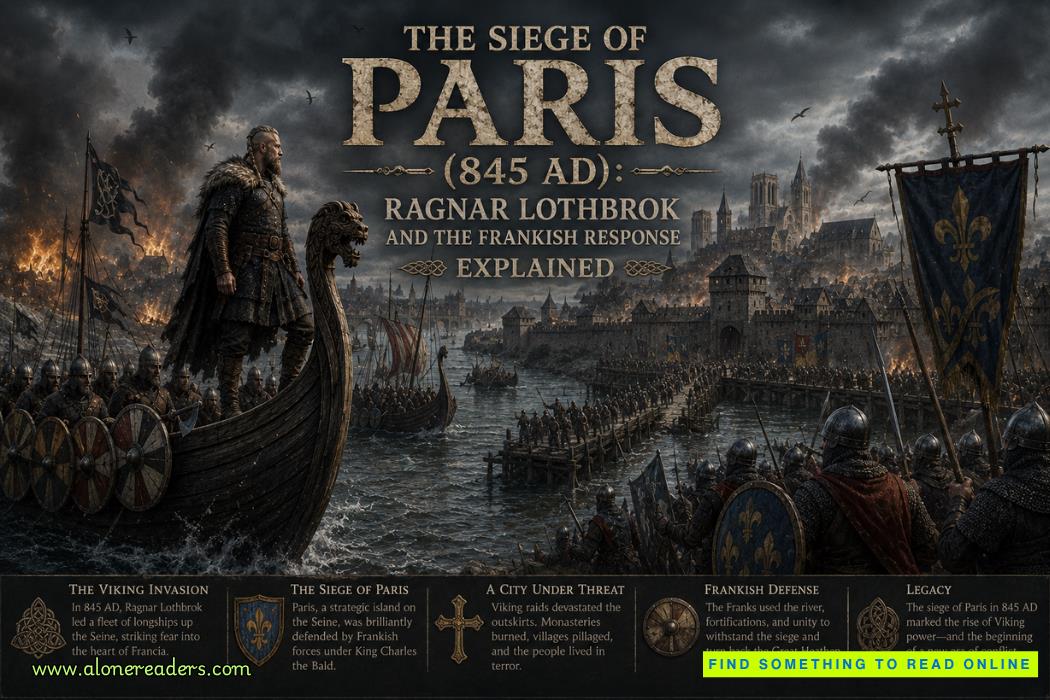
One of the most infamous episodes of Viking activity along the Seine was the siege of Paris in 845. Led by a chieftain often identified as Ragnar, a fleet of approximately 120 ships sailed up the river and attacked the city. Paris at this time was not the sprawling metropolis it would later become, but it was already a significant political and economic center. The Frankish king Charles the Bald faced a difficult decision; unable to mount an effective defense, he ultimately chose to pay a large ransom to persuade the Vikings to withdraw. This payment, known as Danegeld, set a dangerous precedent. It demonstrated that Viking aggression could yield immense rewards with relatively low risk.
The use of tribute payments became a recurring strategy for Frankish rulers, but it also encouraged further raids. Vikings quickly realized that the Frankish kingdoms were willing to exchange wealth for temporary peace, leading to a cycle of invasion and payment that drained resources and undermined royal authority. Each successful raid emboldened future expeditions, and the Seine valley remained under constant threat for decades.
The Loire River, further to the south, became another focal point of Viking activity. While the Seine raids often targeted political centers, the Loire expeditions were notable for their breadth and persistence. Viking fleets established semi-permanent bases along the river, using them as staging points for deeper incursions into the countryside. From these bases, they could launch attacks on cities such as Nantes, Tours, and Orléans, spreading devastation across a wide region.
The raid on Nantes in 843 stands out as one of the earliest and most shocking Viking attacks along the Loire. Occurring on a major religious festival, the Vikings caught the population completely unprepared. The city was sacked, its bishop killed, and its wealth seized. This event marked a turning point, demonstrating that Viking forces were capable of striking far inland and disrupting even well-established urban centers. The psychological impact of such raids cannot be overstated; they shattered the illusion of security that many Frankish communities had previously enjoyed.
Unlike the more episodic raids along the Seine, Viking activity on the Loire often involved prolonged occupation. The establishment of fortified encampments allowed Viking groups to overwinter in the region, transforming seasonal raiding into a continuous presence. This shift from hit-and-run tactics to semi-permanent settlement represented an evolution in Viking strategy. It also forced the Franks to adapt, as traditional defensive measures proved inadequate against an enemy that could not simply be waited out.
Frankish responses to Viking incursions varied over time and reflected the broader political fragmentation of the Carolingian Empire. Initially, local counts and bishops were left to organize defenses, leading to inconsistent and often ineffective resistance. However, as the scale of the threat became clear, more coordinated efforts began to emerge. Fortifications were strengthened, bridges were constructed to block river passage, and fortified towns were developed to serve as defensive hubs.
One of the most significant defensive innovations was the use of fortified bridges across major rivers. In Paris, such a bridge played a crucial role during the famous siege of 885–886. This later siege, far more prolonged than the earlier attack in 845, demonstrated a growing Frankish capacity for resistance. Viking forces, led by experienced commanders, attempted to force their way past the city but were held at bay by determined defenders. The siege lasted for months, highlighting both the resilience of Paris and the limitations of Viking siege capabilities.
Despite these defensive improvements, the Vikings continued to exert pressure on Francia. Their ability to adapt, combined with the political instability of the Frankish realms, ensured that no single victory could end the threat. Over time, however, a new strategy began to take shape—one that would fundamentally alter the relationship between the Vikings and the Franks.
Rather than attempting to expel the Vikings entirely, Frankish rulers began to integrate them into the existing political framework. This approach culminated in the Treaty of Saint-Clair-sur-Epte in 911, when King Charles the Simple granted land along the lower Seine to the Viking leader Rollo. In exchange, Rollo agreed to defend the region against further Viking incursions and to convert to Christianity. This agreement marked the beginning of Normandy, a region that would become a powerful and culturally distinct part of medieval France.
The establishment of Normandy represents one of the most remarkable outcomes of Viking activity in Francia. What began as a series of destructive raids ultimately led to the creation of a stable political entity. The descendants of the Vikings in Normandy adopted the French language, embraced Christianity, and integrated into the feudal system, while still retaining elements of their Scandinavian heritage. This fusion of cultures produced a dynamic society that would later play a crucial role in European history, most notably in the Norman Conquest of England in 1066.
The impact of Viking raids along the Seine and Loire extended far beyond immediate destruction. Economically, the repeated attacks disrupted trade networks and agricultural production, leading to periods of hardship and instability. Politically, they exposed the weakness of centralized authority and accelerated the decentralization of power, contributing to the rise of feudalism. Socially, they fostered a climate of fear and uncertainty, but also resilience and adaptation.
The rivers themselves, once symbols of connectivity and prosperity, became associated with danger and invasion. Communities along their banks were forced to rethink their relationship with these waterways, investing in defenses and altering settlement patterns. Over time, however, the integration of Viking settlers transformed these same rivers into conduits of cultural exchange, linking Scandinavian and Frankish traditions in ways that would shape the future of the region.
In examining the Viking presence in Francia, it becomes clear that the raids along the Seine and Loire were not isolated events but part of a broader process of interaction between two worlds. The Vikings were not merely destroyers; they were also settlers, traders, and state-builders. Their incursions forced the Franks to adapt, innovate, and ultimately redefine their political and social structures.
The legacy of these encounters can still be seen in modern France, particularly in Normandy, where place names, cultural practices, and historical memory reflect a Viking past. The transformation of raiders into rulers is one of the most compelling narratives of the Viking Age, illustrating how conflict can give rise to new forms of identity and governance.
Ultimately, the story of Viking raids along the Seine and Loire is a story of adaptation, resilience, and transformation. It reveals how geography, technology, and human ambition intersected to shape the course of history. The rivers that once carried longships filled with warriors now stand as silent witnesses to a time when the fate of kingdoms was decided on their waters, and when the boundary between invader and inhabitant was far more fluid than it might first appear.



 The Hundred Days Offensive: How the Allies Defeated Germany in World War I
 The Second Battle of the Marne: The Turning Point of World War I in 1918
 The Spring Offensive of 1918: Germany's Final Gamble to Win World War I
 The Treaty of Brest-Litovsk: How Russia Left World War I
 The Russian Revolution and World War I: How War Brought Down the Tsar
 The Zimmermann Telegram Explained: Germany's Secret Offer to Mexico in World War I