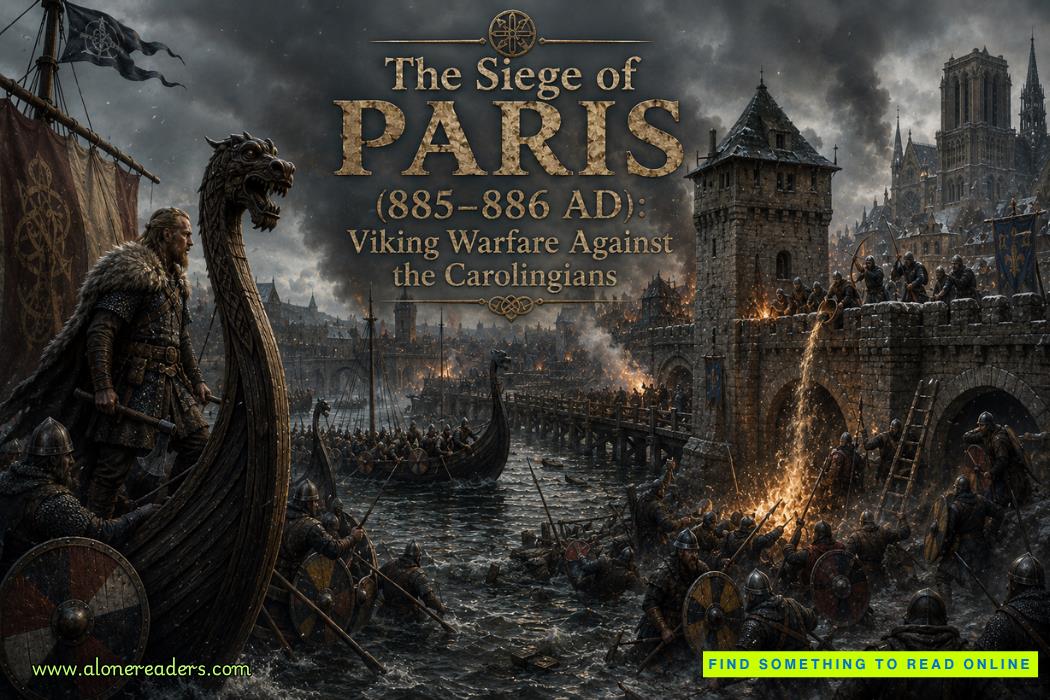
The Siege of Paris (885–886 AD) stands as one of the most defining confrontations between the expanding Viking world and the fragile remnants of Carolingian authority in Western Europe. It was not merely a battle for a city, but a prolonged and grueling contest of endurance, strategy, and political will. In this moment of crisis, Paris transformed from a vulnerable settlement into a symbol of resistance, while the Vikings demonstrated both their formidable military capabilities and the limits of their raiding strategy when faced with determined opposition.
By the late ninth century, the Carolingian Empire had fractured into competing kingdoms, each struggling to maintain control over its territories. The once-unified empire of Charlemagne had dissolved into a patchwork of weak rulers and regional power struggles. This fragmentation created an ideal environment for Viking incursions, as defenses were inconsistent and often poorly coordinated. The Vikings, originating from Scandinavia, had already spent decades refining their tactics across the coasts and rivers of Europe. Their longships, shallow-drafted and highly maneuverable, allowed them to penetrate deep inland via river systems such as the Seine, making cities like Paris particularly vulnerable.
Paris in the late ninth century was not the sprawling metropolis known today. It was primarily concentrated on the Île de la Cité, a fortified island in the Seine River. Two crucial bridges connected the island to the riverbanks, each protected by defensive towers. These bridges were not merely structural features; they were strategic chokepoints that prevented enemy ships from passing further upstream. Control of these crossings would determine whether the Vikings could extend their campaign deeper into Frankish territory or be halted at the gates of Paris.
In November 885, a massive Viking fleet arrived at the outskirts of Paris. Contemporary accounts describe hundreds of ships and thousands of warriors, although exact numbers remain debated. What is certain is that this was not a typical raiding party. It was a large-scale military expedition led by experienced chieftains, including the notable figure Sigfred. Their objective was clear: secure passage up the Seine, extract tribute, and demonstrate dominance over the weakened Carolingian realm.
The Viking leaders initially attempted negotiation, demanding payment in exchange for sparing the city. This was a common tactic, as tribute often proved more profitable and less risky than prolonged warfare. However, the defenders of Paris, led by Count Odo and Bishop Gozlin, refused to yield. This decision would transform the encounter into one of the longest sieges of the Viking Age.
The defense of Paris relied heavily on its fortifications and the determination of its leaders. Count Odo, a noble of rising prominence, played a central role in organizing the city's resistance. Bishop Gozlin, representing both spiritual and temporal authority, also contributed significantly to the defense. Together, they coordinated efforts to reinforce the walls, maintain supplies, and inspire the defenders. The population of Paris, though limited in number, demonstrated remarkable resilience in the face of overwhelming odds.
The Vikings launched their initial assault with characteristic ferocity. They targeted the bridges and towers, recognizing that these structures were the key to breaking the city's defenses. Siege engines, including battering rams and possibly primitive siege towers, were employed to weaken the fortifications. The attackers also used fire as a weapon, attempting to burn the wooden elements of the bridges and create chaos among the defenders.
Despite these efforts, the Parisians held firm. The narrow approaches to the bridges limited the effectiveness of the Viking assault, forcing them into confined spaces where defenders could concentrate their efforts. Archers, stones, and boiling liquids were used to repel attackers, turning each assault into a costly endeavor for the besiegers. The defenders’ ability to exploit the terrain and fortifications proved crucial in offsetting the numerical advantage of the Vikings.
As the siege dragged on, it evolved into a test of endurance. The Vikings established camps along the riverbanks, maintaining a continuous presence around the city. They attempted repeated assaults, each time seeking to exploit weaknesses in the defenses. However, the defenders adapted quickly, repairing damage and reinforcing vulnerable points. The prolonged nature of the siege highlighted a critical limitation of Viking warfare: while highly effective in swift raids, it was less suited to sustained siege operations against well-defended positions.
Winter added another layer of hardship to both sides. Harsh weather conditions strained resources and morale. For the defenders, maintaining supplies within the confined city was a constant challenge. Disease and hunger posed significant threats. For the Vikings, the need to sustain a large force in hostile territory created logistical difficulties. Their reliance on mobility and raiding for sustenance became a liability during the prolonged encampment.
One of the most dramatic moments of the siege occurred when flooding weakened part of the bridge defenses. The Vikings seized this opportunity to destroy a tower, gaining a temporary advantage. Yet even this breakthrough did not lead to a decisive victory. The defenders continued to resist, demonstrating a level of determination that surprised their attackers.
Count Odo’s leadership proved particularly crucial during this period. In a daring move, he managed to slip through Viking lines and seek reinforcements from Emperor Charles the Fat. This journey underscored both the desperation of the situation and the importance of external support. Odo’s actions would later elevate his status and contribute to his eventual rise as king.
When Emperor Charles the Fat finally arrived with his forces in 886, the outcome of the siege took an unexpected turn. Rather than engaging in a decisive battle against the Vikings, the emperor chose to negotiate. He agreed to pay them tribute and, more controversially, allowed them to pass further up the Seine to raid other regions. This decision effectively ended the siege but at a significant political cost.
The emperor’s actions were widely perceived as a betrayal of Paris and its defenders. After months of hardship and resistance, the inhabitants of the city had expected a decisive victory. Instead, they witnessed their ruler conceding to the enemy. This undermined Charles the Fat’s authority and contributed to his eventual deposition. In contrast, Count Odo’s reputation was greatly enhanced, as he was seen as a leader who had stood firm against the invaders.
The Siege of Paris revealed several important aspects of Viking warfare. It demonstrated their ability to organize large-scale expeditions and adapt their tactics to different environments. At the same time, it exposed the limitations of their approach when faced with strong fortifications and determined defenders. The siege also highlighted the importance of leadership and morale in medieval warfare, as the resilience of the Parisians played a decisive role in their survival.
From a broader perspective, the siege marked a turning point in the relationship between the Vikings and the Carolingian world. It signaled a shift from opportunistic raids to more sustained and organized campaigns. At the same time, it underscored the need for improved defenses and stronger leadership within the Carolingian territories. In the years that followed, efforts to fortify cities and develop more effective responses to Viking incursions would become increasingly important.
The legacy of the siege can also be seen in the eventual integration of Viking groups into European society. Rather than remaining perpetual raiders, many Vikings began to settle in the lands they had once targeted. This process would culminate in the establishment of regions such as Normandy, where Viking leaders were granted land in exchange for loyalty and protection. The events at Paris, while not directly responsible for this transformation, were part of the broader pattern that made such arrangements possible.
Perhaps the most enduring aspect of the Siege of Paris is its symbolic significance. It represents a moment when a relatively small and vulnerable community stood against a formidable external threat and endured. The image of Paris resisting the Vikings became a powerful narrative, shaping perceptions of both the city and the broader struggle between the Norse and the Carolingians.
In examining this event, it becomes clear that the siege was not simply a clash of armies, but a convergence of political, cultural, and military forces. The Vikings brought with them a tradition of mobility, adaptability, and aggression, while the Carolingians relied on fortifications, local leadership, and a sense of collective identity. The outcome was not a clear victory for either side, but rather a complex and nuanced result that reflected the realities of the time.
The Siege of Paris (885–886 AD) ultimately stands as a testament to the evolving nature of warfare in the early medieval period. It illustrates the transition from rapid raids to more structured military engagements, the importance of strategic geography, and the decisive role of leadership in shaping outcomes. Through its drama and significance, it continues to capture the imagination of historians and readers alike, offering a vivid glimpse into a pivotal moment of the Viking Age.




 The Hundred Days Offensive: How the Allies Defeated Germany in World War I
 The Second Battle of the Marne: The Turning Point of World War I in 1918
 The Spring Offensive of 1918: Germany's Final Gamble to Win World War I
 The Treaty of Brest-Litovsk: How Russia Left World War I
 The Russian Revolution and World War I: How War Brought Down the Tsar
 The Zimmermann Telegram Explained: Germany's Secret Offer to Mexico in World War I










