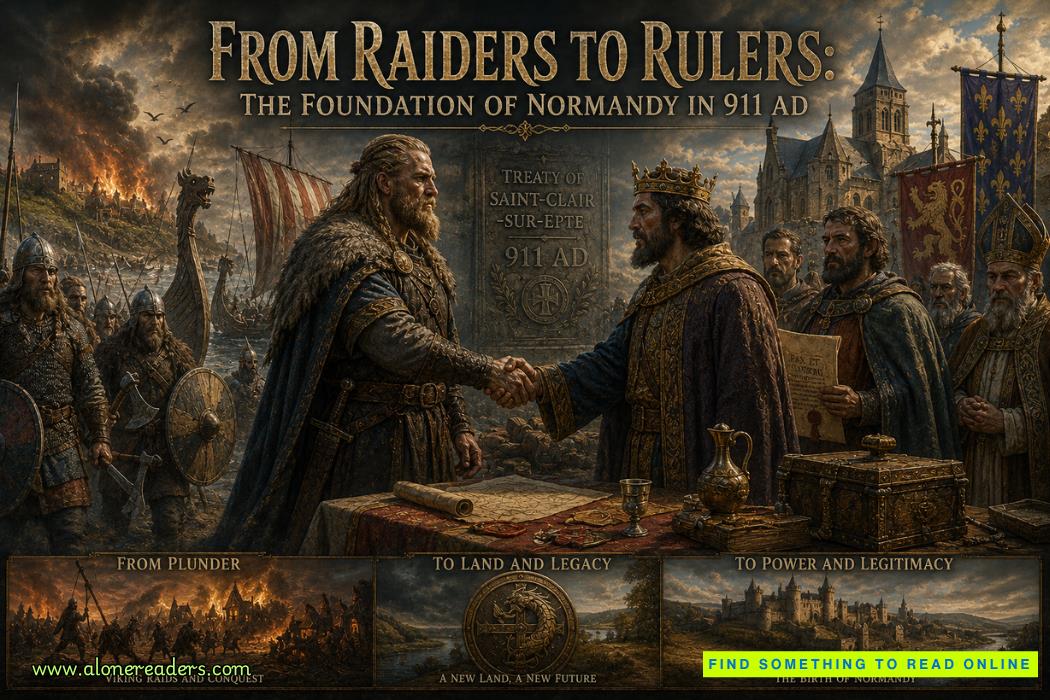
From the late eighth century onward, the coasts and riverways of Western Europe lived under the shadow of sudden violence. Swift longships appeared without warning, disgorging warriors who struck monasteries, towns, and trading centers before vanishing back into the sea. To the people of the Frankish kingdoms, these attackers were a terrifying force—the Northmen, later known as Vikings. Yet, within little more than a century, a remarkable transformation unfolded. These same raiders, once symbols of chaos, became landholders, administrators, and founders of one of medieval Europe’s most influential regions: Normandy.
The story of Normandy’s foundation in 911 AD is not merely a tale of conquest but one of adaptation, negotiation, and identity. It marks a turning point where violence gave way to political integration, and where cultural fusion reshaped the destiny of Western Europe.
By the late ninth century, Viking incursions into the Frankish territories had intensified dramatically. The Seine River became a vital artery for these expeditions, allowing fleets to penetrate deep into the heart of the kingdom. Cities such as Rouen, Paris, and Chartres faced repeated assaults. The Frankish defenses, weakened by internal divisions following the fragmentation of the Carolingian Empire, struggled to respond effectively. Local rulers often found themselves isolated, forced to either resist with inadequate forces or negotiate under duress.
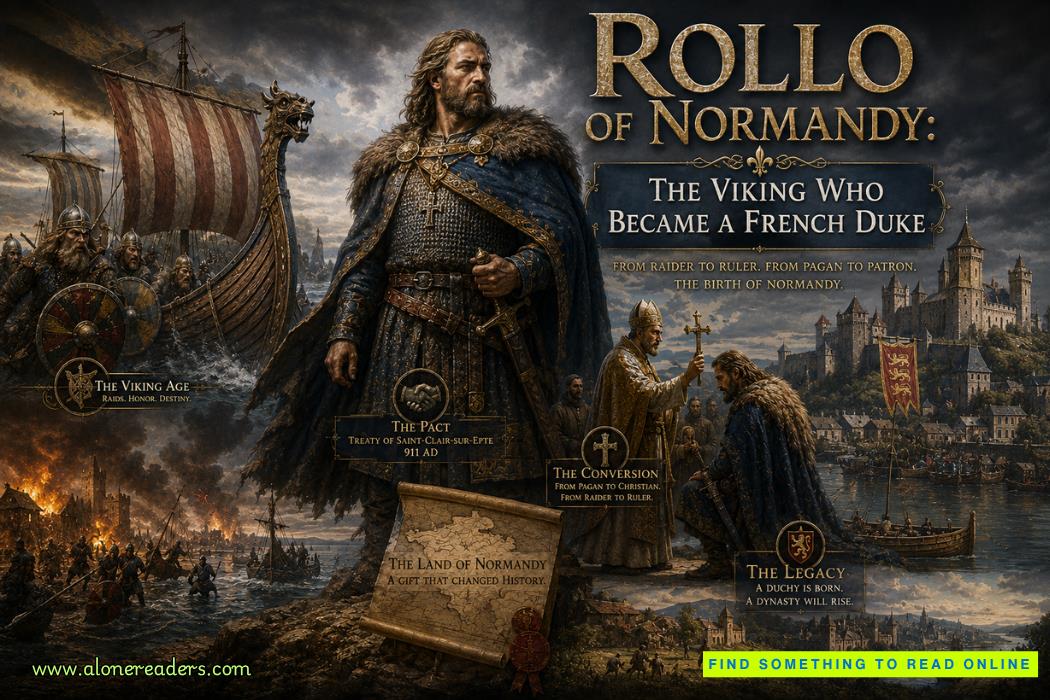
Among the Viking leaders who emerged during this period, one figure stands out with particular clarity: Rollo, a chieftain whose origins remain partially obscured by legend. Described as both formidable and pragmatic, Rollo commanded a significant force of warriors who had established a semi-permanent presence along the lower Seine. Unlike earlier raiders who sought only plunder, Rollo and his followers displayed a growing interest in settlement. They recognized the advantages of controlling land, resources, and trade routes rather than relying solely on unpredictable raids.
The Frankish king at the time, Charles the Simple, faced a dilemma that had become all too familiar. Military resistance alone had proven insufficient to eliminate the Viking threat. Instead, Charles adopted a strategy that had precedent but would reach its most famous expression in 911: he chose negotiation. This decision culminated in the Treaty of Saint-Clair-sur-Epte, a moment that would redefine the relationship between the Norsemen and the Frankish world.
Under the terms of the treaty, Charles granted Rollo and his followers a stretch of land along the lower Seine, centered around Rouen. In return, Rollo agreed to several crucial conditions. He would convert to Christianity, accept baptism, and become a vassal of the Frankish king. Perhaps most importantly, he would defend the region against further Viking incursions, effectively transforming former raiders into guardians of the realm they once attacked.
This arrangement was both pragmatic and revolutionary. It acknowledged a reality that could no longer be ignored: the Vikings were not merely transient threats but potential settlers. By integrating them into the feudal structure, Charles sought to stabilize a volatile frontier while turning a liability into an asset.
The ceremony that sealed this agreement has become legendary. According to later accounts, Rollo was required to perform the act of homage by kissing the king’s foot. Unfamiliar with Frankish customs and unwilling to submit in such a manner, Rollo reportedly ordered one of his warriors to perform the act instead. The warrior, equally unaccustomed, lifted the king’s foot so abruptly that Charles was toppled backward. Whether entirely factual or embellished, this story captures the cultural friction and mutual misunderstanding that characterized this moment of transition.
Once established in their new territory, Rollo and his followers began the process of transformation. The land granted to them would come to be known as Normandy, derived from “Northmen’s land.” Yet, the identity of its inhabitants evolved rapidly. The Norse settlers did not remain isolated; instead, they intermarried with the local Frankish population, adopted the French language, and embraced Christian practices. Within a few generations, the descendants of these Vikings had become indistinguishable in many respects from their Frankish neighbors.
This process of assimilation did not erase their heritage but rather reshaped it into something new. The emerging Norman identity was characterized by a blend of Norse vigor and Frankish sophistication. Their leaders maintained a strong sense of martial tradition, while also developing administrative and political structures that reflected the broader feudal system of medieval Europe.
Rollo himself ruled as the first Count of Rouen, laying the foundations of a principality that would grow in power and influence. His successors expanded and consolidated their territory, establishing a stable and prosperous region. The Normans proved to be effective rulers, fostering agriculture, trade, and urban development. The Seine River, once a route for raiding fleets, became a channel for commerce and communication.
One of the most striking aspects of Normandy’s development was the speed with which its inhabitants adapted to their new circumstances. The adoption of Christianity was not merely symbolic; it played a central role in integrating the Normans into the broader European world. Monasteries and churches were established, serving as centers of learning, administration, and cultural exchange. The church also provided a framework for legitimizing Norman rule, reinforcing their position within the feudal hierarchy.
At the same time, the Normans retained certain qualities that set them apart. Their military organization remained highly effective, combining discipline with adaptability. This would later enable them to achieve remarkable feats beyond their homeland, most notably the Norman Conquest of England in 1066, led by William the Conqueror, a direct descendant of Rollo. The foundations laid in 911 thus had far-reaching consequences, shaping the course of European history for centuries.
The transformation from raiders to rulers also had a psychological dimension. For generations, Vikings had been defined by mobility and opportunism. Settlement required a shift in mindset, emphasizing stability, governance, and long-term planning. This transition was not without challenges, as it demanded new forms of authority and social organization. Yet, the Normans managed to navigate this change with remarkable success.
The Treaty of 911 can be seen as a turning point not only for the Vikings but also for the Frankish world. It demonstrated that integration could be more effective than exclusion, and that former enemies could become valuable allies. This approach would be echoed in other regions and contexts, highlighting the dynamic nature of medieval political strategies.
Moreover, the foundation of Normandy illustrates the fluidity of identity during the Viking Age. The boundaries between “Viking” and “European” were not fixed but constantly evolving. Cultural exchange, intermarriage, and adaptation blurred these distinctions, giving rise to new identities that transcended their origins. The Normans exemplify this process, embodying a synthesis of influences that defies simple categorization.
Economically, the establishment of Normandy contributed to regional stability and growth. The cessation of constant raids allowed for the development of agriculture and trade networks. Markets flourished, and towns expanded. The Normans’ strategic position along the Seine enabled them to control key routes, enhancing their economic power. This prosperity, in turn, supported their political ambitions and military capabilities.
Socially, the integration of Norse and Frankish elements created a unique cultural landscape. Language evolved as Old Norse influences merged with the local Romance dialects, eventually contributing to the development of the Norman language. Legal practices and customs also reflected this blend, combining Scandinavian traditions with Frankish law.
It is important to recognize that this transformation was not instantaneous. It unfolded over decades, shaped by both internal developments and external pressures. The Normans had to defend their territory against rivals, assert their authority over local populations, and navigate the complexities of feudal relationships. Their success was the result of both strategic leadership and adaptability.
The legacy of Normandy’s foundation extends far beyond its immediate context. It represents a moment when conflict gave way to cooperation, and when cultural boundaries were redefined. The story of Rollo and the Treaty of Saint-Clair-sur-Epte serves as a powerful example of how societies can evolve through interaction and compromise.
In many ways, the creation of Normandy encapsulates the broader dynamics of the Viking Age. It was a period marked by movement, encounter, and transformation. The Vikings were not merely destroyers but also creators, capable of building new societies in the lands they once raided. Normandy stands as a testament to this duality, illustrating the complexity of their legacy.
The events of 911 remind us that history is often shaped by unexpected outcomes. What began as a response to persistent raids became the foundation of a powerful and enduring polity. The decision to grant land to a Viking leader may have seemed risky at the time, but it ultimately contributed to the stabilization and enrichment of the region.
As the centuries passed, the Normans would leave their mark on Europe in profound ways. Their influence can be seen in the political, cultural, and linguistic developments of regions far beyond their original homeland. Yet, all of this can be traced back to a single moment of negotiation and transformation, when raiders became rulers and a new chapter in history began.



 The Hundred Days Offensive: How the Allies Defeated Germany in World War I
 The Second Battle of the Marne: The Turning Point of World War I in 1918
 The Spring Offensive of 1918: Germany's Final Gamble to Win World War I
 The Treaty of Brest-Litovsk: How Russia Left World War I
 The Russian Revolution and World War I: How War Brought Down the Tsar
 The Zimmermann Telegram Explained: Germany's Secret Offer to Mexico in World War I