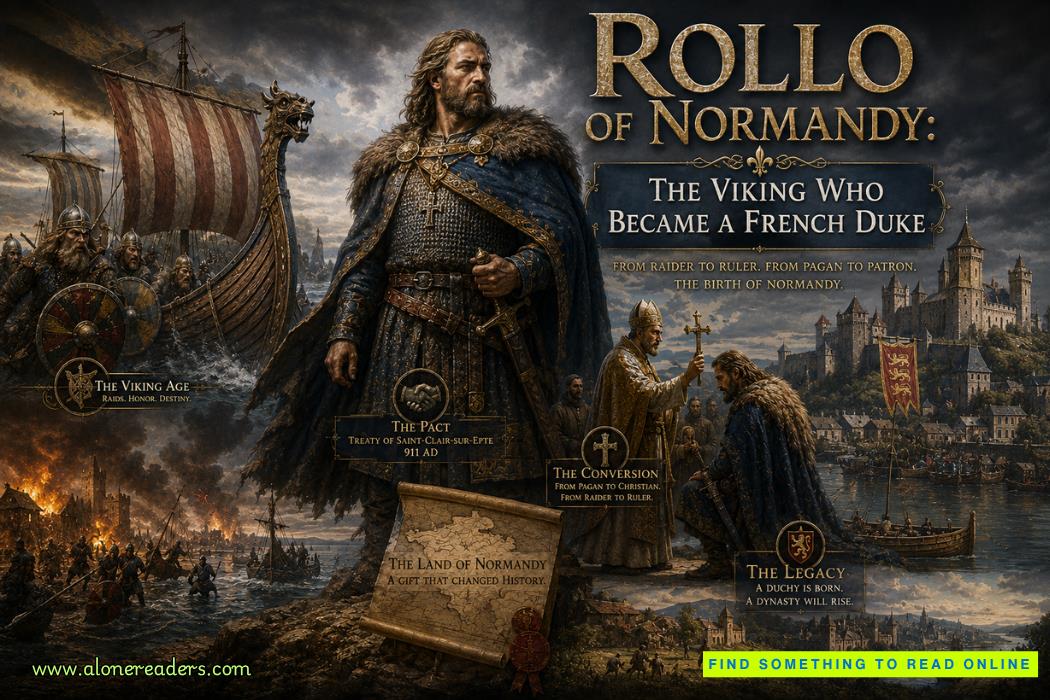
Rollo of Normandy stands among the most important figures of the Viking Age because his life captures a rare historical transformation: a seaborne raider became a territorial ruler, and a northern war leader became the founder of a lasting European dynasty. His story is not only about violence and conquest, but also about negotiation, adaptation, and political survival. In him, the old world of Viking mobility met the emerging world of medieval state power, and the result was Normandy, a region that would shape French and English history for centuries.
Rollo was likely born in Scandinavia sometime in the late ninth century, though the exact place and year remain uncertain. Later traditions linked him to Norway, while other medieval and modern interpretations have placed his origins more broadly within the Norse world. What matters most is that he emerged from the northern warrior culture that sent fleets across the North Sea and into the rivers of western Europe. That world valued strength, loyalty, reputation, and the ability to seize opportunity where others saw only danger.
The Viking Age was an era of movement, and Rollo moved with it. Like many ambitious leaders of his time, he took part in raids and military expeditions that struck coastal and inland settlements across Scotland, England, Flanders, and Francia. These raids were not random acts of destruction alone; they were part of a broader system of wealth gathering, political pressure, and prestige building. A successful Viking leader needed more than courage. He needed ships, followers, bargaining power, and the ability to turn temporary gains into durable advantage.
Rollo’s early reputation was built on force, but his long-term achievement came from diplomacy. By the late ninth and early tenth centuries, the Frankish lands had been battered repeatedly by Viking incursions. The lower Seine Valley, especially around Rouen, had become a strategic target because it linked river travel, inland trade, and access to the heart of the Frankish realm. Rather than simply trying to expel the Norsemen by force, the Frankish king Charles the Simple chose a more practical route: he negotiated with Rollo.
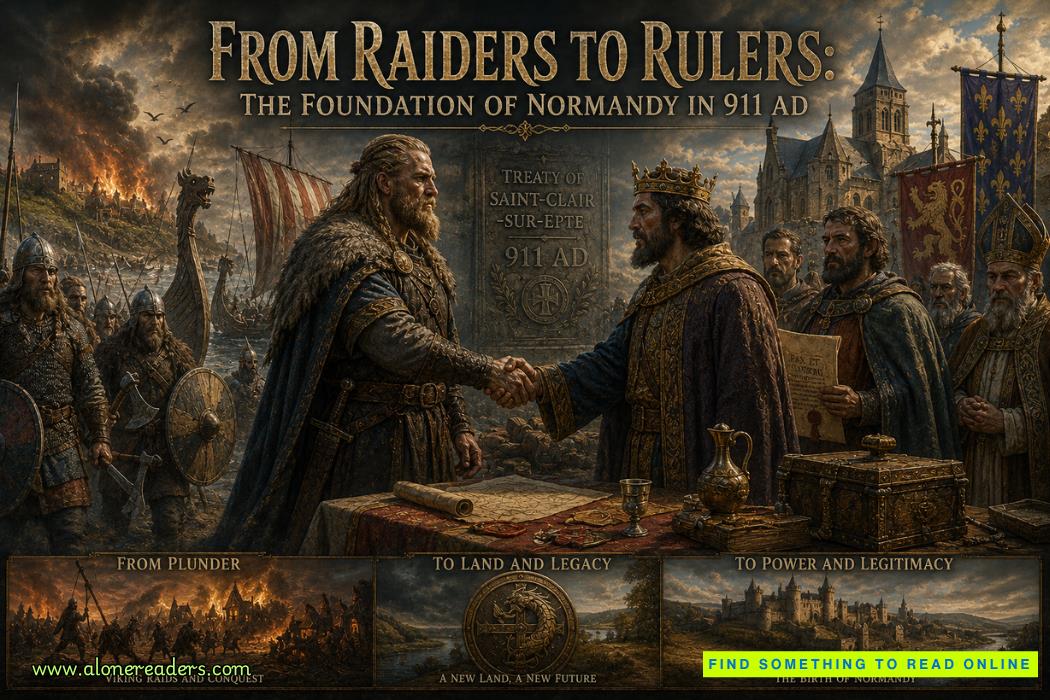
This agreement became the turning point of Rollo’s life. In 911, through the famous settlement associated with St. Clair-sur-Epte, Rollo received control over land in the lower Seine region in exchange for defending it against further Viking attacks. The land that came under his rule eventually became known as Normandy, the land of the Northmen. The arrangement reflected hard political reality. The Frankish crown needed protection. Rollo needed legitimacy. Each side gained something the other could not easily take by force.
That moment was a profound shift. Rollo did not merely become a richer raider; he became a ruler with obligations. He was expected to guard the region, stabilize it, and hold back other Viking groups. This meant moving from the logic of plunder to the logic of governance. Instead of sailing away after a raid, he had to manage territory, secure loyalty, and make a home for his followers in a foreign land. In practical terms, that meant building a new political order out of mixed Norse and Frankish realities.
His relationship with Christianity also mattered. Medieval sources present Rollo as receiving baptism as part of his settlement with the Franks, though details vary across traditions. Whether his conversion was deeply spiritual or politically useful, it carried major consequences. Christianity gave Rollo access to the symbolic language of rulership in western Europe. It also helped knit his new domain into the institutions of the age, where churches, monasteries, and local elites all played a role in political legitimacy. For a Viking chief, baptism could function as both religious change and statecraft.
Rollo’s rise also reveals something important about the Norse world: Viking leaders were not locked into a single identity. They could raid one year and rule the next. They could preserve elements of their culture while adopting the customs of the lands they settled. Normandy became a place where Norse energy met Frankish administration, and Rollo stood at the center of that fusion. His followers did not simply vanish into the French landscape overnight; instead, they gradually became Normans, a people shaped by both northern and continental traditions.
That process of change was not superficial. Over time, the Norman elite developed a distinct identity, one that drew power from military discipline, landholding, and political pragmatism. Rollo’s settlement created a base from which later rulers could expand their influence. The duchy that began under him became one of the most formidable political forces in medieval Europe. His descendants would rise far beyond the Seine Valley, and the legacy of his decision to accept land rather than keep wandering would echo into the history of England, Italy, and the Crusades.
Rollo’s personal image also became part of his legend. Some later traditions called him a giant of a man, so large that he supposedly walked rather than rode a horse. Whether or not such stories are true, they show how medieval memory turned him into a figure of physical and political might. The nickname “the Walker” or similar forms of it reflected both admiration and mythmaking. In the world of medieval storytelling, a founder needed to be memorable, and Rollo certainly was.
His rule in Normandy was not merely ceremonial. He was associated with the stabilization of the region and the establishment of an enduring ruling house. By creating a territory that could defend itself and attract settlement, he helped transform a contested frontier into a durable principality. This was one of the most important achievements in the history of post-Roman western Europe, because it showed how military migrants could become territorial governors without disappearing into chaos. Rollo helped make that possible.
The significance of Rollo becomes even clearer when viewed through the lens of dynastic history. His line eventually produced William the Conqueror, the Norman duke who invaded England in 1066 and permanently altered the course of English and European history. That famous conquest was far removed from Rollo’s own raids, but it depended on the political foundation he helped create. In that sense, the Viking who once arrived as a predator became the ancestor of kings.
Rollo’s burial and memory also became part of Normandy’s identity. Traditions place his tomb in Rouen, the city that served as one of the major centers of his rule. The movement of his remains over time, along with the layering of religious and political memory around his name, shows how deeply he became embedded in Norman history. Even after death, he remained a symbol of foundational authority and of the uneasy but fruitful marriage between Norse origins and French statehood.
What makes Rollo so compelling is not simply that he was a Viking, but that he understood when to stop being only a Viking. He recognized that permanent influence required more than loot and terror. It required land, law, alliances, and continuity. That insight set him apart from countless raiders whose names vanished after a season of plunder. Rollo chose settlement over endless wandering, and that choice created a new political world.
His story also reminds us that the Viking Age was never just a tale of destruction. It was equally a story of exchange, adaptation, and the making of new societies. The Northmen did not merely burn towns; they founded kingdoms, served as mercenaries, married into local elites, and transformed regions from within. Rollo’s life captures that broader truth with unusual clarity. He was both outsider and insider, conqueror and negotiator, pagan raider and Christian ruler, all within the same historical arc.
For modern readers, Rollo offers a powerful example of historical transformation. He began in a world defined by ship crews, seasonal raiding, and warrior prestige. He ended as the founder of a duchy whose descendants would reshape medieval Europe. That trajectory makes him more than a name in a genealogy. It makes him a turning point. Normandy began not as a peaceful province, but as the negotiated reward for a Viking war leader who learned how to turn conquest into continuity.
In the end, Rollo of Normandy is remembered because he did what very few raiders ever managed to do: he became indispensable. He was not merely defeated, absorbed, or forgotten. He became the ruler of the very frontier that had once resisted him. That is why his story still matters. It is the story of a Viking who crossed from the age of the longship into the age of the castle, and in doing so helped create one of the most influential dynasties in European history.



 The Hundred Days Offensive: How the Allies Defeated Germany in World War I
 The Second Battle of the Marne: The Turning Point of World War I in 1918
 The Spring Offensive of 1918: Germany's Final Gamble to Win World War I
 The Treaty of Brest-Litovsk: How Russia Left World War I
 The Russian Revolution and World War I: How War Brought Down the Tsar
 The Zimmermann Telegram Explained: Germany's Secret Offer to Mexico in World War I