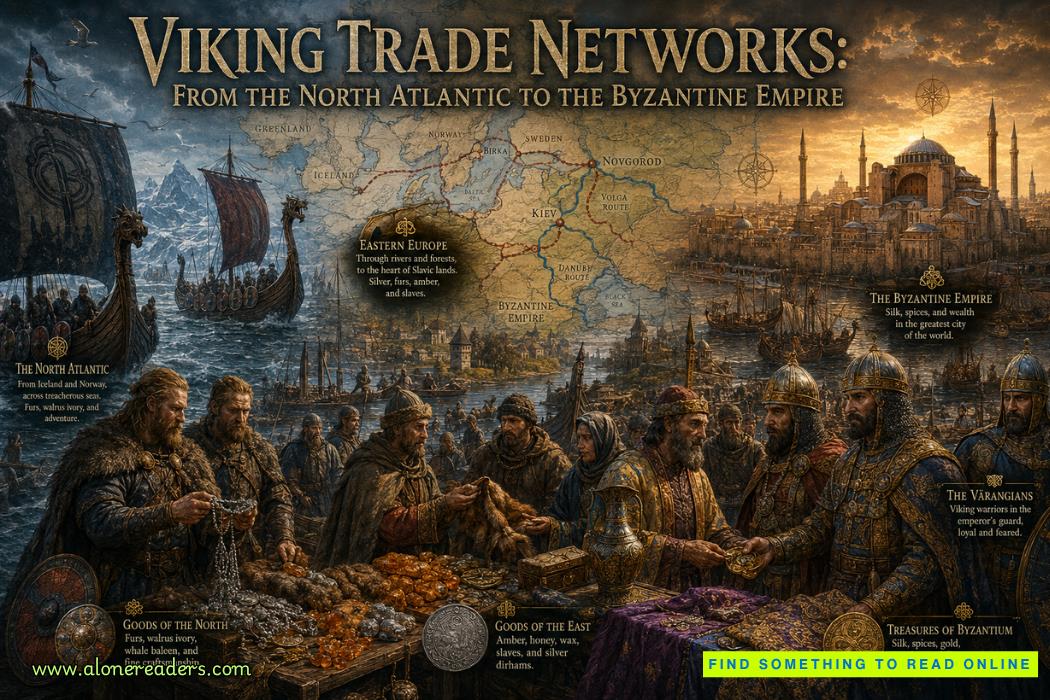
The Viking Age is often remembered for its dramatic raids, burning monasteries, and fierce warriors, but this image captures only a fragment of a far more complex reality. Beneath the surface of conquest lay a vast and sophisticated web of commerce that connected distant regions in ways few other societies of the early medieval world could achieve. The Viking trade networks stretched from the icy coasts of the North Atlantic to the glittering markets of the Byzantine Empire, forming one of the most dynamic economic systems of the 8th to 11th centuries. These routes were not simply lines on a map; they were living arteries through which goods, ideas, technologies, and cultures flowed.
At the heart of this system was the Scandinavian homeland, a region defined by rugged coastlines, dense forests, and limited agricultural capacity. These environmental constraints played a crucial role in shaping Viking behavior. Trade was not merely an option but a necessity. Resources such as arable land were scarce, yet Scandinavia was rich in other valuable commodities, including timber, iron, furs, and amber. This imbalance drove the Norse people outward, pushing them to explore and establish connections across vast distances. Their mastery of shipbuilding and navigation enabled them to transform geographical challenges into opportunities.
The iconic Viking longship was more than a vessel of war; it was a technological masterpiece that made long-distance trade feasible. With its shallow draft, the longship could navigate both open seas and narrow rivers, allowing traders to penetrate deep into continental interiors. This versatility was essential for connecting the North Atlantic world with Eastern Europe and beyond. Viking merchants, often referred to as Varangians in the east, used intricate river systems such as the Volga and Dnieper to reach the Black Sea and ultimately the Byzantine Empire. These routes were not straightforward highways but complex networks requiring portages, negotiations with local tribes, and an intimate knowledge of seasonal conditions.
The western branches of Viking trade extended across the North Atlantic, linking Scandinavia with the British Isles, Iceland, Greenland, and even North America. Settlements such as Dublin and York became thriving commercial hubs where goods from different regions were exchanged. In these markets, one could find Irish textiles, Anglo-Saxon metalwork, and Scandinavian furs side by side. Dublin, in particular, evolved into a major slave trading center, reflecting a darker aspect of Viking commerce. Enslaved individuals captured during raids were treated as commodities and sold across Europe and the Middle East, illustrating how trade and violence were often intertwined.
Moving eastward, the scale and sophistication of Viking trade became even more apparent. The river routes through what is now Russia and Ukraine formed the backbone of a vast economic corridor connecting Northern Europe with the Islamic Caliphates and the Byzantine Empire. The Volga route led traders to the Caspian Sea and the rich markets of the Abbasid Caliphate, where silver coins known as dirhams became a key medium of exchange. These coins have been discovered in large quantities across Scandinavia, evidence of the immense wealth flowing into the region. The Dnieper route, on the other hand, connected Viking traders directly to Constantinople, the capital of the Byzantine Empire and one of the most magnificent cities of the medieval world.
Constantinople represented both a destination and a symbol of opportunity. Its massive walls, bustling harbors, and opulent markets stood in stark contrast to the relatively modest settlements of Scandinavia. For Viking traders, the city was a gateway to luxury goods that were otherwise inaccessible. Items such as silk, spices, wine, glassware, and finely crafted jewelry flowed northward, while raw materials like furs, wax, honey, and slaves moved southward. This exchange was not merely economic; it was deeply cultural. Norse traders encountered new religions, languages, and artistic traditions, many of which left lasting impressions on their own societies.
One of the most fascinating aspects of this interaction was the role of the Varangian Guard. Composed largely of Scandinavian warriors, this elite unit served as the personal bodyguard of the Byzantine emperor. Their presence in Constantinople highlights the dual nature of Viking activity: they were not only traders but also mercenaries and diplomats. Service in the Varangian Guard offered immense rewards, including wealth, prestige, and exposure to the sophisticated culture of Byzantium. When these warriors returned home, they brought with them not only riches but also new ideas, artistic influences, and even elements of Byzantine court culture.
Trade networks also facilitated the spread of religion, particularly Christianity. As Viking traders interacted with Christian communities in Europe and Byzantium, they gradually adopted aspects of the faith. This process was neither immediate nor uniform, but over time it contributed to the Christianization of Scandinavia. Churches were built, missionary efforts intensified, and rulers began to align themselves with Christian powers. The transformation of Viking society from pagan to Christian was deeply intertwined with the economic and cultural exchanges enabled by trade.
The organization of Viking trade was remarkably advanced for its time. Markets and trading towns, known as emporia, emerged as central nodes in the network. Places like Hedeby, Birka, and Kaupang became bustling centers of commerce where merchants from مختلف regions gathered. These settlements were characterized by specialized crafts, standardized weights and measures, and a degree of urban planning that reflects a high level of economic sophistication. Archaeological evidence from these sites reveals a diverse array of imported goods, underscoring the global reach of Viking trade.
Another critical element of this system was the use of silver as a primary medium of exchange. Unlike later economies that relied on minted coins with fixed values, Viking trade often operated on a weight-based silver economy. Coins, ingots, and even fragments of silver jewelry were weighed and used in transactions. This flexible system allowed for trade across different cultures and regions, where standardized currencies might not exist. The influx of Islamic silver, in particular, played a crucial role in sustaining this economy, linking the Viking world to the broader Afro-Eurasian trade network.
Despite its strengths, the Viking trade network was not without challenges. Political instability, conflicts with local populations, and the inherent dangers of long-distance travel posed constant risks. River routes could be blocked by hostile groups, while sea voyages were subject to unpredictable weather and navigation hazards. Yet the resilience of Viking traders allowed them to adapt and maintain these connections over centuries. Their ability to negotiate, form alliances, and integrate into foreign societies was key to their success.
By the late Viking Age, these trade networks began to evolve and, in some cases, decline. The consolidation of political power in Europe, the rise of stronger centralized states, and changes in trade patterns gradually reduced the dominance of Viking merchants. However, their legacy endured. The routes they established continued to be used, and the cultural exchanges they facilitated left a lasting imprint on the regions they connected. The emergence of cities, the spread of technologies, and the integration of distant economies all bear the mark of Viking influence.
What makes the Viking trade network particularly remarkable is its scope and adaptability. It was not a rigid system but a dynamic and interconnected web that responded to changing conditions and opportunities. From the windswept coasts of Greenland to the bustling streets of Constantinople, Viking traders navigated a world of immense diversity and complexity. They were intermediaries between cultures, carriers of goods and ideas, and architects of a network that bridged continents.
In understanding the Viking Age, it is essential to move beyond the stereotype of the raider and recognize the merchant, explorer, and cultural broker that existed alongside the warrior. The true legacy of the Vikings lies not only in their battles but in their ability to connect worlds that were otherwise separated by vast distances and profound differences. Their trade networks stand as a testament to human ingenuity, resilience, and the enduring power of exchange.



 The Hundred Days Offensive: How the Allies Defeated Germany in World War I
 The Second Battle of the Marne: The Turning Point of World War I in 1918
 The Spring Offensive of 1918: Germany's Final Gamble to Win World War I
 The Treaty of Brest-Litovsk: How Russia Left World War I
 The Russian Revolution and World War I: How War Brought Down the Tsar
 The Zimmermann Telegram Explained: Germany's Secret Offer to Mexico in World War I